Upgrading to a sharper webcam changes the way you show up on calls, streams, and lessons, especially when your laptop’s built-in lens keeps making you look like you’re sitting inside a paper bag. A good 4K computer camera pulls in real detail, balances tricky indoor lighting, and gives you the kind of presence that feels professional without a studio setup. Whether you teach online, present to clients, or stream after hours, the right camera turns your workspace into a space people actually want to look at.
An Overview Of The Picks
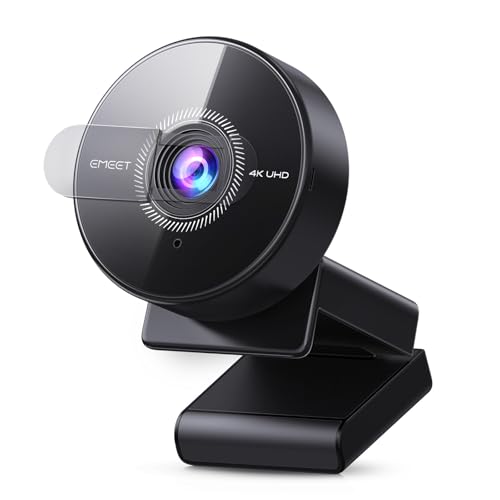
EMEET C950 4K Webcam

EMEET NOVA 4K Webcam

EMEET C960 4K Webcam

EMEET S600L 4K Webcam with Ring Light

Logitech Brio Video Conferencing Webcam

EMEET C100 2K Webcam
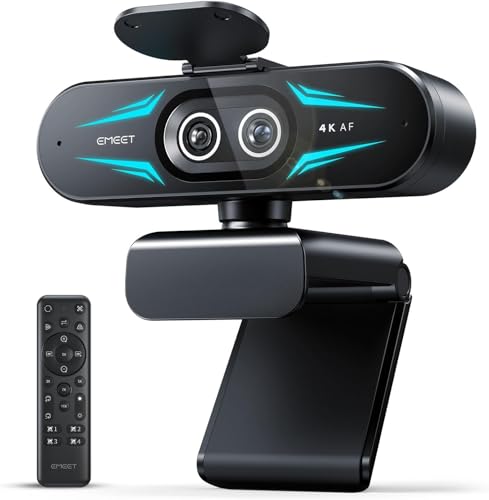
EMEET C60E Dual-Camera 4K Webcam

TONGVEO 4K Conference Room Camera System

EMEET S600 4K Webcam for Streaming

EMEET Piko Dual-Camera 4K Webcam
More Details On Our Top Picks
The EMEET C950 is the kind of webcam you set up once and forget about, which is exactly what most people want from a daily workhorse. It captures at 4K resolution up to 30 frames per second, dropping to 1080p at 60fps when smoother motion matters for casual streaming. The PDAF autofocus (a fast phase-detection system that locks onto your face quickly) keeps things sharp when you lean in to read a document or gesture during a call.
Built around a CMOS sensor, it handles typical home office lighting without the grainy, washed-out look cheaper lenses produce. For anyone running a standard workday on Zoom, Teams, or Google Meet, this lands as a sensible starting point in the 4K tier, and it undercuts the Logitech Brio on cost without giving up the core resolution benefit.
What Pays Off
- 4K at 30fps delivers noticeably sharper detail than 1080p models in the same price bracket.
- PDAF autofocus responds quickly when you move, so you are not stuck adjusting yourself mid-call.
- CMOS sensor holds up better than older CCD designs in mixed indoor lighting.
- Integrated microphone means one less accessory to buy for basic video calls.
Points To Note
- Low-light performance improves with a desk lamp, but dim rooms still show some noise.
- Built-in mic works for talking but is no match for a dedicated USB microphone for podcasts.
- Clip mount fits most monitors, though ultrawide curved screens may need repositioning.
Who It Suits Best
Remote workers and managers who want clean 4K video without paying for streaming-grade extras, and who spend most of their day on standard video calls.
Look Elsewhere When
You need a built-in ring light for low-light streaming, where the EMEET S600L 4K Webcam with Ring Light makes more sense.
Where the C950 focuses on practical daily use, the EMEET NOVA 4K Webcam pushes toward a more polished image. The 30fps 4K capture pairs with a CMOS sensor tuned for sharper edges and more accurate color reproduction, which matters when you are presenting slides or showing physical products on camera. Dual omnidirectional microphones (mics that pick up sound from all directions) widen the audio pickup compared to single-mic designs.
It runs on a standard USB connection, so setup stays painless across Windows and macOS. For online teachers presenting materials or small business owners running client-facing demos, the NOVA trades a few dollars more than the C950 for a noticeably more refined output, which is a worthwhile jump if your audience judges you on screen presence.
Strong Points
- Sharper color rendering than entry-level 4K cams makes printed materials and slides readable.
- Dual omnidirectional mics pick up voices from a wider range of positions around your desk.
- Plug-and-play USB keeps installation to a single step.
- Sturdy mounting clip stays put on thicker monitor bezels.
Small Caveats
- Audio still trails a dedicated external microphone for any serious recording.
- Best results require reasonable ambient lighting, since the sensor cannot fully compensate for pitch-dark rooms.
Right Fit For
Online educators and consultants who frequently share visual materials and need both clear video and dependable audio pickup in one package.
Skip It When
You primarily need 1080p high-frame-rate capture for gaming streams, where the EMEET S600 4K Webcam for Streaming offers better motion handling.
The EMEET C960 makes a quiet argument for itself: genuine 4K resolution without the inflated price tag of premium alternatives. The 4K CMOS sensor captures real detail rather than digitally upscaling lower-resolution footage, so the difference shows up the moment you compare side-by-side recordings. PDAF autofocus adds quick response, while the 73-degree field of view frames a single person nicely without distorting edges.
Compared to the NOVA above, the C960 narrows the field of view slightly, which helps in tighter workspaces where you do not want to broadcast the room behind you. Dual omnidirectional mics handle everyday call audio, though dedicated creators will still want something separate. The honest read is that this is a smart middle-ground pick for anyone upgrading from 1080p.
Features That Help
- True 4K output without interpolation tricks that muddy fine details like text and hair.
- 73-degree FOV keeps the frame focused on you, not your cluttered bookshelf.
- Dual mics cut down on the hollow sound that plagues cheaper single-mic webcams.
- PDAF keeps the focus locked during hand gestures or note reading.
Honest Caveats
- Tighter FOV makes two-person calls slightly cramped without zooming out digitally.
- No physical privacy shutter means you will want to unplug or cover it manually between calls.
Best Suited To
Solo remote workers and freelancers upgrading from a basic 1080p laptop camera who care more about image clarity than lighting flexibility.
Consider Something Else When
Privacy matters more than price, in which case the EMEET C100 2K Webcam with its rotating privacy cover is worth a look.
Streaming and recording in dim rooms is where most webcams fall apart, which is exactly the problem the EMEET S600L sets out to solve. The integrated ring light surrounds the lens and synchronizes with the image processing, automatically balancing exposure when the light turns on so you do not blow out your skin tone. The 1/2-inch sensor is physically larger than typical webcam sensors, gathering more light in the first place.
PDAF autofocus with a claimed 0.2-second lock time keeps reaction shots and product holds sharp. Where the C960 above sticks to clean, controlled meeting rooms, the S600L leans into unpredictable home studios where lighting changes throughout the day. Creators filming in bedrooms or shared spaces will appreciate the all-in-one approach, no extra ring light or software tweaks required.
What Earns Its Place
- Built-in ring light saves desk space and removes the need for a separate streaming light.
- Larger 1/2-inch sensor pulls in noticeably more light than standard webcam sensors.
- Fast PDAF autofocus keeps handheld product demonstrations in focus.
- Auto-exposure sync prevents the harsh overexposure that plagues manual ring lights.
A Few Limitations
- Ring light alone may not fully replace a key light for serious YouTube production.
- Bulkier housing takes more room above a monitor than slimmer options like the C950.
Made For
Content creators and Twitch streamers working in small or dim rooms who want better lighting without buying separate accessories.
A Better Fit Elsewhere
You mainly need wide-angle scene coverage for product unboxings, where the EMEET Piko Dual-Camera 4K Webcam serves better.
The Logitech Brio carries the kind of reputation that comes from years of corporate boardroom use. It records at resolutions up to 4096 x 2160 over USB 3.0, with a 90fps option for smooth motion at lower resolutions, and 5x digital zoom for cropping in tight. The integrated microphone handles standard meeting audio, though serious users tend to pair it with a dedicated unit.
Unlike the EMEET options that lean toward consumer and creator use cases, the Brio targets enterprise environments where consistency and driver support matter more than flashy extras. It is the safe choice for IT teams managing fleets of laptops, and it shows up on most approved equipment lists. For a solo creator on a tight budget, the EMEET C960 or C950 delivers comparable 4K resolution at noticeably lower cost.
The Helpful Details
- 4096 x 2160 resolution captures more vertical detail than standard 4K for tall subjects or shared screens.
- USB 3.0 bandwidth handles 4K cleanly without dropped frames on modern laptops.
- 5x digital zoom offers framing flexibility without moving the camera.
- Broad driver support across Windows, macOS, and major conferencing platforms.
Trade Offs
- Premium positioning means a noticeably higher cost than EMEET alternatives with similar resolution.
- Older design language compared to the sleeker EMEET S600 series.
Who Will Love This
IT managers and executives in larger organizations who need a dependable, well-supported 4K webcam that integrates cleanly with enterprise software stacks.
Reach For A Different Pick When
You are an independent creator chasing the best streaming image per dollar, where the EMEET S600 4K Webcam for Streaming offers stronger value.
Strictly speaking, the EMEET C100 is a 2K camera rather than 4K, which makes it the odd one out in this roundup, but it earns a spot by solving a problem none of the 4K models above address well. The rotating privacy cover lets you physically block the lens with a simple twist, a feature privacy-conscious users have asked for repeatedly. The metal clip also feels more durable than typical plastic mounts.
It captures at 2K resolution with fixed focus, which avoids the autofocus hunting (the distracting pulse in and out) that frustrates some users on cheaper cams. For anyone whose priority is privacy hardware over pixel count, this delivers peace of mind without abandoning decent image quality. You trade resolution for that physical shutter, and for the right person, that trade is absolutely worth it.
Everyday Advantages
- Built-in rotating privacy cover is the simplest way to ensure no accidental broadcasts.
- Metal clip survives travel better than plastic alternatives in laptop bags.
- Fixed focus eliminates the pulsing refocus that distracts viewers during long calls.
- 2K resolution still looks noticeably better than most built-in laptop cameras.
Points To Keep In Mind
- 2K resolution falls short of true 4K for users who need maximum on-screen detail.
- No ring light, so dim environments require external lighting for clean video.
Perfect Match For
Privacy-focused professionals and frequent travelers who want a hardware shutter and durable build more than the highest possible resolution.
Not Your Match When
Crisp 4K detail is the priority, where the EMEET C960 4K Webcam covers the same audience at higher resolution.
The EMEET C60E is built around an unusual idea, two cameras sharing a single 1/2.8-inch CMOS 4K sensor. One lens covers wide-angle scenes, the other telephoto close-ups, and you can switch between them based on what the moment calls for. Up to 11x hybrid zoom (a blend of optical and digital magnification) extends your reach for product demos or detailed shots. PDAF autofocus and a remote control round out a feature set aimed squarely at active streamers.
RGB lighting on the body adds a layer of visual personality that the more understated C950 and C960 do not offer. Two built-in microphones handle stereo capture for calls. Compared to the single-lens EMEET S600, this trades simplicity for genuine creative flexibility, which is a worthwhile step up for livestreamers running dynamic formats.
Why It Works Well
- Dual-camera design lets you flip between wide scene shots and close-ups without swapping gear.
- 11x hybrid zoom covers everything from face shots to small product details.
- RGB lighting adds visual energy that fits streaming and gaming aesthetics.
- Included remote control lets you adjust framing without touching the camera.
Where It May Fall Short
- Dual-lens complexity is overkill for users who just need a clean video call image.
- Higher learning curve to use all features effectively.
Built With In Mind
Lively streamers and creators running shows that alternate between full-room scenes and tight close-ups in the same broadcast.
Swap It Out When
You only need one camera angle and value straightforward simplicity, where the EMEET NOVA 4K Webcam is a calmer choice.
The TONGVEO is not really a webcam, it is a small meeting room system in a box. The kit pairs an AI-tracking 4K PTZ camera (PTZ stands for pan, tilt, and zoom, meaning the motorized camera can move automatically to follow a speaker) with 3x optical zoom and a 93-degree wide angle, plus a wireless Bluetooth speakerphone for table audio. It outputs over USB 3.0 and HDMI, giving installers flexibility for permanent setups.
This is a different category from the desk-mounted EMEET cams above, more like outfitting a small conference room than upgrading your home office. AI auto-tracking follows whoever is speaking without a human camera operator, which matters for worship spaces, clinics, and medium-sized meeting rooms. For anyone running a personal Zoom call from a laptop, the EMEET C960 makes far more sense than this kind of kit.
Where It Excels
- AI auto-tracking keeps the active speaker framed without manual camera control.
- 3x optical zoom preserves image quality at distance, unlike digital zoom.
- 93-degree wide angle captures whole tables or pulpits in a single frame.
- Wireless speakerphone separates mic placement from the camera.
Some Limits To Know
- System complexity means installation takes more effort than a simple USB webcam.
- Significantly more desk or shelf space required than the clip-on EMEET models.
The Right Fit
Small organizations, churches, and clinics outfitting a dedicated meeting or presentation space that needs hands-free camera tracking.
Where Another Pick Suits Better
You work from a single desk at home, where the EMEET C950 4K Webcam is the right size and capability.
The EMEET S600 focuses on one job: clean, detailed streaming footage. The Sony 1/2.55-inch sensor is the standout feature, larger than typical webcam sensors and tuned for better dynamic range, which is the ability to capture both bright and shadow areas without losing detail. It records 4K at 30fps or drops to 1080p at 60fps for smoother motion during gameplay or live demos.
PDAF autofocus keeps fast movements in focus, useful for streamers who gesture or move around the frame. Compared to the ring-lit S600L above, this model skips the built-in light in favor of a more traditional sensor-first design. Creators who already own good key lighting and want the best possible capture quality will find this delivers noticeably better low-light performance than budget options.
The Case For It
- Sony sensor offers stronger dynamic range than most webcam-grade sensors.
- 1080p at 60fps option is ideal for gameplay streaming where motion matters more than resolution.
- PDAF autofocus handles sudden movement without losing sharpness.
- Sensor-first design rewards users who already have proper lighting.
Things To Weigh Up
- No built-in light means dim setups need external lighting to look their best.
- Premium sensor comes at a higher cost than the C960 for similar resolution.
Whose Shelf It Belongs On
Aspiring streamers and content creators who already have a lighting setup and want the best possible image quality from a single webcam.
Another Choice May Suit
You are starting from scratch with no lights, where the EMEET S600L 4K Webcam with Ring Light is the more practical all-in-one pick.
The EMEET Piko brings the dual-camera concept from the C60E above into a slightly different package, pairing a wide-angle lens with a telephoto lens for true scene flexibility. The wide-angle captures immersive full views with both you and your environment framed naturally, while the telephoto delivers sharp close-ups for tutorials, product demos, and detailed expressions. You switch between them based on what the moment calls for.
Built for content creators who move between formats, the Piko solves a common streaming problem: a single fixed lens always forces compromises between showing your face and showing what you are working on. The dual setup removes that choice by giving you both. For someone running a single-camera operation, the EMEET NOVA 4K Webcam keeps things simpler without the learning curve.
The Practical Payoff
- Wide-angle lens keeps both subject and environment visible without awkward cropping.
- Telephoto lens delivers detailed close-ups for product work and tutorials.
- Switching between lenses eliminates the need for multiple cameras in simple setups.
Possible Compromises
- Two-lens system requires more setup thought than a single-lens webcam.
- Higher cost than basic 4K options like the C950 for users who only need one angle.
Who Should Grab It
Creators and educators running tutorials or product demonstrations who need both wide scene coverage and sharp close-ups from a single camera.
Wrong Turns To Avoid
You mainly join standard video calls and never switch angles, in which case the simpler EMEET C960 4K Webcam is a better everyday fit.
What To Weigh Before Picking Your 4K Computer Camera
Sensor Size And Resolution Trade Offs
Resolution gets the headlines, but sensor size quietly shapes how good a 4K computer camera looks in real rooms. Larger sensors (like the 1/2-inch or 1/2.55-inch options in the EMEET S600 series) gather more light, which means cleaner footage in dim home offices. Smaller sensors can still hit 4K resolution, but they compensate by amplifying the signal, which adds visible noise (grainy speckles) in low light. If your workspace leans dim, prioritize sensor size before chasing extra pixels.
Field Of View And Framing
Field of view, often expressed in degrees, decides how much of your room ends up in the frame. The EMEET C960 at 73 degrees keeps things tight and personal, while the TONGVEO conference system at 93 degrees captures whole tables. Wide fields introduce edge distortion (curved lines near the corners), especially at close range. Match the FOV to your space: solo desks want narrower lenses, shared spaces want wider ones.
Autofocus And Fixed Focus
PDAF autofocus locks onto your face quickly and follows you as you move, which feels natural during energetic presentations. Fixed focus, used in the EMEET C100, removes the refocus pulse but only works if you stay within a specific distance range, roughly 12 to 40 inches. Think about how you actually use the camera: do you sit still and take notes, or do you gesture, hold things up, or pace?
Microphones And Audio Path
Most built-in webcam microphones handle standard meetings adequately but rarely impress in serious recording scenarios. Dual omnidirectional mics, found in the EMEET NOVA and C960, pick up voices from a wider range of positions than single-mic designs. For calls, they are perfectly fine. For podcasts, voiceover work, or any content where audio matters as much as video, plan for a separate USB microphone eventually.
Lighting And Special Features
Built-in ring lights, like the one on the EMEET S600L, solve a common pain point for streamers working in unpredictable lighting. AI tracking and PTZ movement, like the TONGVEO system, are valuable in conference rooms but wasted in personal setups. Match special features to your actual scenario rather than paying for capabilities you will never use.
Key Considerations Across These Picks
Common Buying Traps
The first trap is assuming 4K resolution alone guarantees a better picture. A poor sensor with aggressive noise reduction can make 4K footage look worse than a clean 1080p image from a better sensor. The second trap is ignoring your lighting situation. Buying a premium sensor like the EMEET S600 and using it in a dim room leaves money on the table. Match the camera to your environment, not the spec sheet to your wish list.
The third trap is overpaying for dual-camera or PTZ features you will not use. The EMEET Piko and C60E shine for creators switching between formats, but for standard calls they add complexity without proportional benefit. Decide whether you actually need those features before paying for them.
Where The Extra Money Goes
Higher tiers earn their price through better sensors, larger apertures (the opening that lets light hit the sensor), and improved low-light performance. The EMEET S600’s Sony sensor captures a wider dynamic range than budget options, which means highlights and shadows both retain detail. Dual-camera systems like the C60E and Piko add optical flexibility that single-lens designs cannot replicate without expensive add-ons.
The upgrade is worth it when your content justifies the cost. Aspiring streamers producing regular videos, teachers recording lessons for replay, and small businesses running polished client calls will feel the difference. Casual users who hop on a few meetings a week rarely need the premium tier, and a solid mid-range option like the EMEET C960 will serve them well.
Frequently Asked Questions
What Makes A 4K Computer Camera Better Than A 1080P Model?
A 4K computer camera captures roughly four times the detail of 1080p, which translates to sharper text on slides, more natural skin texture, and the ability to crop in without losing quality. For most video calls, the difference is subtle but visible, especially on larger monitors where 1080p can look slightly soft.
Do I Need A Special USB Port For 4K Video?
Most modern laptops handle 4K webcams over standard USB ports, though USB 3.0 or higher prevents frame drops on higher-end models like the Logitech Brio. If your computer is more than a few years old, check that it meets the USB requirement listed for the specific camera you choose.
Are Built-In Microphones Good Enough For Video Calls?
Built-in microphones on cameras like the EMEET NOVA and C960 handle standard video calls without issue. For podcasting, voice-over work, or any content where audio quality matters as much as video, a dedicated USB microphone is a worthwhile upgrade.
Can A 4K Webcam Improve My Streaming Quality?
A 4K webcam sharpens your on-camera presence considerably, but streaming platforms often compress footage down to 1080p for viewers anyway. The benefit shows up most in recordings and in close-up framing, where the extra detail survives compression better than wide shots.
What Is PDAF Autofocus And Why Does It Matter?
PDAF (phase-detection autofocus) measures the distance to your subject directly, which speeds up focus locking and tracking compared to older contrast-detection systems. For people who move around, gesture, or hold objects up to the camera, PDAF keeps the image sharp where fixed-focus or slower systems would lag.
Final Takeaway
The right 4K computer camera depends entirely on how you show up on screen. Solo remote workers will find the EMEET C950 or C960 cover daily needs without complexity, while streamers chasing better lighting will appreciate the S600L’s built-in ring light. Creators running dynamic formats benefit from dual-camera flexibility in the Piko or C60E, and outfitting a meeting room calls for a system like the TONGVEO kit. Pick the camera that matches your actual room, lighting, and workflow, and the upgrade pays off every time you hit the join button.