Putting together a real home theater means wrestling with two stubborn problems at once: you want a giant image, and you want clean dialogue that actually reaches the seats. Hiding speakers behind a solid wall kills one or the other. That is the whole case for screens that pass sound through the fabric itself, so the speaker sits behind the picture without muffling it.
The challenge is that not every “acoustic” screen actually behaves like one. Some weaves scatter the highs and make voices sound like they are coming through a pillow, while others hold up beautifully but cost a fortune. Below are ten fixed-frame, pull-down, and portable options worth comparing, from serious permanent installs to flexible choices for backyards and rentals.
The Choices Worth Comparing

Elite Screens Sable Frame 2 165″ Fixed Projector Screen ER165WH2
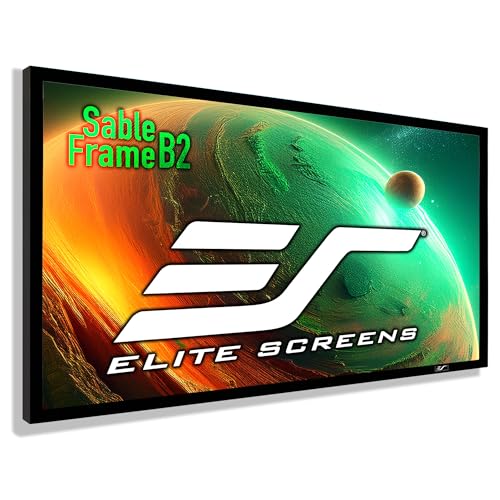
Elite Screens Sable Frame B2 120″ Fixed Projector Screen SB120WH2
Elite Screens Sable Fixed Frame B2 135″ Projector Screen SB135WH2

AWOL Valerion 135″ Fixed Frame Projector Screen

Silver Ticket Products STR Series 120″ Projection Screen

SUPER DEAL 120″ Manual Pull Down Projector Screen

JWSIT 120 inch Outdoor Projector Screen with 3-Layers PVC

Mdbebbron 120 inch Foldable Portable Projector Screen

Vamvo 100 Inch Projector Screen with Stand
LCUIRC 120 Inch Projector Screen with All-Metal Frame
More Details On Our Top Picks
The Elite Screens Sable Frame 2 ER165WH2 is the kind of screen you build a room around, not the other way around. At a 165-inch diagonal in 16:9, it fills a wall, so the rest of your seating, lighting, and speaker layout follows its footprint. The CineWhite UHD-B surface carries a 1.3 gain, which gives the picture a slight brightness boost that helps in rooms where you cannot fully kill ambient light.
Compared with the smaller Sable Frame B2 screens later in this list, this one trades a modest bump in picture punch for sheer presence. If you have the wall space and a projector with the throw distance to light it, the immersive effect is hard to match.
The Value In It
- 165-inch diagonal creates a true cinema-scale image without stepping up to custom framing.
- 1.3 gain surface pushes extra brightness, which helps with HDR content and modestly lit rooms.
- 180-degree viewing angle means seats off to the side still get a clean picture.
- Fixed aluminum frame keeps the surface taut and flat, reducing ripple over time.
Practical Considerations
- This size needs a dedicated wall and careful measurement, so it is a poor fit for rentals.
- The frame assembly is a two-person job, and the corners want attention to stay square.
Quick Facts
Whose Living Room It Belongs In
Dedicated theater owners with a wide wall and a projector that can throw a 165-inch image benefit most from this scale.
Consider Something Else When
Anyone working with a smaller wall should look at the Elite Screens Sable Frame B2 120″ SB120WH2 for a more room-friendly footprint.
The Sable Frame B2 120″ SB120WH2 sits in the sweet spot for most living room conversions. Its 120-inch diagonal fits above a typical media console without forcing a structural rethink. The same CineWhite UHD-B 1.3 gain material from the larger 165-inch model carries over, so color and contrast stay consistent.
For shoppers stepping up from a pull-down screen for the first time, this frame offers a real upgrade in flatness. The wraparound aluminum border also frames the picture like a piece of art, which matters when the screen is the focal point of the room.
Everyday Wins
- 120-inch size works in typical 12-to-15-foot seating rooms without crowding the walls.
- 1.3 gain surface keeps the picture punchy even with some ambient light.
- ISF certification supports accurate color for both movies and sports viewing.
- Fixed frame stays flat, which you notice during slow panning shots.
Small Caveats
- Wall mounting hardware is straightforward, but studs need to be located first to avoid sagging over time.
Made For
Living room theater builders who want a permanent, clean-looking 120-inch picture without committing to a 165-inch wall.
A Better Fit Elsewhere
For maximum scale in a dedicated room, the Elite Screens Sable Frame 2 165″ ER165WH2 is the step-up choice.
The Sable Fixed Frame B2 135″ SB135WH2 lands between the 120″ and 165″ Sable models, and for many people that middle size is the honest answer. A 135-inch diagonal still feels oversized when you sit down, but it does not force you to reorganize an entire room around it.
The 1.3 gain CineWhite surface behaves the same as its smaller and larger siblings, which makes comparing these three straightforward. You are really choosing wall real estate, not picture character.
Key Advantages
- 135-inch diagonal gives a noticeable step up from 120″ without the 165″ wall commitment.
- Active 3D and 4K Ultra HD support cover most modern projector signals.
- Wraparound frame design hides edge bleed and looks tidy once mounted.
- Wide viewing angle suits sectional seating layouts.
Worth Noting
- At this size, the projector needs enough throw distance, so a short-throw room may push you toward the AWOL Valerion instead.
- Two-person mounting is strongly recommended for keeping the frame square during install.
Feature Snapshot
Right Fit For
Shoppers who want a noticeable step up from 120″ but do not have the wall depth for a full 165-inch install.
Where Another Pick Suits Better
Ultra-short throw projector owners should consider the AWOL Valerion 135″ Fixed Frame, which is built for UST placement.
The AWOL Valerion 135″ stands out in this list because it is explicitly built to play nicely with ultra-short throw projectors, in addition to long and short throw models. That flexibility matters if you have moved past a ceiling-mounted unit and switched to a UST sitting on the same credenza as the screen.
Its matte white PVC surface delivers 1.3 gain and a 170-degree half-gain viewing angle, so brightness holds up even when guests sit at the far ends of the couch. The wrinkle-free claim also matters more than it sounds, because creases show up immediately on a white screen during dark scenes.
Practical Pluses
- Works with long throw, short throw, and ultra-short throw projectors from one mount.
- 1.3 gain gives a clean, bright image even with mixed lighting.
- 170-degree viewing angle keeps side seats in the picture.
- Wrinkle-free surface treatment holds up over years of wall time.
Trade Offs
- UST setups require careful placement relative to the bottom of the frame to avoid geometry issues.
- PVC surface can collect dust, so routine gentle wiping helps the picture stay clean.
Feature Card
Best Suited To
Owners of ultra-short throw projectors who want a fixed frame purpose-built for that geometry.
Skip It When
Anyone mounting from a ceiling at long throw distances who wants to save money should consider the Silver Ticket Products STR Series 120″.
The Silver Ticket STR Series 120″ gives first-time fixed-frame shoppers a way to step up from a pull-down screen without overspending. The 1.1 gain white surface is more neutral than the 1.3 gain CineWhite material on the Elite options, which can actually help in fully darkened theaters where brightness is already plentiful.
The six-piece aluminum frame is the headline feature. It assembles with corner brackets and gives the whole screen a tighter tolerance than cheaper plastic frames, so the surface stays flat once tensioned.
Reasons It Performs
- 1.1 gain white surface works well in dedicated dark rooms where extra brightness is not needed.
- 160-degree viewing angle keeps the picture uniform across wide seating.
- Aluminum frame resists warping over years of wall time.
- Native 16:9 alignment suits modern projectors without masking adjustments.
Some Limits To Know
- No option for legs or stands, so this is a wall-mount-only screen.
- Six-piece frame takes careful assembly to keep corners flush, especially on uneven walls.
Who Should Grab It
First-time fixed-frame shoppers who want aluminum-frame quality without the cost of a CineWhite surface.
Reach For A Different Pick When
Anyone needing a portable or outdoor solution should look at the JWSIT 120″ Outdoor Projector Screen instead.
The SUPER DEAL 120″ manual pull-down screen trades a few niceties for flexibility and a lower entry price. Because it rolls into a case, it disappears when you are not using it, which renters and shared-space dwellers tend to appreciate. The 1:1 format is also a reminder that this is a multipurpose screen, not a dedicated 16:9 home theater surface.
For casual viewing, classrooms, or a multipurpose family room where the screen comes down only on movie nights, the trade-off usually makes sense. You give up flat-frame tautness in exchange for being able to put the screen away.
What Makes Sense
- Manual pull-down design fits rental situations where wall drilling must be minimal.
- 1:1 format works for presentations, classrooms, and square content alongside movies.
- High-gain surface helps in rooms where some ambient light stays present.
- Lower cost makes it a reasonable trial screen before committing to a fixed frame.
Where It Is Less Suited
- Pull-down design means slight wave at the edges, which is visible on letterboxed movies.
- 1:1 format means you will have black bars above and below 16:9 content.
Perfect Match For
Renters and multipurpose-room owners who need a screen that rolls away between uses.
Swap It Out When
Dedicated theater builders should move to the Elite Screens Sable Frame B2 120″ SB120WH2 for a taut, permanent picture.
The JWSIT 120″ outdoor screen is built around fast setup, which is what backyard nights actually demand. The one-piece frame snaps together without tools, and the PVC surface stretches across it with metal snaps. You can realistically go from car to movie in a few minutes.
The 1.1 gain surface and 160-degree viewing angle are similar to the Silver Ticket STR, but the lighter frame and 16:9 format make this one aimed at outdoor movie nights rather than permanent installs.
Positive Points
- Tool-free assembly means a single person can set it up quickly.
- 3-layer PVC surface is more wrinkle-resistant than single-layer fabrics.
- Active 3D and 4K Ultra HD support covers most modern portable projectors.
- Detachable legs allow free-standing use in yards and driveways.
Trade-Offs To Consider
- Lightweight frame can catch wind, so staking is important for open yards.
- PVC surface collects dust between uses and benefits from a wipe-down before each event.
Quick Facts
Who Will Love This
Backyard hosts running weekly movie nights who want a screen one person can deploy without help.
Where A Sibling Pick Shines
Wind-prone yards benefit from the LCUIRC 120″ Projector Screen with All-Metal Frame for added stability.
The Mdbebbron 120″ is the most packable option in this roundup, because it folds down rather than rolling or breaking apart into a frame. The polyester fabric stores flat in a backpack or suitcase, which makes it the practical choice for road trips, off-site presentations, or anyone without room to store a rigid screen.
The double-sided projection surface is a useful detail for trade shows, where presenters need a clean side to fall back on if the first gets scuffed. At home, it also gives you the option to set up either side out.
The Good Stuff
- Folding design packs into a small footprint for transport and storage.
- Double-sided projection doubles the usable life of the surface.
- Anti-crease polyester helps the picture stay flat without a rigid frame.
- 16:9 format fits standard widescreen content out of the box.
A Few Limitations
- Without a frame, the fabric relies on careful hanging to avoid distortion.
- Polyester absorbs some light, so it needs a reasonably bright projector for outdoor use.
Built With In Mind
Road presenters and renters who need a screen that disappears into a closet between uses.
Not Your Match When
Anyone wanting a taut fixed-frame picture should pick the Elite Screens Sable Frame B2 120″ SB120WH2.
The Vamvo 100″ screen with stand is the fastest setup option in this group, mostly because of the built-in elastic cord system inside the aluminum stand. The frame snaps into shape on its own, which is genuinely useful when you are juggling a projector, speakers, and snacks at a campsite.
At 100 inches, it is smaller than most of the other portable options here. For many casual viewing situations, that smaller size is actually a plus, because it is easier to position and gives you more flexibility on where to set up.
What Stands Out
- Elastic cord system gets the frame from bag to upright in around two minutes.
- Front and rear projection surfaces give you setup flexibility.
- 16:9 format suits most modern content without cropping.
- Carry bag makes transport to campsites and events simpler.
Potential Drawbacks
- 100-inch diagonal is smaller than the 120″ portable screens, so impact is more modest.
- Aluminum stand needs flat ground to stay square on uneven terrain.
The Right Fit
Casual campers and apartment dwellers who value quick assembly more than maximum screen size.
Look Elsewhere When
Anyone wanting a larger portable surface should consider the JWSIT 120″ Outdoor Projector Screen instead.
The LCUIRC 120″ leans into stability with an all-metal frame and base, which is a meaningful upgrade over the typical mix of plastic and aluminum on portable screens. The 12-by-8 inch, 2-pound base keeps the screen upright, and the included ground stakes and windproof ropes are a thoughtful addition for outdoor use.
It also supports both front and rear projection, which gives you more flexibility when setting up in unusual spaces. The wrinkle-free claim is the kind of detail that matters once you have fought a creased screen for the third time during a movie.
Real-World Strengths
- All-metal frame and base stay rigid in light wind better than mixed-material stands.
- Mounting holes let you anchor the base for extra security on hard ground.
- Wrinkle-free surface treatment reduces prep time between uses.
- Front and rear projection open up creative placement options.
Honest Caveats
- All-metal construction adds weight, so the carry bag fills up quickly.
- Assembly still takes longer than elastic-cord designs like the Vamvo 100″.
Who It Suits Best
Outdoor hosts in breezy spots who are willing to trade a few extra minutes of setup for a screen that holds position once it is up.
Consider Something Else When
Campers prioritizing the fastest possible setup should reach for the Vamvo 100″ instead.
What Matters Most Before Choosing an Acoustically Transparent Projector Screen
Surface Material and Weave Density
Acoustically transparent materials pass sound through tiny perforations or a woven mesh. Perforated vinyl can slightly dim the picture because the holes scatter some light, while woven weaves tend to preserve more brightness but may show a faint texture up close. If you sit close to the screen, woven options often look cleaner. For middle-distance seating, perforated vinyl is usually fine.
Gain Rating and Room Lighting
Gain describes how much light the screen reflects back compared to a neutral reference surface. A 1.0 gain surface is balanced, while 1.3 gain pushes a brighter picture, which helps in rooms with some ambient light. In a fully darkened theater, lower gain can actually give more accurate black levels. Match the gain to your room rather than chasing the highest number.
Frame Style and Installation Reality
Fixed frames stay taut and look like a piece of art on the wall, but they require commitment and accurate measurement. Pull-down and folding screens roll or pack away, which renters and presenters appreciate. Consider who will install it, whether the wall can support it, and how often you actually want the screen visible.
Throw Distance and Projector Type
Standard long-throw projectors pair with nearly any screen, but ultra-short throw projectors need a flat, rigid surface to avoid geometry issues. Screens like the AWOL Valerion are built specifically to handle UST placement, while generic fixed frames work well for ceiling-mounted units. Always confirm throw distance before sizing up.
Key Considerations Across These Picks
Common Shopping Slip Ups
The biggest mistake is buying a screen that is too big for the wall or seating distance. A 165-inch diagonal in a small room forces you to sit close enough that pixel structure and weave patterns become visible. Measure first, then pick the largest size that fits comfortably.
Another common slip is ignoring projector compatibility. Ultra-short throw projectors on generic fixed frames can show wavy geometry at the bottom of the image. If you use a UST, pick a screen built for it, or be ready to tweak placement.
What The Higher Tier Buys
Stepping up to premium fixed-frame screens buys you a taut, ripple-free surface, an aluminum frame that stays square for years, and acoustic transparency that holds up across the frequency range. For a dedicated theater that runs nightly, that upgrade translates to fewer visual distractions and clearer dialogue through hidden speakers.
Frequently Asked Questions
What does “acoustically transparent” actually mean?
It means the screen material lets sound pass through with minimal distortion, so you can place speakers directly behind the picture. This keeps dialogue anchored to the image without needing a center channel above or below the screen.
Do acoustically transparent screens hurt picture quality?
Older perforated screens could dim the image noticeably, but modern woven and finely perforated materials preserve most of the brightness and contrast. From typical seating distance, the surface texture is rarely visible.
Can I use any projector with these screens?
Most screens work with standard long-throw and short-throw projectors out of the box. Ultra-short throw projectors need a rigid, flat surface, and a few screens on this list are specifically built for UST placement.
How big should my screen be?
A common rule is to sit between 1.5 and 2.5 times the screen’s diagonal width away. For a 120-inch screen, that means roughly 10 to 16 feet of seating distance. Larger rooms comfortably support 135-inch and 165-inch screens.
How do I clean a projector screen safely?
Use a soft, lint-free cloth slightly dampened with water, and avoid household cleaners. For PVC and vinyl surfaces, gentle wiping along the weave keeps dust from settling into the texture. Always check the manufacturer’s care notes before applying anything.
Closing Remarks
Choosing an acoustically transparent projector screen comes down to how permanent your setup is and how close you sit. Fixed frames deliver the cleanest picture for dedicated rooms, while portable and pull-down options give flexibility for renters and outdoor hosts. Match the size, gain, and mounting style to your space, and the screen will quietly do its job for years.