Chasing sharp stars starts with the right glass. Canon shooters shooting the Milky Way, deep-sky targets, or wide aurora frames need lenses that gather serious light, hold coma and chromatic aberration in check, and focus precisely on dim points. The mounts matter too, since Canon now spans EF DSLRs and RF mirrorless bodies. This list walks through ten lenses built around night-sky work, covering ultra-wide rectilinear designs, circular fisheyes for full-dome compositions, and a couple of specialty telephotos that pull in the moon and tight star clusters. Each pick notes real-world trade-offs, mount fit, and the kind of shooter it suits best.
An Overview Of The Picks

BENOISON 240mm f/5.6 Reflex Mirror EF Lens

NiSi 9mm f/2.8 Sunstar ASPH Lens

TTArtisan 7.5mm f/2.0 APS-C Fisheye (Nikon Z)

Rokinon AF 14mm f/2.8 for Canon EF

Rokinon 14mm f/2.8 Series II for Canon EF

Rokinon RF14 14mm f/2.8 for Canon RF

7artisans 10mm f/2.8 II Fisheye (Sony E)

TTArtisan 7.5mm f/2.0 APS-C Fisheye (Sony E)
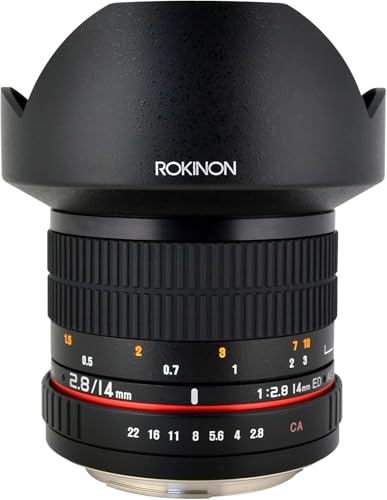
Rokinon FE14M-C 14mm f/2.8 for Canon

JINTU 420-800mm f/8.3 Telephoto Zoom (Canon EF/EF-S)
Inside Each Recommended Option
The BENOISON 240mm f/5.6 reflex mirror lens brings a catadioptric (a design that uses mirrors inside the lens to fold the light path, which keeps the body short) approach to Canon EF-mount astrophotography, trading a wide field of view for tight framing of the moon, lunar craters, and bright planetary conjunctions. Unlike the Rokinon ultra-wides ahead in this list, this pick reaches further into the sky and stays compact thanks to its mirror-based optical path.
It pairs with a long list of Canon DSLRs from older Rebels through the 90D and 6D Mark II line. Manual focus only, so live view magnification becomes your friend when chasing craters along the terminator (the line dividing the lit and dark halves of the moon).
Positive Points
- Compact telephoto reach that pulls in lunar detail without a giant tripod rig.
- Broad Canon EF and EF-S compatibility across older and current DSLR bodies.
- Distinctive donut-shaped bokeh from the mirror design adds character to bright points.
- Manual focus ring stays smooth enough for careful star point checks in live view.
Things To Consider
- Fully manual operation means the body must be set to M mode before the shutter will fire.
- Fixed f/5.6 aperture limits how dim a target you can pull in compared to faster ultra-wides.
- Owners commonly report the mirror design produces a secondary mirror reflection in some highlights, which may show up as a faint ring around very bright stars.
Made For
DSLR shooters who want tight lunar and planetary framing on a Canon Rebel, 80D, 6D, or similar EF body without carrying a heavy refractor.
Reach For A Different Pick When
The Rokinon 14mm f/2.8 Series II is a better match when sweeping Milky Way panoramas across a full-frame EF body matter more than telephoto reach.
NiSi built the 9mm f/2.8 Sunstar for APS-C mirrorless bodies, and that ultra-wide angle of view plus filter support makes it a sleeper hit for nightscape shooters who like to stack light pollution or ND filters (ND, or neutral density, filters cut light evenly so you can use longer exposures in bright conditions). Compared with the BENOISON mirror lens above, this is a totally different approach: short focal length, broad sky coverage, and a manual focus ring tuned for fine star-point confirmation.
The 67mm filter thread and compatibility with the NiSi 100mm filter holder system lets you drop in square filters for Milky Way work in suburban skies. Aspherical elements (aspherical elements are specially curved glass surfaces that correct distortion in wide-angle designs) help keep straight lines straight, which matters when architecture sneaks into your foreground.
A Favorable Mix
- Wide 113-degree field of view captures huge swaths of sky in a single frame.
- Bright f/2.8 aperture gathers meaningful light for short tripod exposures.
- Crisp 10-point sunstars from f/2.8 down through f/16 for creative night compositions.
- Standard 67mm thread and NiSi 100mm holder support streamline filter workflows.
Worth Noting
- E-mount only, so Canon EF and RF bodies need an adapter or a different pick.
- Manual focus operation requires live view magnification to nail star sharpness.
Right Fit For
Sony APS-C mirrorless shooters who filter-stack and want the widest possible rectilinear (rectilinear means straight lines stay straight, with no fisheye curve) sky grab in a small package.
Consider Something Else When
The Rokinon RF14 14mm f/2.8 is the better choice when you shoot Canon RF mirrorless and want a native mount with no adapter hassle.
TTArtisan stretches the limits of a circular fisheye with a fast f/2.0 aperture on this 7.5mm optic for Nikon Z APS-C bodies. That bright opening is unusually aggressive for a fisheye and helps the lens swallow dim starlight without dragging exposures into noise territory. Where the NiSi 9mm above keeps lines straight, this one embraces the curved sky, putting every star inside one round frame.
Manual focus only, which matches what most nightscape shooters expect from creative glass. The silver finish and small footprint keep it balanced on a Z50 or Z fc body during long tripod sessions.
Where It Excels
- f/2.0 aperture outperforms typical f/2.8 fisheyes for dim star fields and auroras.
- Circular fisheye projection captures the entire sky dome in a single frame.
- Sturdy metal-barrel feel that handles tripod use and bag travel well.
- Manual focus ring has enough damping for precise infinity tweaks in cold air.
Points To Keep In Mind
- Nikon Z APS-C mount only, so Canon shooters will need a different body or adapter.
- Circular fisheye coverage leaves a black frame around the image circle, which affects composition choice.
- Manual operation means no autofocus confirmation for fast targets like meteors.
Who Will Love This
Nikon Z APS-C owners who want a single image that captures the whole overhead sky during meteor showers or geomagnetic storms.
A Better Fit Elsewhere
The Rokinon 14mm f/2.8 Series II works better when you shoot Canon EF and prefer a rectilinear ultra-wide over a circular fisheye.
Rokinon’s autofocus 14mm f/2.8 for full-frame EF DSLRs is one of the rare ultra-wides that actually drives the lens on a Canon body, which helps when you toggle between daytime landscapes and nighttime sky work. Autofocus lands somewhere between useful and quiet for star work, but the real story is that you can confirm focus through the viewfinder rather than relying solely on live view magnification.
Compared with the BENOISON reflex lens above, this is a wide and bright complement rather than a competing focal length. Optical construction uses 15 elements in 10 groups with multiple special glass types to keep distortion reasonable across the frame.
What Earns Its Place
- Rare autofocus capability for an ultra-wide on Canon EF mount bodies.
- Full-frame coverage with a 14mm focal length that frames big sky arcs on the Milky Way.
- Multi-coated optics help reduce ghosting (ghosted flares are hazy, semi-transparent reflections that can wash out night images) under moonlight or light pollution.
Honest Caveats
- Autofocus accuracy drops in very dim conditions, so manual focus remains the safer night workflow.
- Weather sealing is limited, so fog-prone environments may need extra lens protection during long dew-heavy nights.
Feature Snapshot
Best Suited To
Hybrid Canon EF shooters who want one lens for both daylight landscapes and Milky Way nightscapes without swapping glass.
Not Your Match When
The Rokinon RF14 is a better pick when you shoot Canon EOS R mirrorless and want a native RF mount without an EF-to-RF adapter.
The Rokinon 14mm f/2.8 Series II refines the original 14mm design with a sleeker housing, weather-sealed mount area, and improved optical coatings aimed at astrophotographers. Compared with the autofocus Rokinon 14mm above, this one drops motor-driven focus for a smoother manual experience that dedicated nightscape shooters tend to prefer.
The 115.7-degree angle of view on full frame and around 90 degrees on APS-C makes it flexible across sensor sizes, and the optical design uses multiple special glass elements to hold coma (coma is the optical flaw that turns pinpoint stars into tiny comet shapes near the edges of the frame) and astigmatism in check toward the corners, which matters most for stars.
What Works In Its Favor
- Manual focus ring is well-damped for precise infinity tweaks on cold nights.
- Improved coatings help reduce ghosting near bright moonlight or sodium street lamps.
- Compact body balances well on small tripods for hiking dark-sky locations.
Practical Considerations
- Manual focus only, so live view magnification stays essential for sharp stars.
- Larger front element means standard filters need a specific holder rather than screw-in threading.
- Heavier build than some ultra-wides can strain smaller travel tripods over long sessions.
Perfect Match For
DSLR nightscape shooters who want manual precision, weather sealing, and clean corner performance for stacked Milky Way frames.
Skip It When
The Rokinon AF 14mm f/2.8 makes more sense when you want autofocus confirmation during daytime landscape work alongside night sky shoots.
The Rokinon RF14 14mm f/2.8 targets Canon EOS R mirrorless shooters who want a native ultra-wide without stacking adapters. The RF mount version preserves the manual focus design of the EF Series II while updating electronics for the mirrorless body. Where the EF Series II above uses an older communication protocol, this lens talks directly to R5, R6, and RP bodies.
Angle of view sits at roughly 115.7 degrees on full-frame RF bodies, with a corrected image circle for the larger RF mount flange. Weather sealing around the mount helps in damp night environments, which is one of the more useful real-world touches for astrophotographers shooting in dew-heavy locations.
Bright Spots
- Native RF mount removes the wobble and tilt risk of EF-to-RF adapters.
- Wide 14mm focal length suits Milky Way panoramas on full-frame R bodies.
- Weather sealing at the mount reduces worry on long, damp nights.
- Manual focus ring offers smooth, well-damped control for fine star checks.
Minor Gripes
- Manual focus only, so live view magnification is the main sharpness tool.
- Front element curves out, limiting standard threaded filter use without a dedicated holder.
Quick Facts
Who Should Grab It
Canon EOS R series shooters who want a clean, native-mount ultra-wide for full-frame nightscapes and aurora work.
Look Elsewhere When
The Rokinon AF 14mm f/2.8 on an EF body is a stronger fit when autofocus confirmation matters during daytime shooting.
The 7artisans 10mm f/2.8 II stretches coverage to a wide 185-degree angle of view in a full-frame fisheye package for Sony E-mount. That means more sky in every direction than the Rokinon 14mm rectilinear options above, plus that signature curved horizon fisheye shooters chase for immersive Milky Way frames.
Compared with the TTArtisan 7.5mm circular fisheye ahead in this list, this is a full-frame diagonal fisheye that fills the whole sensor with curved geometry rather than leaving a circular black border. Weight sits at roughly 602 grams, which is manageable on a Sony A7 body but worth considering for very compact travel rigs.
What Makes Sense
- 185-degree angle of view captures dramatic, sweeping nightscape compositions.
- f/2.8 aperture holds up against dim starlight in moderately dark skies.
- Full-frame coverage that fills the sensor with no black border on E-mount bodies.
Room For Improvement
- Curved geometry means straight lines bow, which is fine for sky work but distorts architecture.
- Sony E mount only, so Canon shooters will need an adapter or another lens.
- Manual focus only, with no electronic confirmation.
Key Product Details
Built With In Mind
Sony full-frame mirrorless owners who love fisheye drama and want maximum sky coverage in one click.
Another Choice May Suit
The TTArtisan 7.5mm f/2.0 is a stronger pick when you shoot Nikon Z APS-C and want the brightest possible circular fisheye.
The TTArtisan 7.5mm f/2.0 for Sony APS-C E-mount brings the same bright f/2.0 fisheye formula as the Nikon Z version earlier in this list, adapted for smaller-sensor Sony bodies like the A6000 series and FX30. For nightscape shooters, f/2.0 is the standout number, since it lets you cut exposure times compared to typical f/2.8 fisheyes and still bring home clean star fields.
The circular fisheye projection creates a round image inside the APS-C frame, which means composition choices look closer to a planetarium view than a wide landscape.
Useful Highlights
- f/2.0 aperture outperforms most fisheye lenses in dim night conditions.
- Manual focus ring is smooth and easy to nudge for fine star checks.
- Compact size balances nicely on smaller Sony APS-C bodies for travel and hiking.
Some Limits To Know
- APS-C sensor coverage only, leaving a black frame around the circular image.
- Sony E mount only, so Canon shooters need a different setup.
- Manual operation means you cannot rely on AF for fast moving targets like meteors.
Whose Shelf It Belongs On
Sony APS-C mirrorless shooters who want the brightest circular fisheye possible for aurora and Milky Way dome shots.
Swap It Out When
The 7artisans 10mm f/2.8 II is a better fit when you want full-frame diagonal fisheye coverage on a Sony A7 body.
The Rokinon FE14M-C 14mm f/2.8 is the lens that built Rokinon’s reputation among Canon astrophotographers. It’s a long-running manual-focus ultra-wide that delivers a 115.7-degree angle of view on full frame and stays useful on APS-C bodies too. Compared with the newer Series II above, this one keeps things simple with a classic optical formula and a more affordable position.
The 14-element, 10-group optical design uses multiple high-refractive-index elements (high-refractive-index glass bends light more efficiently, helping a wide-angle lens stay compact) and one aspherical element to hold distortion and edge coma in check. For dedicated deep-sky nightscape shooters on a budget, this is one of the more proven options out there.
Positive Takeaways
- Long-running design with a strong track record in astrophotography communities.
- Wide 14mm focal length fits both full frame and APS-C Canon EF bodies.
- Solid optical formula for the price tier, holding stars reasonably tight at the edges.
- Light enough to balance on entry-level DSLRs without strain.
Less Ideal Details
- Older coating design can show more ghosting near bright moonlit scenes than newer Series II glass.
- Manual focus only, with no weather sealing around the mount for damp locations.
The Right Fit
EF-mount Canon shooters stepping into astrophotography who want proven optics without paying for the newest housing or coatings.
Where A Sibling Pick Shines
The Rokinon 14mm f/2.8 Series II is a better choice when you want weather sealing and improved coatings for fog-prone dark sites.
The JINTU 420-800mm f/8.3 telephoto zoom reaches far beyond the ultra-wides in this list, pulling in distant lunar craters, planetary details, and tight star clusters. The T2 thread design (a T2 mount is a universal screw-style mount used to attach lenses to different camera bodies via a brand-specific adapter) lets you swap brand adapters as your kit evolves, which extends the lens’s life across body upgrades.
It covers a wide range of Canon EF and EF-S bodies, from older Rebels through the 90D and 80D. Aperture sits at f/8.3 across the zoom range, which means you will want a sturdy tripod and clear skies for best results. This is the most niche pick in the roundup, aimed at shooters who lean into long-reach lunar work rather than wide-sky nightscapes.
Features That Help
- Long 420-800mm zoom range reaches far beyond standard telephotos.
- Universal T2 thread design works across future body upgrades with the right adapter.
- Broad Canon EF and EF-S compatibility covers many current DSLR bodies.
Things To Weigh Up
- f/8.3 maximum aperture requires longer exposures and very stable tripod setups.
- Manual focus only, with a long focus throw that takes practice for fine star or lunar checks.
Built With In Mind
Canon DSLR owners who want a budget long-reach option for casual moon shots and tighter celestial subjects.
Skip It When
The Rokinon RF14 is a smarter buy when wide Milky Way framing on an EOS R body is the primary goal.
What Matters Most Before Choosing Astrophotography Lenses For Canon
Mount fit sits at the top of the list. Canon shooters run everything from older EF DSLRs to EOS R mirrorless bodies, and picking a lens that mounts natively avoids adapter wobble and tilt. Focal length and aperture form the second decision: ultra-wide rectilinear lenses like 14mm f/2.8 models frame sweeping Milky Way arcs, while fisheyes capture whole sky domes in creative ways. Aperture matters because faster glass gathers more starlight per second, letting you shorten exposures and reduce star trailing on a fixed tripod.
Field of view, optical corrections, and build quality round out the choice. Coma performance, the ability to keep pinpoint stars tight at the edges of the frame, varies between lenses and matters more than headline specs once you start pixel-peeping. Weather sealing and filter support matter too, since dark-sky locations tend to be damp and many shooters want light-pollution or night-sky filter options.
Key Considerations Across These Picks
Pitfalls Shoppers Hit
The most common slip is choosing a lens for the wrong mount. EF glass on RF bodies works through an adapter, but the reverse rarely fits cleanly. Another frequent mistake is chasing maximum aperture without checking edge sharpness, since a wide-open f/2.0 lens with poor corner performance can disappoint more than a slower f/2.8 with corrected optics. Skipping live view magnification for manual focus is another classic miss, since viewfinder focusing in dim conditions rarely lands on true infinity for stars.
Where The Extra Money Goes
Higher-priced models tend to add weather sealing, better optical coatings that fight ghosting under moonlight, and improved corner correction for cleaner stars at the edges of the frame. AF capability on an ultra-wide, like the Rokinon 14mm f/2.8 AF for Canon EF, costs more but adds flexibility for daytime shooting. For dedicated deep-sky nightscapes, the manual-focus designs often deliver cleaner star points per dollar spent, especially when paired with a sturdy tripod and careful focusing technique.
Frequently Asked Questions
Do I need autofocus for astrophotography lenses?
Not really. Manual focus is the standard for nightscape work because live view magnification gives the most accurate star-point focus, and autofocus struggles in very dim conditions on most ultra-wides.
Can I use EF lenses on Canon RF mirrorless bodies?
Yes, with an EF-to-RF adapter. Native RF lenses remove any risk of adapter wobble and often communicate better with the body, but adapted EF glass still performs well.
What focal length works best for the Milky Way?
Around 14mm to 24mm on full frame tends to frame the Milky Way core nicely with room for foreground. Wider fisheyes work if you want the entire sky dome in one image.
Are fisheye lenses good for astrophotography?
Fisheyes work well for full-sky compositions like auroras and meteor showers, though straight lines bow at the edges. They trade correction for coverage.
How important is weather sealing for night sky lenses?
It helps in damp or dew-heavy locations, but it is not essential for occasional clear-night outings. Many shooters add a dew heater instead and skip the sealed mount.
Wrap Up
Your best match depends on which Canon body you shoot and what kind of sky you chase. EF DSLR shooters get the widest support, with the Rokinon 14mm options leading the pack for full-frame nightscapes. EOS R mirrorless users get a clean native fit with the Rokinon RF14, while specialty options like the BENOISON 240mm reflex lens pull in the moon. Match the mount first, pick the focal length that fits your framing style, and you’ll be set for clear nights ahead.