A ball head is one of those small parts of a tripod kit you stop noticing when it’s dialed in, and start cursing the moment it isn’t. The right one turns a frustrating framing session into a one-handed tweak. The wrong one drags, slips, or fights you every time you try to recompose a landscape horizon.
Photographers swapping from a pan-tilt head, hunters mounting a spotting scope, and videographers chasing a level glide all want the same thing: predictable control under load. The ten tripod heads below cover that range, from Arca-type quick-release workhorses to low-profile rifle rests and smooth fluid pan heads.
The Choices Worth Comparing

EVUMO Ball Head Conversion Kit for BOG DeathGrip Tripod
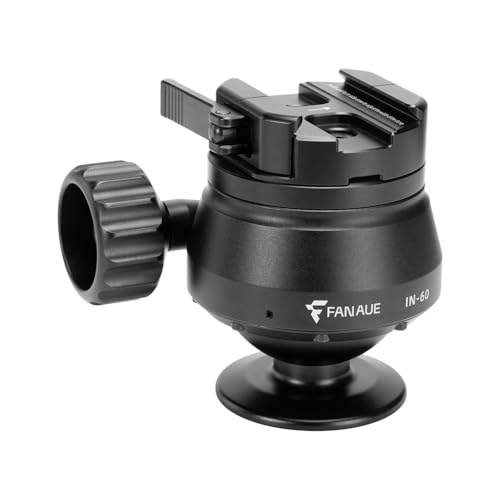
FANAUE 60mm Tripod Ball Head (IN-60T)

FANAUE 65mm Low Profile Hunting Ball Head

FANAUE 55mm Heavy Duty Low Profile Panoramic Ball Head

FANAUE 40mm Tripod Ball Head with Quick Release Plate
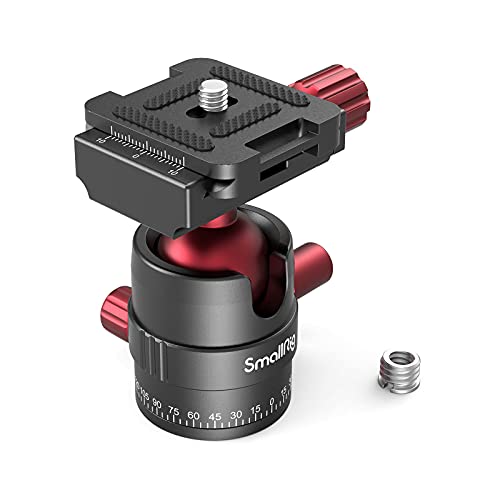
SmallRig 360 Rotating Panoramic Tripod Ball Head

K&F CONCEPT 28mm Metal Tripod Ball Head

Manfrotto Traveler Top Lock Quick Release Adaptor (MSQ6T)

K&F CONCEPT 3-Way Geared Tripod Head

K&F CONCEPT Fluid Head FH-03
The Details Behind The Selections
If you already shoot from a BOG DeathGrip shooting tripod and want true Arca-type compatibility, this conversion kit skips the adapter-juggling routine. Unlike the standalone FANAUE ball heads further down the list, EVUMO’s value sits in the mounting interface, not a refined pan knob.
The converter is machined from 6061-T6 aluminum (an aerospace-grade alloy prized for its strength-to-weight ratio) and finished in matte anodizing for corrosion resistance in damp field conditions. A stainless 3/8-inch bolt threads into the DeathGrip’s mounting platform, giving you a sturdy anchor that won’t corrode after a wet morning on a tree stand.
Useful Strengths
- Adds proper Arca-Swiss saddle support to a hunting tripod that ships with a limited yoke head.
- Lightweight aluminum build keeps your pack weight manageable on long walks.
- Matte anodized finish resists scratches and weathering in field use.
- Stainless mounting bolt cuts down on rust worries in coastal or wet environments.
Things To Consider
- Only fits the original DeathGrip tripod, not the Infinite version, so verify your model before ordering.
- You still need your own quick-release plate and ball head to complete the system.
Who It Suits Best
BOG DeathGrip owners who want to standardize on Arca plates across their shooting and camera setups.
Where Another Pick Suits Better
Photographers who don’t already own a DeathGrip will get more from the FANAUE 55mm Heavy Duty Low Profile Panoramic Ball Head, which is a complete head with pan and ball locks already integrated.
The FANAUE IN-60T leans into the kind of confident single-knob lock that event and wedding shooters tend to want. The 60mm ball is bigger than the 40mm unit in this lineup, so it holds heavier rigs without a fight.
The oversized main lock is the headline feature here. It is large enough that you can spin it with a gloved thumb in winter, and tightens down without the slow drift you sometimes get from cheaper knobs. The head is built around standard Arca-type plates, which keeps your plate collection portable across other mounts.
Where It Excels
- The large lock knob is comfortable for one-handed framing changes mid-shoot.
- Standard Arca-Swiss compatibility means most quick-release plates you already own will drop in.
- Aluminum body keeps weight down while supporting heavier DSLR or mirrorless rigs.
- Lock action feels firm once tightened, with minimal reported sag under load.
Worth Noting
- The quick-release plate is not included, so budget for a compatible plate.
- You may find the lack of an independent pan lock limiting for stitched panoramas.
Feature Snapshot
Made For
Photographers who frequently reframe mid-session, especially event shooters and portrait pros working solo.
Consider Something Else When
If stitched panoramas are your main game, the FANAUE 55mm Heavy Duty Low Profile Panoramic Ball Head has an independent pan lock that makes nodal-point rotation simpler.
The TA-65T flips the usual geometry. Instead of a tall ball perched on a stem, it uses an inverted head with a low-profile mount that sits closer to the tripod platform. Hunters chasing a stable cheek weld appreciate that lower stack height.
With a 22-pound load rating, it is no lightweight workhorse. The QR clamp uses a lever release, which is faster than a knob under the pressure of a waiting shot. Compatibility with standard Arca-Swiss plates also means you can share plates between your rifle scope mount and a camera setup.
What Works In Its Favor
- Low-profile design lowers your line of sight for prone shooting positions.
- 22lb load rating covers most spotting scopes and riflescams.
- Lever release speeds up plate swaps in cold or gloved hands.
- Inverted head geometry reduces wobble compared to conventional tall ball heads.
Trade Offs
- The aggressive low-profile stance makes over-head angles trickier than a standard ball.
- Lever release mechanisms can collect grit in dusty hunting environments, so occasional cleaning is wise.
Best Suited To
Hunters and spotter shooters who want a stable, low-stack platform and already use Arca plates across their gear.
Not Your Match When
Studio photographers framing high overhead shots should look at the FANAUE 40mm Tripod Ball Head, whose taller stance handles top-down compositions more naturally.
Where the IN-60T focuses on a single oversized knob, this 55mm unit splits duties between a pan lock and a ball lock. That separation matters when you stitch panoramas and need precise nodal rotation without the ball relaxing.
The load capacity is the real story here: 44 pounds is enough to support a 600mm telephoto with a teleconverter and a flash bracket without complaint. A U-notch in the clamp body gives you 90-degree vertical articulation for sports or wildlife shooting, and the panoramic base handles a full 360-degree sweep with its own dedicated knob.
Strengths Worth Knowing
- 44lb load capacity handles pro telephoto combinations with teleconverters.
- Independent pan and ball locks allow micro-adjustments during composition.
- 90-degree vertical drop via U-notch supports overhead or low-angle work.
- 55mm precision-machined ball resists drift under heavy payloads.
Small Caveats
- Heavier than travel-oriented heads, so it adds noticeable pack weight on long hikes.
- The dual-lock setup has a slight learning curve if you’re used to single-knob heads.
Quick Facts
Who Should Grab It
Wildlife and sports shooters carrying long glass who also dabble in stitched panoramas.
Look Elsewhere When
If you’re packing lighter and don’t need 44 pounds of headroom, the FANAUE 40mm Tripod Ball Head is a more travel-friendly alternative.
The 40mm ball is on the smaller side, but the low-profile body keeps the center of gravity close to the tripod platform. That combination is the real stability trick here, and it matters more than chasing a bigger ball.
You get a 1/4-inch Arca-Swiss quick-release plate in the box, which is convenient if you’re starting from scratch. The head supports 360-degree horizontal rotation and 90-degree vertical tilt, so the basic articulation range is full.
Real-World Strengths
- Low-profile body lowers center of gravity for more stable setups on uneven ground.
- Includes a 1/4″ Arca-Swiss plate, which saves a separate purchase.
- 22lb load capacity comfortably handles mirrorless bodies with mid-range zooms.
- Compact size suits travel tripods and smaller backpacks.
Points To Keep In Mind
- The smaller ball offers less contact area than the 55mm or 60mm units for very heavy rigs.
- Owners commonly report that long telephotos stress the lock past 15 pounds in real-world use.
The Right Fit
Traveling mirrorless shooters who want a compact head that still feels planted on a light carbon-fiber tripod.
A Better Fit Elsewhere
Photographers pairing big 300mm-plus lenses with the body will be happier with the FANAUE 55mm Heavy Duty Low Profile Panoramic Ball Head and its larger load ceiling.
SmallRig built this one with the vlogger and content creator in mind. The panning dial sits up top with calibration markings, which makes repeatable horizontal moves much easier than eyeballing it.
The body stays light and small enough that it disappears in a kit bag. A separate pan knob handles horizontal rotation while a main ball knob locks the tilt axis. The bottom features a 3/8-inch thread, and a 1/4-inch screw secures the included quick-release plate.
Useful Touches
- Calibrated panning dial supports repeatable video pans and panorama angles.
- Compact body suits travel tripods and gimbal-adjacent workflows.
- Independent pan and tilt knobs let you isolate each axis cleanly.
- Includes a removable quick-release plate to get you started.
A Few Limitations
- The 11lb max load rules out heavier cinema rigs or DSLR-plus-telephoto combos.
- Plastic-feeling knobs can wear faster than metal alternatives under heavy daily use.
Key Attributes
Whose Shelf It Belongs On
Content creators and vloggers shooting mostly mirrorless bodies who need repeatable panning for B-roll.
Swap It Out When
Photographers building heavier DSLR-plus-lens setups will be happier with the FANAUE 60mm Tripod Ball Head, which carries more weight with a simpler one-knob interface.
The 28mm ball keeps this K&F CONCEPT unit compact enough to live on a tabletop or travel tripod without dominating your pack. It is a metal-bodied head at a price point where plastic is the norm, which is a small surprise.
You get a 1/4-inch quick-release plate, a built-in bubble level for keeping horizons honest, and a 360-degree panoramic base with two twist locks. Three non-slip pads on the bottom add grip when mounted on smooth surfaces. It carries roughly 22 pounds, which is impressive for the size.
The Good Stuff
- Metal construction at a compact price tier is uncommon.
- Built-in bubble level helps with precise horizon alignment.
- Tiny footprint suits tabletop tripods and travel kits.
- Includes a 1/4″ quick-release plate so you can shoot immediately.
Honest Caveats
- The small ball diameter limits stability with very long lenses.
- Twist-lock knobs feel lighter than the larger FANAUE units and may wear over years of daily use.
At A Glance
Who Will Love This
Travelers and vloggers building a minimal mirrorless kit who want a metal head without bulk.
Another Choice May Suit
Anyone running heavier full-frame bodies with zooms should look at the FANAUE 40mm Tripod Ball Head for more substantial load support.
This Manfrotto accessory solves a specific problem: getting Arca-type plate compatibility onto a Befree tripod or one of the 494/496 ball heads. If you are already in the Manfrotto ecosystem, the lock geometry is dialed in.
The MSQ6T adapter is a top-lock quick-release plate holder made specifically to fit the travel-friendly footprint. Two-axis bubble level integration helps with precise alignment, and the aluminum construction keeps weight low.
The Case For It
- Native compatibility for Befree legs and 494/496 heads avoids adapter fiddling.
- Aluminum build keeps added weight to a minimum in travel kits.
- Dual-axis bubble level aids landscape and architectural alignment.
- Compact enough to fold with Befree legs without getting in the way.
Practical Considerations
- Only useful if you already own a compatible Manfrotto head or tripod.
- The plate system is proprietary enough that swapping to a different brand of head means leaving this adapter on the shelf.
Perfect Match For
Travel photographers committed to the Manfrotto Befree system who want Arca plate convenience.
Reach For A Different Pick When
If you don’t already own Befree legs or 494/496 heads, the FANAUE 60mm Tripod Ball Head gives you a complete head with Arca compatibility at a similar point of entry.
A 3-way geared head is a different beast than the ball heads above. Instead of one knob that does everything, you get three separate handles with geared reduction. The trade is slower movement, but the gain is precision: tiny, calibrated adjustments without touching the camera.
The K&F CONCEPT unit uses aluminum alloy with CNC machining (a computer-controlled cutting process that produces very tight tolerances) for a precise fit. Each axis moves independently, so you can lock one and adjust another, which is a real workflow win for architectural and landscape work where fine alignment matters.
A Favorable Mix
- Independent geared knobs let you dial in each axis with millimeter precision.
- Aluminum alloy construction stays rigid under slow, deliberate framing.
- Ideal for studio, architectural, and macro work where small shifts matter.
- Excellent damping helps one-step positioning without overshoot.
Where It Is Less Suited
- Slower than a ball head for sports or fast-moving subjects.
- Bulkier than the ball heads above, so it adds noticeable weight in travel kits.
Feature Snapshot
Built With In Mind
Architectural, landscape, and studio photographers who prize precision over speed during framing.
A Better Fit Elsewhere
Run-and-gun photographers and wildlife shooters chasing fast movement will find the FANAUE 55mm Heavy Duty Low Profile Panoramic Ball Head far more responsive.
Fluid heads sit in a different category than ball heads, but videographers shopping for one often land here first. The FH-03 uses hydraulic damping to smooth pan and tilt moves, so the on-camera result looks like a glide rather than a stop-start jolt.
It weighs just over a pound, supports up to 11 pounds, and works with standard Arca-Swiss plates. Tilt runs from +90 to -90 degrees, and the pan axis sweeps a full 360. For solo shooters filming interviews or B-roll, the predictable resistance makes framing easier than fighting a stiff ball head.
The Value In It
- Hydraulic damping delivers smooth pan and tilt for video work.
- Compact and lightweight at roughly one pound for travel-friendly video kits.
- Arca-Swiss compatibility keeps plate choice flexible.
- Wide +90 to -90 tilt range handles both horizontal and vertical compositions.
Some Limits To Know
- 11lb load limit rules out heavier cinema rigs and DSLR-plus-telephoto combos.
- Fluid damping introduces a slight lag that still-photographers may find frustrating for fast framing.
Who Should Grab It
Solo videographers and hybrid shooters capturing interviews, B-roll, and event footage who want smooth motion.
Skip It When
Still photographers who never shoot video will get more from a traditional ball head like the FANAUE 60mm Tripod Ball Head with its single-knob quick locking.
Picking The Right Ball Head For Your Tripod Setup
Ball heads look similar from a distance, but the differences show up fast once a real camera sits on top. Load rating is the first spec worth checking. A 22lb-rated head handles a mid-range mirrorless kit comfortably, while a 44lb-rated model is what you want for long telephoto lenses with teleconverters.
Ball diameter affects stability too. A 60mm ball gives you more contact area than a 28mm ball, which translates into less wobble when the lock is loose during framing. Smaller balls work fine for compact mirrorless rigs, but they tend to flex under heavier loads.
Plate compatibility matters more than people expect. Standard Arca-Swiss plates (a dovetail-shaped mounting standard used across most quality tripod heads) are the lingua franca of the photo world, and choosing a head that supports them keeps your plate collection portable across bodies, lenses, and other tripods. If you already own Manfrotto Befree gear, a native Manfrotto adapter avoids friction with that ecosystem.
Use case drives a lot of the decision. Hunters and spotters want low-profile geometry for stable cheek welds. Videographers need fluid damping for smooth pans. Landscape photographers often prefer geared heads for tiny, calibrated moves. Match the head to the work, not the spec sheet.
Shopping With Confidence: What To Avoid
Pitfalls Shoppers Hit
Picking a head by load rating alone is a common trap. A 44lb ceiling doesn’t help if the head weighs three pounds and adds to arm fatigue on long hikes. Match the rating to your heaviest realistic rig, not your theoretical maximum. Owners commonly report that overspec’d heads feel overbuilt for everyday use.
Buying a ball head without checking the included plate is another miss. Some models ship with a plate, others don’t. A head that needs a separate plate turns into a frustrating wait if your local shop doesn’t stock the right Arca-type fit.
When Paying More Pays Off
Premium heads justify their cost in three places: lock smoothness, material finish, and drift resistance under load. A high-end ball head tightens without sag, where cheaper units slowly drift as the lock settles. CNC-machined aluminum bodies resist wear on locking surfaces, which matters for daily shooters. Geared heads and fluid heads also carry premium pricing because of the internal damping mechanisms, and the smoothness translates directly to better footage or more precise framing.