Shopping for binoculars under 500 feels easy until you realize how many models claim to do the same job. The list below sorts through ten solid options built for birding, hiking, travel, hunting, marine use, and casual stargazing, so you spend less time comparing spec sheets and more time looking at the view.
A Quick View Of The Lineup

Vortex Diamondback HD 10×42 Binoculars

Bushnell Trophy XLT 10×42 Binoculars

Vortex Copperhead HD 10×42 Binoculars

Pankoo 20×55 Binoculars (Waterproof)

Steiner 7×50 Marine Binoculars

Pankoo 20×55 Binoculars with Phone Adapter

Vortex Crossfire HD 10×42 Binoculars

Vortex Viper HD 12×50 Binoculars
Pankoo 20×55 Binoculars (Convenient)
The Picks, Examined More Closely
The Vortex Diamondback HD 10×42 sets a high bar right out of the gate. Compared to most entry-level pairs in this price bracket, the optical system feels notably refined, with fully multi-coated lenses (multiple anti-reflective coatings on every glass surface) that boost light transmission and help cut glare during dawn hikes or shaded forest walks.
The rubber-armored chassis shrugs off typical bumps, and the 10×42 combination, meaning 10x magnification and 42mm front lenses, strikes a comfortable balance between reach and brightness. For travelers packing light or birders moving between blinds, that middle-ground formula usually wins.
The Helpful Details
- Sharp HD glass with full multi-coating, which reduces internal reflections for clearer, brighter images
- Comfortable eye relief, the distance from the eyepiece to where the image comes into focus, which matters for glass wearers on long sessions
- Armor-textured body that grips well in cold or wet hands
- Tripod-adaptable for extended wildlife observation
- Trusted Vortex warranty coverage handled directly by the maker
Points To Keep In Mind
- Slightly heavier than compact 8×42 models, which you may notice on full-day hikes
- The included strap and case tend to feel basic
Right Fit For
Birders, hikers, and sports spectators who want a versatile 10×42 they can lean on across multiple outings without overthinking the choice.
Swap It Out When
Budget-focused shoppers who don’t need Vortex’s build quality should consider the Vortex Crossfire HD 10×42 instead, since it covers similar ground at a friendlier cost.
The Bushnell Trophy XLT 10×42 leans hard into real-world versatility. With a notably wide 6.2-degree angle of view, which describes how much scenery fits into the image at a set distance, tracking a ship channel or scanning a coastline feels less like searching and more like watching a movie pan across.
It’s rated waterproof and fog-proof, so a misty morning on deck or an unexpected rain shower won’t end your outing. For cruise travelers, casual birders, and anyone who hops between climates, this pair feels built for unpredictable schedules.
Advantages To Know
- Wide field of view helps with fast-moving subjects and scenic landscapes
- Waterproof construction survives splashes and humid environments
- Light enough for a full day of casual carry
- Comfortable focus wheel with smooth resistance
Honest Caveats
- Coatings are competent but not quite at the HD-glass tier
- Low-light performance trails higher-end options like the Diamondback HD
Made For
Travelers and casual birders who want a forgiving 10×42 that handles weather shifts without complaint.
Look Elsewhere When
Shoppers chasing sharper low-light performance should reach for the Vortex Viper HD 12×50, which pairs a larger objective lens with premium glass.
The Vortex Copperhead HD 10×42 is the entry point most people overlook. It uses an HD optical system with fully multi-coated lenses, which is the kind of language usually reserved for higher-priced siblings, and pairs that with adjustable eyecups and a diopter, a small adjustment ring that lets you fine-tune focus between your eyes.
It’s also waterproof, fog-proof, and shockproof, which is unusually thorough for the bracket. For newer birders or first-time binocular shoppers, the Copperhead covers a lot of bases without forcing you to learn a new hobby to operate it.
Reasons It Performs
- HD optics at a competitive price
- Twist-up eyecups suit eyeglass wearers comfortably
- Weather sealing across three categories: water, fog, and impact
- Trusted Vortex warranty handling
Some Limits To Know
- Color fidelity is good, but edge sharpness trails the Diamondback HD
- Body styling is functional rather than premium
Best Suited To
Beginners and casual weekend birders who want real optical quality without paying for premium trim.
Consider Something Else When
Birders prioritizing long sessions through glasses should look at the Athlon Optics Midas UHD 8×42, which offers ED (extra-low dispersion) glass for noticeably truer colors.
The Pankoo 20×55 sits firmly in high-magnification territory. The 20x setting pulls in distant ridgelines, stadium details, and far shoreline markers that 10x pairs barely hint at, while the 55mm front lenses keep the image bright enough for dawn and dusk use.
Because higher magnification magnifies hand shake too, these are best paired with a tripod for serious viewing. For skywatchers, hikers studying distant peaks, or sports fans in the upper deck, the reach is the whole appeal.
What Stands Out
- Powerful 20x magnification pulls in distant details
- Large 55mm objective lenses gather light well in dim conditions
- Waterproof build handles outdoor weather
- BAK4 prisms, a high-grade glass prism that transmits more light than standard alternatives, for clearer edge-to-edge views
Worth Noting
- Heavier and bulkier than 10x pairs, which makes handheld viewing tiring over time
- Field of view is narrower at 20x, so locating moving subjects takes practice
- Color correction is decent but not at premium HD tier
Who It Suits Best
Stargazers, sports spectators in distant seats, and nature observers who mostly view from a fixed spot with a tripod handy.
A Better Fit Elsewhere
Hikers who want reach without weight should consider the Athlon Optics Midas UHD 8×42, which trades magnification for steadier handheld comfort.
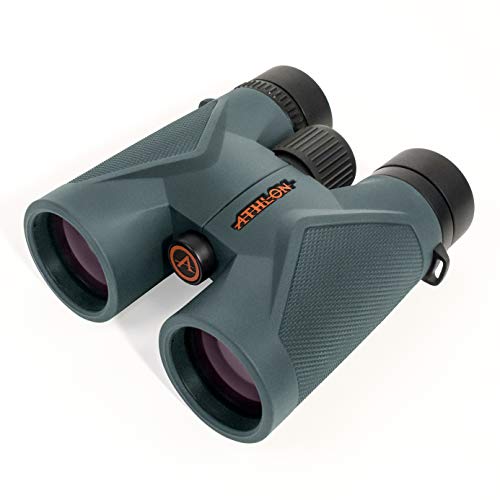
The Athlon Optics Midas UHD 8×42 is the pair you hand to a friend who doesn’t want to compromise. It features ED (extra-low dispersion) glass, which reduces color fringing around high-contrast edges like tree limbs against bright sky, plus phase-corrected BAK4 prisms for crisper detail resolution.
The 8×42 formula is gentler than 10x or 12x for long sessions. With 17.2mm of eye relief, eye-glass wearers in particular tend to find the view comfortable, and the close focus of about 6.5 feet lets you switch from distant birds to nearby butterflies without resetting.
A Strong Showing
- ED glass noticeably reduces chromatic aberration, the color fringing that appears around high-contrast edges
- Wide 8.1-degree field of view tracks moving subjects easily
- Lightweight at around 25 oz for long carrying days
- Phase-corrected prisms sharpen contrast across the image
Things To Weigh
- Lower 8x magnification reaches less far than 10x or 12x peers
- Pricing typically sits above budget-bin options
Who Will Love This
Birders, hunters, and hikers who value color accuracy and steadiness over maximum magnification.
Reach For A Different Pick When
Viewers needing more reach for distant targets should look at the Vortex Viper HD 12×50, which steps up magnification at the cost of a steadier image.
The Steiner 7×50 Marine is purpose-built for water and weather. The 7x magnification is intentionally moderate so boaters can use them on rolling decks without their hands amplifying every wave, and the 50mm objective lenses pull in enough light for low-visibility mornings.
Steiner’s Sports Auto Focus system keeps things sharp from about 20 yards out to infinity, which means less fiddling with the focus wheel when something surfaces unexpectedly. Sailors, whale-watchers, and waterfront homeowners tend to find this approach refreshingly low-effort.
The Value In It
- Bright 50mm optics handle fog, overcast, and twilight well
- Sports Auto Focus keeps the image sharp across most ranges
- Marine-grade waterproof and fog-proof sealing
- Stable 7x magnification suits rocking boats
Trade Offs
- Larger and heavier than compact 10×42 pairs
- 7x reach falls short for very distant shore details
Right Fit For
Boaters, mariners, and waterfront birders who need waterproof confidence more than maximum magnification.
Swap It Out When
Casual land birders who don’t face splash zones should pick the Vortex Copperhead HD 10×42, which is lighter and pulls in more reach.
The Pankoo 20×55 with Phone Adapter wraps the standard 20×55 long-range formula into a digiscoping package, which means attaching your smartphone to the eyepiece to capture magnified photos and video through the optics. The included adapter holds most modern phones in line with the eyepiece for steady framing.
It’s an accessible entry into long-distance photography without buying a dedicated scope. For concertgoers, casual wildlife shooters, and travelers wanting to share what they see, the bundle saves a separate accessory hunt.
The Case For It
- Long 20x reach for distant subjects
- Phone adapter included for quick photo and video capture
- FMC (fully multi-coated) lenses improve light transmission
- Wide field of view up to roughly 1200 yards
Soft Spots
- Smartphone mounting takes practice to align correctly
- Handheld 20x viewing is shaky without a tripod, which isn’t included
Best Suited To
Casual shooters and travelers who want to photograph distant scenes through their phone without a separate camera rig.
Look Elsewhere When
Pure visual viewers uninterested in phone photography should pick the Vortex Diamondback HD 10×42 for steadier handheld optics.
The Vortex Crossfire HD 10×42 is the everyday workhorse of the line. It uses select glass elements with full multi-coating for solid clarity, and Vortex pairs it with the GlassPak harness system, which is a chest rig that keeps the binos ready while distributing weight away from your neck.
Compared to its Diamondback sibling above, the Crossfire trades a touch of optical refinement for a friendlier cost. For first-time shoppers or anyone who just wants a reliable 10×42 without studying spec sheets, it lands in the sweet spot.
Noteworthy Benefits
- HD optical system with fully multi-coated lenses
- GlassPak harness included for hands-free carrying
- Lightweight feel for long outdoor days
- Backed by Vortex’s warranty handling
Factors To Consider
- Edge sharpness trails the Diamondback HD in side-by-side use
- No premium chassis detailing like the Viper HD
Right Fit For
First-time buyers and casual outdoor users who want a trusted name without stretching their budget.
Reach For A Different Pick When
Birders wanting crisper color and contrast should look at the Athlon Optics Midas UHD 8×42 instead.
The Vortex Viper HD 12×50 sits at the top of the company’s mid-tier lineup. The 12x magnification pulls in noticeably more detail than 10x, while the 50mm objective lenses keep the image bright enough for dawn hunts and overcast hikes. Roof-prism construction (where the prisms sit aligned in a straight tube) lets the chassis stay compact despite the larger optics.
The included GlassPak chest harness keeps weight distributed during long stalks. For hunters, long-range birders, and shooters checking distant targets, the Viper HD balances reach and portability unusually well.
Everyday Advantages
- HD optical system with strong color fidelity
- Lightweight for a full-size 12×50 roof-prism design
- GlassPak harness included
- Tripod-compatible for long observation sessions
Smaller Caveats
- Higher magnification amplifies handshake, so steady handling or a tripod helps
- Pricing tends to sit above the Crossfire HD
Built With In Mind
Hunters, long-range birders, and target shooters who want premium clarity without jumping to flagship pricing.
Consider Something Else When
Viewers who prefer steady handheld viewing should consider the Athlon Optics Midas UHD 8×42, which trades magnification for a steadier image.
The Pankoo 20×55 (Convenient) rounds out the list as a budget-friendly high-power pick. With BAK4 roof prisms and fully multi-coated lenses, the optical formula is more ambitious than its pricing suggests, and the 20×55 setup delivers strong reach for distant landmarks, stadium action, and casual skywatching.
For shoppers who want magnification without premium-brand cost, this pair covers the basics well. It’s a sensible entry point if you’re still deciding how often you’ll actually use high-power binoculars.
Where It Helps
- Strong 20x magnification at accessible pricing
- BAK4 prisms with FMC coatings for clean light transmission
- Waterproof housing handles outdoor weather
- Comfortable grip for handheld sessions
Possible Compromises
- Color accuracy is good but not at the ED-glass tier of premium peers
- Handheld 20x viewing is tiring without a tripod, which adds to the total spend
- Build quality feels solid but lighter than premium brands
Who Should Grab It
Casual users curious about high-power viewing who want to test 20x without committing to premium pricing.
Consider Something Else When
Birders wanting a steadier all-around pair should step up to the Vortex Crossfire HD 10×42, which is easier to handhold for long sessions.
Matching Magnification To The Way You Actually Use Them
Choosing binoculars under 500 comes down to honest matching between the optic and the way you spend time outside. Magnification and objective lens diameter matter, but they only tell part of the story. The full picture includes glass quality, ergonomics, and how a pair feels after a two-hour walk.
How Magnification And Objective Size Work Together
The two numbers on every binocular tell a story. A 10×42 means 10x magnification with 42mm front lenses. The first number describes how much closer things appear, while the second describes how much light the binocular can gather. Higher magnification shows more detail but amplifies handshake, and larger objectives brighten the image but add weight.
Why Glass Quality Changes The Whole Experience
ED (extra-low dispersion) glass and fully multi-coated lenses reduce color fringing and internal reflections. If you’ve ever noticed purple halos around tree branches or dim, hazy views, you’ve seen what those upgrades fix. BAK4 prisms, a premium optical glass used in the internal prism system, also tend to deliver sharper edge-to-edge clarity than cheaper alternatives.
Fitting The Pair To The Activity
Hikers and birders usually do best with 8×42 or 10×42, because the steadier image beats maximum reach. Hunters and stadium watchers often prefer 10×42 or 12×50 for the extra pull. Boaters gravitate to 7×50 for stable views on rolling decks, and high-power users (20x and up) should plan on tripod use for the best experience.
Comfort, Coatings, And Build
Eye relief (the distance your eye can sit from the eyepiece and still see the full image) matters most for eyeglass wearers, and rubber-armored bodies protect against real-world drops. Waterproof and fog-proof ratings are worth the small added cost for anyone who uses them outdoors in changing weather.
Reading The Field Before You Commit
Pitfalls Shoppers Hit
The most common mistake is chasing magnification without considering stability. A 20x binocular sounds impressive until you realize that every hand tremor is also magnified 20 times. Another trap is buying on appearance alone: a glossy body with vague “high-power” claims usually hides lower-grade glass. Look for stated optical specifications and named technologies rather than marketing adjectives.
When Paying More Pays Off
Spending more typically buys better ED glass, phase-corrected prisms, and tougher waterproofing. For daily users, those upgrades add up fast across years of ownership. If you only use binoculars occasionally, a mid-tier 10×42 covers nearly every outing well. For frequent hunters, birders, and travelers, premium options like the Viper HD or Midas UHD usually justify the added cost.
Frequently Asked Questions
What magnification should I look for in binoculars under 500?
Most shoppers do well with 8×42 or 10×42 because they balance reach and steadiness for handheld use. Higher magnifications like 12×50 or 20×55 pull in more detail but work best with a tripod.
Are waterproof binoculars worth it?
For anyone using binoculars outdoors in changing weather, waterproof and fog-proof sealing is worth the modest added cost. It protects internal optics from moisture damage and prevents internal fogging during temperature swings.
What is ED glass and why does it matter?
ED (extra-low dispersion) glass reduces color fringing around high-contrast edges. If you’ve ever seen a faint purple or green halo around tree branches or signs, that is chromatic aberration, and ED glass minimizes it for cleaner, more true-to-life views.
Can I use high-power binoculars without a tripod?
You can, but at 12x and above, hand-shake becomes very visible. For occasional short viewing, it’s tolerable. For longer sessions, a tripod or monopod makes a major difference in image stability.
How do I clean binocular lenses safely?
Use a soft brush or air blower first to remove dust, then a microfiber cloth with lens cleaning fluid for smudges. Avoid household cleaners or paper products, which can scratch the coatings.
The Takeaway
Ten pairs, ten different use cases, and probably one that matches your actual habits. Start with the activity you do most often, pick the magnification that fits it, and let the rest fall into place. The right pair should feel like an extension of how you already explore.