Choosing a telescope can feel like learning a new language, especially when you’re standing outside with a sky full of stars and a box full of unfamiliar parts. Whether you’re hunting for your first crisp view of Saturn’s rings or upgrading from a travel scope to something that can pull in deep-sky nebulae, this lineup covers the path from casual observer to serious astrophotographer. Each pick below addresses a different kind of stargazer, from families sharing the Moon with kids to hobbyists chasing distant galaxies on clear nights.
A Side-By-Side Look

Askar 71F Flat-Field Telescope 71mm ED Glass Refractor OTA
SVBONY SV223 1.25″ Telescope Diagonal Dielectric Mirror

HUGERSTAR 90mm Aperture 600mm Refractor Telescope

Celestron PowerSeeker Telescope Accessory Kit
Celestron StarSense Explorer LT 114AZ Newtonian Telescope

HUGERSTAR 80mm Aperture 500mm Refractor Telescope

HUGERSTAR 90mm 600mm Refractor Telescope

HUGERSTAR 90mm Aperture 800mm Refractor Telescope

SVBONY SV503 102mm F7 ED Refractor Telescope
A Deeper Look At The Lineup
The Askar 71F sits firmly in dedicated astrophotography territory, a quadruplet refractor (a four-lens optical design that corrects optical errors across the frame) aimed at shooters who already own a mount and camera. Its 71mm aperture and f/6.9 focal ratio strike a balance between light grasp and portability, which matters when you’re hauling gear to a dark-sky site. The integrated 230mm Vixen-style dovetail bar (a standardized mounting rail that fits most telescope mounts) slides directly onto common equatorial mounts without adapters.
Compared to the travel-friendly refractors later in this list, the 71F is heavier and demands a sturdier tripod. For imaging nebulae and wide-field star clusters, the flat-field design means stars stay pinpoint from corner to corner, which is the difference between a frame worth keeping and one that gets deleted. Visual observers can use it too, though its strengths really shine when paired with a dedicated astronomy camera.
The Upside
- ED (extra-low dispersion) glass minimizes the purple fringing you see around bright stars and the Moon’s edge
- Quadruplet air-spaced APO (apochromatic) optics deliver a flat image plane, so corner stars stay sharp in wide-field shots
- Total weight around 3kg with the dovetail and ring, manageable for a sturdy star tracker mount
- Standard Vixen dovetail means compatibility with the mounts most amateur astrophotographers already own
- CNC-machined (computer numerically controlled, a precision manufacturing process) tube body suggests long-term durability for repeated setup and teardown
Things To Consider
- No mount or finder included, so this is an OTA (optical tube assembly, the telescope body without mount or tripod) for someone who already has a tracking setup
- Owners commonly note the focuser needs a patient hand to reach precise focus for high-resolution imaging
Quick Facts
Who It Suits Best
Intermediate astrophotographers with a tracking mount who want sharp, flat-field images of nebulae and star clusters without hauling a heavy refractor.
Where Another Pick Suits Better
Casual beginners should look at the Celestron StarSense Explorer LT 114AZ Newtonian, which includes a mount and smartphone guidance to get you observing faster.
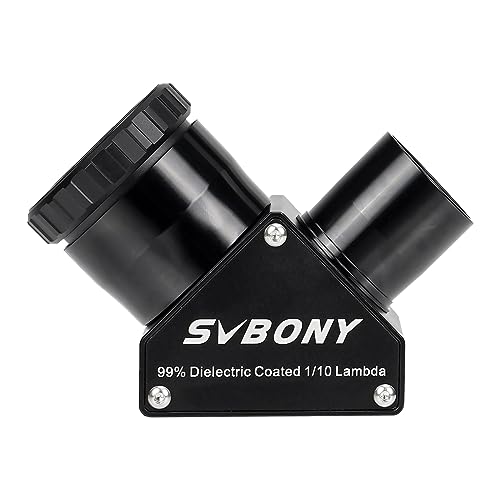
The SV223 is a star diagonal (a small mirror or prism that bends the light path 90 degrees so you can look down into the eyepiece instead of craning your neck upward), not a full telescope, which makes it the most niche pick in this roundup. It slots between the focuser and the eyepiece on any 1.25″ refractor and angles your view for far more comfortable zenith-pointing sessions. The dielectric coating (a multi-layer mirror coating that reflects more light than standard aluminum) helps preserve brightness during that 90-degree redirect.
This is the kind of accessory that transforms a usable refractor into a comfortable one, especially for anyone who has spent an evening with a stiff neck. Where the HUGERSTAR refractors in this list bundle everything you need to start, the SV223 assumes you already have a scope and want to refine the experience.
What Pays Off
- Clicklock mechanism clamps eyepieces securely without the wiggle of a standard thumbscrew
- Dielectric mirror coatings reflect around 99% of light, brighter than many basic diagonals
- Standard 1.25″ barrel fits the eyepieces and Barlow lenses (a magnification-multiplying accessory that triples or doubles eyepiece power) included with most beginner scopes
- Angled viewing saves your neck during long sessions on overhead targets like the Moon and planets
Worth Noting
- This is a 1.25″ accessory, so it won’t accept larger 2″ eyepieces used on some bigger refractors
- A star diagonal adds one more reflective surface, which some owners feel needs occasional cleaning to stay dust-free
Built With In Mind
Refractor owners who already have a telescope and want a more comfortable viewing angle during long observation sessions.
Consider Something Else When
You’re just starting out, in which case the HUGERSTAR 90mm Aperture 600mm Refractor Telescope ships with everything you need in one box.
This HUGERSTAR refractor arrives as a complete observing kit, tripod, phone adapter, Moon filter, carry bag, and a printed Moon phase guide included. The 90mm aperture (the diameter of the main light-gathering lens or mirror) pulls in enough light for crisp lunar craters and a respectable view of Saturn’s rings, while the 600mm focal length (the distance light travels inside the telescope, which determines magnification potential) keeps magnification sensible for beginners. Fully multi-coated optics (lenses treated with multiple anti-reflective coatings) help boost contrast so the Moon doesn’t look washed out.
Compared to the bare-bones travel scope later in this list, you trade a little portability for a more generous aperture and a kit that includes thoughtful extras like the Moon filter, which dims glare during the bright half of the lunar cycle. For families sharing first light together, this bundle covers the awkward gear gap that often stops new observers before they ever find Saturn.
Features That Help
- Includes 25mm and 10mm eyepieces plus a 3x Barlow lens for a wide magnification range from a single kit
- Carry bag and phone adapter let you start sharing astrophotos on the first clear night
- Moon filter reduces glare during bright phases, so kids can actually look at the Moon comfortably
- Tripod and mount included, no extra purchases required to get outside
- Printed Moon phase guide helps beginners pick the right targets for the right night
Honest Caveats
- The included tripod is light, so owners commonly upgrade it later for steadier views at higher magnifications
- A 90mm refractor shows chromatic fringing (color halos around bright objects) on the brightest planets, a normal trade-off at this aperture
Best Suited To
Families and first-time observers who want one box that includes every accessory needed to start sharing the night sky.
Look Elsewhere When
You want smartphone-guided target finding, in which case the Celestron StarSense Explorer LT 114AZ Newtonian Telescope makes finding objects dramatically easier.
This accessory kit is a practical upgrade rather than a telescope on its own, two 1.25″ Kellner eyepieces (a basic three-element eyepiece design that offers decent views at a modest price), three colored filters, a Moon filter, a cleaning cloth, and a foam-lined carry case. Drop it next to any 1.25″ eyepiece-compatible telescope and you instantly broaden what that scope can do. For anyone who started with a basic refractor and wants more viewing options without buying a second scope, this is the most logical next purchase.
It pairs naturally with the HUGERSTAR refractors in this list, since those scopes ship with one or two eyepieces and nothing else. Compared to building your own filter and eyepiece collection piece by piece, the kit offers a tidy, organized starting point.
Useful Highlights
- 15mm and 9mm Kellner eyepieces cover medium and high power viewing in one purchase
- Moon filter dims glare during bright lunar phases, a small accessory that makes a huge comfort difference
- Three colored filters help pull planetary detail out of Jupiter’s bands and Saturn’s zones
- Foam-lined case keeps everything organized and protected between sessions
- Standard 1.25″ barrels fit most beginner and intermediate telescopes on the market
Points To Note
- Kellner eyepieces are entry-level optics, so purists may want to upgrade them later for sharper edge performance
- Not a standalone telescope, this kit assumes you already have a scope to attach it to
Whose Shelf It Belongs On
Telescope owners looking to expand their eyepiece collection and add filters without sourcing each piece individually.
A Better Fit Elsewhere
Anyone who doesn’t yet own a scope should start with the HUGERSTAR 90mm Aperture 600mm Refractor Telescope, which ships with its own eyepieces.
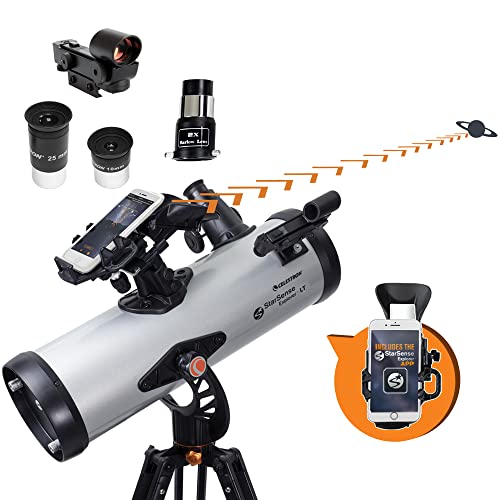
The StarSense Explorer LT 114AZ tackles the single biggest obstacle for new observers: figuring out where to point the thing. A Newtonian reflector (a telescope design using mirrors instead of lenses, named after Isaac Newton), this 114mm aperture scope pulls in noticeably more light than the 80mm or 90mm refractors also on this list, and the dock-your-phone-in-the-mount system uses your camera to identify stars overhead. On-screen arrows guide you to planets, galaxies, and nebulae without memorizing star charts.
The trade-off is bulk. A Newtonian on an alt-azimuth mount (a simple up-down-left-right mount, the easiest type for beginners) like this one is heavier than the travel refractors, and you’ll need a clear view of the sky for the phone to lock onto reference stars. For someone who has struggled to find anything beyond the Moon, that guidance app is the difference between a hobby that sticks and one that gets abandoned in the garage.
Where It Excels
- Smartphone-guided targeting helps beginners find deep-sky objects on the first clear night out
- 114mm Newtonian aperture gathers more light than comparable 80mm or 90mm refractors
- App generates a guided tour of tonight’s best targets, so you don’t need to plan ahead
- Manual alt-azimuth mount keeps the setup simple with no polar alignment (a precise balancing procedure needed for tracking the sky’s rotation) required
Trade Offs
- Heavier than the travel-ready refractors elsewhere in this list, less suited for hiking to dark sites
- Newtonian optics need occasional collimation (realignment of the internal mirrors) to keep images sharp, a maintenance step beginners may find intimidating
Who Should Grab It
First-time telescope owners who want the easiest possible path to finding planets, galaxies, and nebulae without learning star charts.
Swap It Out When
Portability matters most, in which case the HUGERSTAR 80mm Aperture 500mm Refractor Telescope is lighter and easier to throw in a backpack.
If the heavier Newtonian feels like too much gear, this 80mm HUGERSTAR refractor trims the weight without abandoning core optics. The 500mm focal length keeps magnification modest, which actually helps when hand-tracking objects across the sky, and the included backpack makes it the most genuinely portable scope on this list. Fully multi-coated lenses boost contrast on the Moon and bright planets, the targets that suit a shorter focal length best.
The kit adds small but thoughtful extras: a phone adapter for casual astrophotos, plus stickers that tend to appeal to younger observers. Compared to the larger HUGERSTAR refractors later in the lineup, you sacrifice light-gathering power for a grab-and-go setup that fits in a closet between camping trips.
Useful Touches
- Lightest full-kit option in this list, genuinely portable for hikes and weekend trips
- Included backpack keeps the scope, tripod, and accessories organized in one place
- Phone adapter and stickers make it approachable for younger or first-time users
- Fully multi-coated glass helps images stay bright in low-light backyard conditions
A Few Limitations
- 80mm aperture gathers less light than the 90mm scopes elsewhere here, limiting faint deep-sky views
- Short focal length means less magnification reach, so deep-sky nebulae appear small in the eyepiece
Perfect Match For
Casual observers, campers, and families who want a grab-and-go scope that travels well and sets up in minutes.
Skip It When
Deep-sky imaging is the goal, in which case the Askar 71F Flat-Field Telescope is purpose-built for that kind of work.
This 90mm HUGERSTAR hits the same core numbers as the bundled kit earlier in this list, but in a stripped-down package focused on the optics themselves. Same 90mm aperture for solid light gathering, same 600mm focal length for friendly magnification, fully multi-coated glass to keep contrast strong. Without the bundled bag, phone adapter, and Moon filter, you get the scope itself at a more accessible entry tier.
For someone who already owns accessories, or doesn’t need the Moon phase guide, this trims the extras and keeps the heart of the kit intact. Compared to the 80mm travel option, you get noticeably brighter views for a modest increase in tube size.
A Strong Showing
- 90mm aperture outperforms 80mm scopes for faint targets like star clusters and nebulae
- Fully multi-coated optics improve contrast, especially on the Moon’s terminator (the line dividing the lit and dark sides of the Moon)
- 600mm focal length keeps magnification manageable for beginners tracking objects by hand
Room For Improvement
- No included carry bag, phone adapter, or Moon filter compared to the broader HUGERSTAR bundle
- The stock tripod and mount may feel underbuilt for the 90mm tube during higher magnification viewing
The Right Fit
Budget-focused beginners who want solid 90mm aperture performance and don’t need the bundled accessories.
Another Choice May Suit
If you want everything in one box, the HUGERSTAR 90mm Aperture 600mm Refractor Telescope kit adds the bag, phone adapter, and Moon filter without much fuss.
Stretched to 800mm, this HUGERSTAR refractor trades wide-field comfort for stronger magnification on small targets. With 10mm and 25mm eyepieces plus a 3x Barlow, the kit reaches useful magnifications for splitting close double stars and pulling Jupiter’s cloud bands into sharper focus. The f/8.89 focal ratio (the focal length divided by the aperture, where higher numbers mean less magnification but more contrast per eyepiece) is on the slower side, which tends to deliver cleaner planetary detail than faster scopes.
Compared to the shorter 500mm and 600mm HUGERSTAR options, you need a steadier tripod to take advantage of the higher magnification. For backyard observers who prioritize the Moon and planets over sprawling nebulae, the longer focal length is a meaningful upgrade.
Noteworthy Benefits
- 800mm focal length pushes magnification higher for closer looks at lunar craters and planetary disks
- Fully multi-coated lenses boost light transmission for cleaner contrast on subtle details
- 3x Barlow triples the magnification range of the included eyepieces for flexible observing
Points To Keep In Mind
- Higher magnification amplifies tripod shake, so a sturdier mount improves the experience noticeably
- Longer focal length narrows the field of view, making wide star clusters harder to frame
Who Will Love This
Lunar and planetary observers who want strong magnification from a refractor and don’t mind a narrower field of view.
Reach For A Different Pick When
Astrophotography is the goal, in which case the Askar 71F Flat-Field Telescope delivers a flat imaging plane for wide-field camera work.
The SV503 jumps a tier over the HUGERSTAR refractors by adding ED (extra-low dispersion) glass, the same kind of specialized element used in the Askar 71F, to a 102mm aperture. The 714mm focal length and f/7 ratio land in a versatile middle ground: enough aperture for dimmer deep-sky targets, enough focal length to push useful magnification on planets. The S-FPL51 ED element specifically reduces the color fringing (a faint colored halo around bright objects caused by lenses focusing different wavelengths at different points) that plain achromatic refractors show around the Moon and bright stars.
Compared to the 90mm HUGERSTAR scopes earlier, the SV503 is a noticeable optical upgrade for visual observers who care about clean, contrast-rich views. It’s also a viable imaging platform when paired with a sturdy mount, making it a flexible pick for someone who wants one scope that handles both observing and casual photography.
Benefits That Matter
- 102mm aperture pulls in noticeably more light than 80mm or 90mm refractors
- S-FPL51 ED glass reduces the violet halos you see around bright objects in basic achromats
- f/7 focal ratio balances wide-field deep-sky viewing with planetary magnification
- FMC (fully multi-coated) optics across all lens surfaces improve overall brightness and contrast
- Works for both visual astronomy and casual astrophotography with the right mount
Where It May Fall Short
- Heavier than 80mm travel scopes, so it’s less ideal for backpacking
- Stock mount and tripod may not be included, check the listing for what’s bundled
Quick Facts
Made For
Serious visual observers and budding astrophotographers who want ED-glass color correction in a versatile 102mm refractor.
Not Your Match When
You want smartphone guidance built in, in which case the Celestron StarSense Explorer LT 114AZ Newtonian Telescope helps you find targets from the first night out.
What Matters Most Before Choosing Astronomy Telescopes
Aperture and Focal Length
Aperture, the diameter of the main lens or mirror, drives how much light your scope collects. A larger aperture reveals fainter objects like distant nebulae and dim galaxies, which is why 102mm and 114mm scopes pull ahead on deep-sky targets. Focal length determines magnification reach: shorter focal lengths give wider fields for sweeping star clusters, while longer focal lengths push higher magnification for the Moon and planets.
The honest trade-off is weight and size. A 102mm refractor in this list gathers more light than an 80mm, but it also weighs more in the backpack. For backyard observers, aperture wins. For frequent travelers, a smaller scope you actually carry beats a larger one you leave at home.
Mount Stability and Tracking
A telescope is only as useful as the mount underneath it. Alt-azimuth mounts, the simple up-down-left-right style, are easy to set up and perfect for casual viewing, but objects drift out of view at high magnification. Equatorial mounts (tilts-aligned mounts that rotate to match the sky’s motion) track the sky’s rotation when properly aligned, which matters for anything beyond casual Moon gazing.
Optical Quality and Coatings
Fully multi-coated lenses, abbreviated FMC, transmit more light than single-coated or uncoated optics. ED or extra-low dispersion glass reduces the colored halos you see around bright objects in basic achromatic refractors. ED glass shows up in the Askar 71F and SVBONY SV503 here, and it’s the kind of upgrade that becomes obvious once you compare views side by side.
Key Considerations Across These Picks
Where Shoppers Go Wrong
First-time buyers often grab the highest magnification they can find, but magnification without aperture produces blurry, dim views. A 90mm scope at 100x outperforms an undersized 60mm scope at 300x every time. Skip the temptation to chase magnification numbers on the box.
Another common slip: ignoring the mount. An expensive optical tube on a wobbly tripod delivers worse views than a modest scope on a steady mount. Budget for stability.
What Separates Premium From Basic
The jump from a beginner achromatic refractor to an ED-glass scope is most visible around bright targets. ED glass in the SVBONY SV503 and Askar 71F reduces the purple fringing you see around the Moon and Jupiter. Higher-tier scopes also tend to include better focusers, more accurate mounts, and CNC-machined tube bodies that hold alignment longer.
Whether that upgrade is worth it depends on how often you’ll observe. Casual weekly backyard sessions don’t demand ED glass; regular deep-sky or astrophotography work does.
Frequently Asked Questions
What aperture telescope do beginners actually need?
For most beginners, 80mm to 90mm refractors or 114mm Newtonians hit the sweet spot. You get bright, satisfying views of the Moon, planets, and brighter deep-sky objects without the weight and cost of larger scopes. Aperture below 70mm tends to disappoint on anything beyond the Moon and the very brightest planets.
Can I use these telescopes for astrophotography?
Some, but not all. The Askar 71F and SVBONY SV503 are designed with imaging in mind, with flat-field optics and ED glass. Most beginner refractors in this list will capture casual phone-adapted shots of the Moon and planets but aren’t ideal for long-exposure deep-sky imaging without a sturdy equatorial mount.
What’s the difference between a refractor and a Newtonian reflector?
A refractor uses lenses to gather and focus light, which makes it sealed, low-maintenance, and great for the Moon and planets. A Newtonian reflector uses mirrors, which gives you more aperture for the money and pulls in fainter deep-sky targets, but the mirrors need occasional realignment called collimation. The Celestron StarSense Explorer in this list is a Newtonian; the HUGERSTAR and Askar scopes are refractors.
Do I need a Moon filter?
For a 90mm or larger refractor, a Moon filter helps during bright phases by reducing glare so you can see more surface detail without squinting. The HUGERSTAR 90mm bundle includes one. Smaller scopes under 80mm don’t strictly need one, but it still improves comfort.
What’s a Barlow lens used for?
A Barlow lens slips between the eyepiece and the focuser to multiply magnification, typically 2x or 3x. It effectively doubles or triples the magnification range of your existing eyepieces, which is why beginner kits like the HUGERSTAR 90mm bundle include one.
Bottom Line
The best telescope is the one you’ll actually set up on a Tuesday night after dinner. Beginners looking for low-friction entry should start with the Celestron StarSense Explorer LT 114AZ for guided target finding, while families sharing first light will appreciate the all-in-one HUGERSTAR 90mm kit. Travelers and casual observers fit best with the HUGERSTAR 80mm refractor in its backpack, and visual purists chasing cleaner color correction will find the SVBONY SV503 a worthwhile step up. Astrophotographers ready to commit to a dedicated rig should look straight at the Askar 71F.