Picking up your first astrophotography setup feels exciting and confusing in equal measure. You want sharp views of the Moon, a real chance at Saturn’s rings, and gear that won’t collect dust after two weekends. This roundup focuses on beginner-friendly telescopes and accessories that make those first clear nights feel rewarding rather than frustrating, so you spend your time looking up instead of fiddling with focusers.
A Quick View Of The Lineup
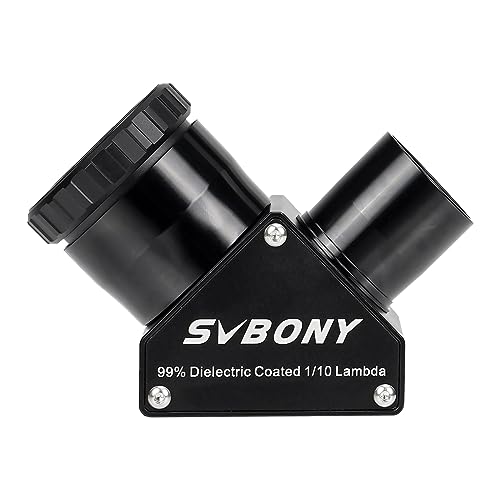
SVBONY SV223 1.25″ Telescope Diagonal

Celestron Eyepiece, Barlow & Filter Kit 1.25″

Hawkko Telescope Kit for Kids 80mm 500mm

Celestron SkyMaster 15×70 Astronomy Binoculars

MEEZAA 90mm 800mm Refractor Telescope
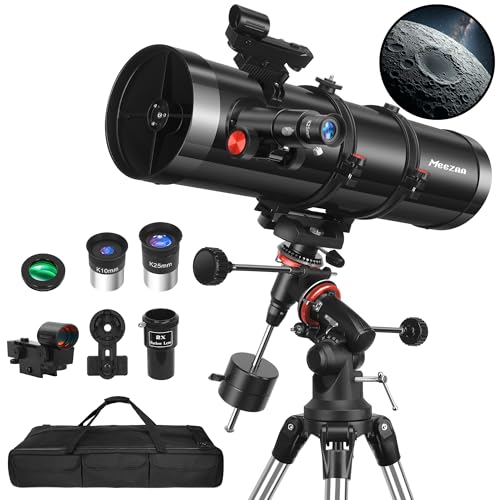
MEEZAA 150EQ Newtonian Reflector Telescope

Celticbird 80mm 900mm Travel Refractor Telescope

Celestron Travel Scope 70mm with Backpack

SVBONY SV503 102mm F7 ED Telescope

MEEZAA 90mm 550mm Portable Refractor Telescope
Inside Each Recommended Option
A telescope diagonal flips your view so you’re not craning your neck into an uncomfortable position, which matters more than you’d think during a long night at the eyepiece. The SVBONY SV223 sits in line with nearly every beginner refractor on this list, accepting standard 1.25-inch eyepieces and barlow lenses (a lens that multiplies your eyepiece’s magnification).
What sets it apart from a cheap generic diagonal is the click-lock collar: you press the eyepiece in, twist slightly, and it holds firmly without thumbscrews that scratch your gear. The dielectric mirror coating (a thin layered film that reflects more than 99% of incoming light) keeps image brightness closer to what you’d get looking directly through the scope. It’s the kind of upgrade that makes an existing telescope feel a step more refined.
The Good Stuff
- Click-lock mechanism secures eyepieces quickly and avoids scratching barrels.
- Standard 1.25-inch barrel fits virtually every beginner refractor and Newtonian on this list.
- Dielectric mirror coating preserves brightness better than basic aluminum diagonals.
- 90-degree angle makes extended lunar and planetary sessions far more comfortable.
Things To Consider
- A diagonal alone won’t improve a scope’s optics; it just makes existing views easier to enjoy.
- You may find the click-lock requires two hands when swapping eyepieces in cold weather.
Built With In Mind
Anyone with a starter refractor who wants better viewing ergonomics without replacing the whole scope.
Reach For A Different Pick When
The MEEZAA 90mm 800mm Refractor Telescope suits shoppers who need a complete first setup rather than an accessory.
Most entry telescopes ship with one or two underwhelming eyepieces, which is where this Celestron kit earns its keep. It bundles five Plössl eyepieces (a four-element design known for sharp, flat fields of view) plus a 2x Barlow lens, all in a foam-lined case that grows with you as your skills develop.
The range of focal lengths lets you jump between sweeping wide-field views of the Pleiades and tighter looks at lunar craters or Saturn’s rings. Moon and color filters round out the box, useful for cutting glare and pulling subtle detail out of planetary atmospheres. Compared to the SVBONY SV223 diagonal above, this kit multiplies what any single telescope can show you.
The Helpful Details
- Five Plössl eyepieces cover low, medium, and high magnification needs in one purchase.
- 2x Barlow lens doubles every eyepiece’s reach without buying more glass.
- Foam-lined carrying case protects the kit and has space for future additions.
- Moon and color filters help beginners see planetary detail they would otherwise miss.
Points To Keep In Mind
- More eyepieces than a casual weekend observer may actually use in their first year.
- Standard 1.25-inch barrels won’t fit older 0.965-inch scopes, so check compatibility first.
Key Specs
Whose Shelf It Belongs On
Beginners who already own a scope and want to expand what it can show without buying a second telescope.
A Better Fit Elsewhere
The Celestron Travel Scope 70mm with Backpack is a better match for someone who doesn’t yet own any optical gear at all.
Few starter telescopes treat kids like real observers, but the Hawkko kit leans into that mindset. It includes a real 80mm refractor (a lens-based scope that bends light through glass) rather than a toy, plus themed stickers and a moon learning booklet that turns viewing sessions into small lessons.
The 500mm focal length keeps magnification moderate, which is a thoughtful call for ages 8 to 12, where high power usually means a shaky, disappointing view. Setup is straightforward enough that a curious child can do it with a parent nearby. Where the Celestron SkyMaster binoculars aim at casual adults, this kit speaks directly to younger learners.
Standout Benefits
- 80mm aperture gathers enough light for satisfying lunar and bright-planet views.
- Included moon booklet and stickers make first sessions feel like an event, not a chore.
- Modest 500mm focal length keeps views stable and forgiving for small hands.
- Real refractor optics rather than plastic toy lenses that frustrate quickly.
Trade Offs
- Not the right tool for faint deep-sky targets like distant galaxies.
- Kids outgrow the educational booklet within a season, so it has a shelf life.
Who Should Grab It
Parents looking for a first telescope for a curious child who already shows interest in space.
Swap It Out When
The MEEZAA 90mm 550mm Portable Refractor Telescope is a more sensible choice for a teenager or adult beginner.
Before committing to a full telescope, many beginners learn the night sky faster with binoculars. The SkyMaster 15×70 pairs big 70mm objective lenses with 15x magnification, which is enough to resolve Andromeda’s bright core and sweep through the Milky Way without the alignment headaches a tripod-mounted Newtonian demands.
They’re also versatile. Daytime birding, distant landscapes, and casual stargazing all work well with the same pair. The build is bulkier than compact binoculars, so a tripod is a near-must for steady views at this size. Where the Hawkko kit focuses on kids, the SkyMaster treats adults who want a no-fuss, two-eyed introduction to the sky.
Well-Handled Touches
- 15×70 configuration delivers wide-field views ideal for learning constellations.
- Built-in tripod adapter threads into standard photo tripods.
- Useful beyond astronomy for daytime wildlife and scenery observation.
- Two-eyed viewing feels more natural and less fatiguing than squinting through an eyepiece.
Honest Caveats
- Heavier than compact binoculars, so handheld use causes arm fatigue within minutes.
- Not designed for lunar crater detail or planetary close-ups where high power matters.
Quick Facts
Right Fit For
Adults who want to learn the sky gradually before investing in a full telescope setup.
Look Elsewhere When
The SVBONY SV503 102mm F7 ED Telescope fits someone ready for serious imaging from night one.
The 90mm aperture on this MEEZAA refractor pulls in noticeably more light than the 80mm scopes earlier on this list, and the 800mm focal length delivers enough magnification to tease Saturn’s rings apart on a steady night. Compared with the Hawkko kid-focused kit, this is a clear step up for adult beginners.
Fully multi-coated optics (multiple anti-reflective layers on every glass surface) help keep contrast high when you’re hunting subtle lunar detail. Setup is mostly tool-free, which means your first session stays focused on the sky rather than on assembly diagrams. It’s a practical midpoint between grab-and-go travel scopes and the larger 150mm reflector covered below.
The Practical Payoff
- 90mm aperture gathers enough light for satisfying planetary and lunar viewing.
- 800mm focal length supports useful magnification without aggressive eyepieces.
- Multi-coated optics preserve contrast for crisp terminator views on the Moon.
- Quick setup keeps beginners engaged instead of fighting hardware.
Some Limits To Know
- Refractor tube is longer than the 550mm MEEZAA, so storage takes more thought.
- Some color fringing on very bright targets is normal for achromatic 90mm refractors.
Spec Overview
Made For
Adult beginners who want sharp planetary views from a manageable backyard refractor.
Consider Something Else When
The MEEZAA 150EQ Newtonian Reflector Telescope suits observers chasing faint deep-sky targets more than planets.
This is the leap-up telescope in the lineup. A 150mm Newtonian reflector (a mirror-based scope that gathers light with a curved primary mirror) gathers more than twice the light of the 90mm refractors above, which opens up dimmer nebulae, star clusters, and galaxies from reasonably dark skies.
The equatorial mount (a mount aligned to Earth’s rotation axis so you track stars with one smooth motion) takes longer to learn than the alt-azimuth mounts on smaller MEEZAA refractors, but it makes long-exposure astrophotography far more practical. Two eyepieces, a 2x Barlow, phone adapter, moon filter, and a carry bag round out a kit that’s unusually complete at this level.
Practical Advantages
- 150mm aperture pulls in faint deep-sky targets the smaller refractors can’t reach.
- Equatorial mount simplifies tracking for short-exposure smartphone imaging.
- Bundled phone adapter and moon filter mean you can start photographing right away.
- Carry bag protects the optical tube during trips to darker sites.
Factors To Consider
- Bigger and heavier than any refractor on this list, so it isn’t a casual grab-and-go.
- Equatorial mount has a real learning curve for first-time owners.
Best Suited To
Beginners committed to learning the night sky deeply and willing to invest setup time.
Where Another Pick Suits Better
The Celticbird 80mm 900mm Travel Refractor Telescope fits shoppers who prioritize portability over light grasp.
If your stargazing tends to happen at campsites, dark-sky cabins, or weekend trips away from city lights, the Celticbird 80mm was built with that life in mind. The 900mm focal length stretches magnification further than the shorter 500mm Hawkko kit, while the alt-azimuth mount (a simple up-down, left-right mount) keeps setup almost instant.
Two wide-angle eyepieces come in the box, which makes finding and framing targets easier than with narrow-field eyepieces on a moving target. The fully coated optics (single-layer anti-reflective coatings on all glass surfaces) boost contrast enough for crisp lunar craters and brighter planetary detail. It’s noticeably more capable than a basic 70mm travel scope, yet still backpack-friendly.
Everyday Perks
- Long 900mm focal length brings meaningful magnification without bulky hardware.
- Wide-angle eyepieces help beginners locate targets without precision tracking.
- Alt-azimuth mount sets up in seconds with no polar alignment required.
- Includes carry bag and phone mount for casual imaging on the road.
A Few Limitations
- 80mm aperture can’t match the MEEZAA 150EQ for faint deep-sky targets.
- Alt-azimuth mount makes longer-exposure astrophotography tricky.
Perfect Match For
Travelers and weekend explorers who value portability over maximum aperture.
Skip It When
The MEEZAA 150EQ Newtonian Reflector Telescope is the smarter pick if your observing happens mostly at home.
For someone who has never owned a telescope and wants the simplest possible start, the Celestron Travel Scope 70 is hard to beat. The whole kit packs into the included backpack, which removes one of the biggest excuses beginners have for not using their gear: hauling it outside.
The 70mm refractor gathers enough light for satisfying lunar views and the brightest planets, though it won’t tease out subtle detail the way the MEEZAA 90mm refractors can. Setup is genuinely tool-free, and the lightweight tripod handles casual backyard use fine. Where the SVBONY SV503 below aims at serious imagers, this scope just wants you to look up.
The Upside
- Backpack-carry design removes friction between “I want to observe” and actually observing.
- Tool-free setup gets a beginner outside in under five minutes.
- Lightweight enough for kids to manage with light adult supervision.
- Includes smartphone adapter for casual Moon and landscape photos.
Possible Compromises
- Stock tripod is wobbly at high magnification, so lunar tracking gets frustrating.
- 70mm aperture caps how much planetary detail you’ll see compared to 90mm+ scopes.
Who Will Love This
First-time telescope owners who want something lightweight, affordable, and unceremonious.
Not Your Match When
The MEEZAA 90mm 550mm Portable Refractor Telescope suits shoppers ready for a more capable backyard option.
The SV503 is the most ambitious scope on this list, and it earns that label with ED glass. ED stands for “extra-low dispersion,” a special glass formula that reduces the false color fringing cheaper achromatic refractors show around bright targets like the Moon or Venus.
The 102mm aperture combined with a 714mm focal length delivers a fast f/7 focal ratio, which is friendly to wide-field astrophotography and keeps exposure times reasonable. Compared with the MEEZAA 90mm refractors covered earlier, the SV503 is the right call for first-time imagers who care about accurate color and contrast.
Where It Delivers
- ED glass element dramatically reduces color fringing on bright targets.
- 102mm aperture gathers noticeably more light than 80mm and 90mm entry scopes.
- F/7 focal ratio supports wide-field deep-sky imaging with shorter exposures.
- Fully multi-coated optics maximize light transmission for photography.
Less Ideal Details
- Heavier and longer than smaller refractors, so it isn’t a casual travel scope.
- Best imaging results require a sturdy mount most beginners add separately.
Feature Rundown
Who It Suits Best
First-time astrophotographers who want image quality closer to enthusiast-grade without skipping to a much larger scope.
Another Choice May Suit
The MEEZAA 150EQ Newtonian Reflector Telescope makes more sense for deep-sky observers on a tighter budget.
Closing out the list is the more compact MEEZAA 90mm refractor. The shorter 550mm focal length gives you wider fields of view than the 800mm model earlier, which is exactly what beginners usually want when they’re still learning to find targets.
Fully multi-coated glass, a moon filter, phone adapter, and carry bag all come in the box. It’s a thoughtful package that mirrors the Hawkko kid kit in completeness but steps up in capability. Where the SVBONY SV503 pushes into enthusiast territory, this scope stays comfortably in the everyday-use zone.
Bright Spots
- Wide-field-friendly focal length makes target acquisition much easier for beginners.
- Fully multi-coated optics deliver bright, contrasty views despite the modest aperture.
- Bundled phone adapter and moon filter mean you can photograph on night one.
- Carry bag supports trips to darker sites without extra luggage.
Practical Considerations
- Lower magnification ceiling means subtle planetary detail is harder to pull out.
- Included tripod is serviceable but limits long-exposure astrophotography.
The Right Fit
Casual backyard observers who want easy framing, low setup hassle, and a friendly first telescope.
Where A Sibling Pick Shines
The MEEZAA 90mm 800mm Refractor Telescope suits shoppers who want more planetary magnification without changing brands.
What Matters Most Before Choosing Beginner Astrophotography Telescopes
Aperture is the single biggest spec to weigh. Aperture means the diameter of the main lens or mirror, and a larger aperture gathers more light, which translates directly into how much detail you’ll see. A 70mm scope shows craters and Saturn’s rings nicely; a 90mm scope reveals lunar rilles and brighter deep-sky objects; a 150mm reflector opens up faint nebulae. For first telescopes, anything from 70mm to 102mm usually hits a sweet spot of capability and portability.
Focal length determines your top useful magnification and field of view. Longer focal lengths favor high-power planetary and lunar detail, while shorter ones favor wide-field sweeping of star clusters and the Milky Way. If you don’t yet know which style you’ll enjoy more, a shorter focal length is the more forgiving starting point.
Mount type quietly shapes how often you’ll actually use the scope. Alt-azimuth mounts (the simple up-down, left-right style) are intuitive and quick to set up, perfect for grab-and-go sessions. Equatorial mounts, which align to Earth’s rotational axis, take longer to learn but make tracking and astrophotography much smoother.
Finally, think about where you’ll observe. Light-polluted backyards favor lunar and planetary viewing with refractors. Darker sites reward larger reflectors with deep-sky targets. Matching the scope to your typical observing conditions matters more than chasing the biggest aperture on paper.
Key Considerations Across These Picks
Traps First Timers Fall Into
The most common beginner mistake is chasing magnification. A telescope that advertises 500x power on a small aperture delivers a dim, blurry view that’s more frustrating than revealing. For most beginners, useful magnification tops out around 50x per inch of aperture, so a 90mm scope reaches a meaningful ceiling around 180x in good conditions.
Another pitfall is buying a heavy, complicated setup before learning the sky. Many new owners never unpack their telescope after the first struggle. Starting with a smaller, simpler scope like the Celestron Travel Scope 70 or the MEEZAA 90mm 550mm keeps momentum going while you learn constellations and find your observing style.
When Paying More Pays Off
Stepping up to the SVBONY SV503 102mm ED or the MEEZAA 150EQ Newtonian Reflector usually pays off when you already know which targets you want to chase. ED glass cuts false color around bright objects, which matters for any kind of imaging. A larger aperture reveals fainter objects that smaller scopes simply can’t show, and that difference becomes obvious once you’ve spent a few seasons observing.
The upgrade is less compelling in your first season, when the sky itself is still the main attraction. Budget for the gear that matches your current curiosity, and let the upgrade come when your interests sharpen.
Frequently Asked Questions
What aperture is best for a first telescope?
A 70mm to 90mm refractor is the friendliest starting point, balancing portability, ease of use, and meaningful lunar and planetary views. Move to 102mm or 150mm once you’ve spent time learning the sky.
Do I need an equatorial mount to start?
No. Alt-azimuth mounts are simpler and work great for visual observation. An equatorial mount becomes valuable once you begin tracking objects for astrophotography.
Can I photograph planets with a beginner telescope?
Yes. Smartphone adapters work well for the Moon and bright planets like Jupiter and Saturn. Deep-sky imaging is much more demanding and usually requires a sturdier mount and more careful technique.
What’s the difference between a refractor and a reflector?
A refractor uses lenses to gather and focus light, and it tends to be low-maintenance and great for lunar and planetary work. A reflector uses mirrors, gathers more light per dollar, and suits faint deep-sky targets better but needs occasional mirror alignment (collimation).
How much should a beginner spend on a first telescope?
There’s no fixed number, but most beginners find their sweet spot in the lower-to-middle price tiers covered here. Spending more before learning the basics rarely pays off, while spending too little often means upgrading within months.
Closing Remarks
Your first telescope doesn’t need to do everything; it needs to get you outside on clear nights and keep you coming back. Match the scope to your usual observing spot, your patience for setup, and the targets that genuinely excite you. The right pick is the one that ends up on your tripod most often, not the one with the longest spec sheet.