During a 1/125-second exposure, timed blades or electronics govern how long light reaches film or an image sensor. Pressing the shutter release starts a sequence that sets exposure, motion blur, flash behavior, and the sound or silence of your camera.
This guide explores shutter components, release timing, curtain travel, design differences, and speed choices for photographers diagnosing exposure problems or seeking deliberate control over moving subjects.
The Shutter Controls Timed Light
Light enters through the lens before a photograph exists. The shutter blocks that light until the camera records an exposure, then stops it after the selected interval. In a film body, light reaches one frame of film. In a digital body, it reaches an image sensor with millions of light-sensitive sites.
Your exposure rests on three controls: shutter speed, aperture, and ISO. Aperture changes the lens opening and depth of field. ISO changes sensor amplification or film sensitivity. Shutter speed changes duration, so it has the clearest effect on blur from camera movement and subject movement.
| Exposure control | What it changes | Visible result for you |
|---|---|---|
| Shutter speed | How long light reaches film or sensor | Brightness and motion blur |
| Aperture | How wide the lens opening becomes | Brightness and depth of field |
| ISO | How strongly the camera amplifies sensor data | Brightness and image noise |
Three broad shutter designs handle timing. A mechanical shutter moves curtains or blades. An electronic shutter starts and ends exposure through image-sensor timing. Electronic leading-curtain shutter mode starts exposure electronically and closes it with a physical curtain, which gives your camera a mixed approach.
Physical and Electronic Light Control
A focal-plane shutter sits directly in front of the film plane or image sensor. Two shutter curtains travel across a rectangular frame, exposing one area after another. Canon, Nikon, Leica, and other camera makers use this design because the shutter stays in the body while lenses can change.
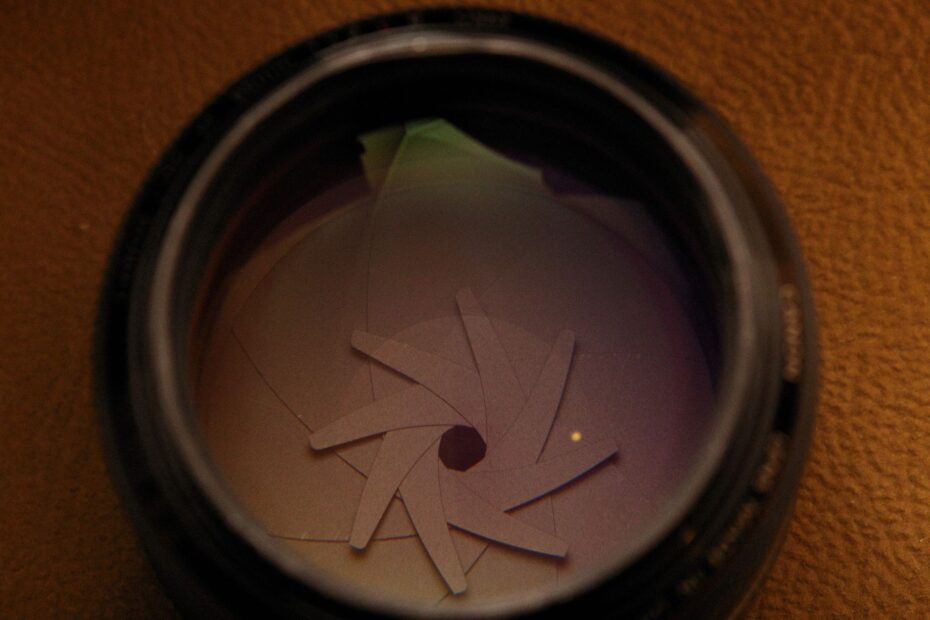
Leaf shutters sit inside a lens or near its aperture. Several blades open from the center, expose the full image area, then close. Your lens carries much of the timing hardware in that layout, which changes flash behavior later in the exposure process.
Electronic timing removes the moving light barrier. The image sensor starts collecting light, then stops collecting or reads its data. A fully mechanical film camera cannot use that method, while a mirrorless camera can offer it through a menu setting.
Regardless of how timing is set, pressing the release initiates the coordinated actions that make an exposure.
The Release Sequence Creates the Frame
A half-press starts preparation before exposure. Metering checks scene brightness, autofocus seeks distance, and the aperture prepares for its selected opening. A full press sends a release command based on settings chosen by you or by the camera’s automatic mode.
- Metering and focus: Your camera samples scene light and seeks focus before exposure begins.
- Release command: The shutter button sends a timed signal to the camera’s control system.
- Exposure start: A curtain moves, blades open, or sensor collection begins at the selected instant.
- Exposure end: A closing curtain, closing blades, or sensor readout stops the light-gathering interval.
- Frame handling: Digital data goes to processing and storage, while film advances toward a fresh frame.
Digital capture continues after the exposure closes. The camera converts electrical sensor data into an image file, adds settings such as white balance and noise reduction to JPEG files, then writes the result to a memory card. RAW files retain more sensor data for later editing.
DSLR Bodies Raise a Mirror
Inside a DSLR, a mirror box sends the lens image upward into an optical viewfinder. During exposure, the mirror flips upward, the aperture closes to its selected opening, and the focal-plane shutter runs. Your viewfinder goes dark because the mirror no longer sends light upward.
Mirror movement adds a small vibration before exposure. At slow speeds on a tripod, mirror lock-up or live view can reduce blur from that movement. Mechanical sound in a DSLR comes from the mirror, aperture, and curtains rather than from one part alone.
Mirrorless and Film Bodies Record Differently
Mirrorless cameras have no mirror box, so the image sensor can feed a live preview until capture. Your electronic viewfinder shows a sensor-derived image rather than an optical reflection. That design also allows silent electronic exposure modes.
Film cameras follow a related release path but leave no digital file to process. Light reaches an emulsion layer, chemical changes form a latent image, and a lever or motor positions fresh film. Your selected exposure still controls brightness and blur.
That release sequence leads directly to focal-plane timing. At fast settings, the sensor is not fully uncovered at one moment. Instead, the shutter curtains form a moving slit across the frame.
Focal-Plane Curtains Form a Moving Slit
At 1/60 s, a focal-plane shutter can uncover the full frame before closing again. The leading curtain travels away from the sensor area, pauses with the frame open, then the trailing curtain follows. Each part of the sensor receives light during the same open interval.
At 1/2000 s, the curtains cannot cross the frame, pause, and return within the selected exposure. The leading and trailing curtains travel together with a narrow slit between them. Each strip receives 1/2000 s of light, but strips record at slightly different moments.
The Slit Creates Fast Exposure Times
A narrower gap between the shutter curtains gives each sensor strip less exposure time. Your camera does not need a curtain that crosses the frame 2,000 times in one second. Curtain travel stays near the same speed while the gap changes.
A document scanner offers a useful comparison. Each line receives a brief view, yet the top and bottom are not recorded at the same instant. Still subjects appear normal. Fast movement can change position during the curtain travel.
A golf club crossing the frame can bend or shift from top to bottom at 1/2000 s. Each strip can look sharp, yet the strips do not show one shared instant. This focal plane shutter explained effect differs from blur caused by a long exposure.
Longer Exposures Open the Full Frame
At 1/30 s, the curtains have time to separate fully. The sensor remains uncovered for a visible fraction of a second, which allows more light into the frame. Hand movement, traffic, and flowing water can leave trails during that interval.
Your camera can use vertical-travel curtains that cross the short side of a full-frame sensor. The shorter route can raise flash synchronization speed. Older horizontal-travel designs crossed the longer side and had lower sync limits.
Copal became a major name in leaf and focal-plane shutter production. Curtain travel must stay consistent across thousands of exposures, since small timing errors can leave one side of your frame brighter than the other.
Leaf, Mechanical, and Electronic Designs Have Trade-Offs
Blade movement near the aperture produces a different exposure pattern from traveling curtains. A leaf shutter opens from the center, exposes the full frame together, and closes across the same area. That full-frame opening gives you a major advantage with flash.
| Design | How exposure starts and ends | Practical result for you |
|---|---|---|
| Mechanical focal-plane shutter | Two physical curtains travel near the sensor | Works across interchangeable lenses, with curtain wear over time |
| Leaf shutter | Several blades open near the lens aperture | Supports high conventional flash-sync speeds |
| Electronic shutter | Sensor timing starts and stops collection or readout | Silent capture, with possible rolling-shutter distortion |
| Electronic leading-curtain mode | Electronic start with mechanical closing curtain | Reduces opening vibration while retaining physical closure |
Mechanical Curtains Create a Physical Barrier
Two metal curtains sweep across the sensor to block and admit light. Closed curtains can shield the sensor from dust and accidental contact while the body is off, though lens changes still need care. Sensor-cleaning mode can open those curtains and expose the sensor surface.
Mechanical designs create sound and vibration, yet they avoid some electronic readout distortion. A Leica rangefinder with a focal-plane shutter has a distinct curtain sound. Your photo does not need that sound, but physical movement can matter under artificial light or around fast lateral motion.
Electronic Timing Removes Curtain Noise
An electronic shutter can record silently because no curtain moves for each frame. Concert halls, courtrooms, and quiet ceremonies suit that mode. Your camera can also record long bursts without cycling a mechanical assembly for every exposure.
Electronic leading-curtain shutter starts exposure electronically and ends it with a mechanical curtain. This can reduce vibration at slow hand-held speeds. Very fast lenses at wide apertures can show uneven blur or uneven exposure in EFCS mode on some bodies, so your camera manual remains useful.
The types of camera shutters do not form a simple ranking. Each design brings a trade between sound, vibration, flash timing, burst rate, and distortion risk. Your subject movement and light source decide which compromise matters most.
Those priorities become concrete when you balance exposure time against the way a subject moves.
Shutter Speed Controls Light and Motion
The setting 1/250 s means each part of your sensor receives light for one two-hundred-fiftieth of a second. It does not describe finger speed or curtain travel speed. A smaller fraction means a shorter exposure.
At 1/30 s, your sensor gathers eight times as much light as it does at 1/250 s. That equals three stops of exposure. But the longer interval also records more movement, turning walking feet into streaks or leaving a hand-held frame soft.
| Selected speed | Light reaching your sensor | Motion result |
|---|---|---|
| 1/30 s | High amount | Hand shake and subject movement show easily |
| 1/125 s | Moderate amount | Useful for calmer hand-held scenes |
| 1/250 s | Lower amount | Helps with walking subjects and casual action |
| 1/2000 s | Very low amount | Freezes splashes, birds, and fast sports action |
The Reciprocal Rule Starts Hand-Held Choices
For a 200mm lens, 1/200 second offers a practical hand-held starting point. A 50mm lens points toward 1/50 s on a full-frame camera. Your hands, sensor resolution, stabilization, and subject movement can demand a faster setting.
Micro Four Thirds bodies use a two-times crop factor, so a 25mm lens gives a field of view close to 50mm on full frame. The old rule points toward 1/50 s from equivalent field of view. A 20-megapixel or 25-megapixel sensor can reveal small blur more clearly than older lower-resolution bodies.
Image stabilization counters your hand movement, not a child turning their head or a cyclist crossing the frame. Raise shutter speed for subject motion even with stabilization active.
Brightness Requires an Exposure Trade
A faster setting darkens your frame unless aperture, ISO, or scene light changes. Moving from 1/250 s to 1/1000 s cuts light by two stops. Your camera can compensate through a wider aperture, higher ISO, or brighter illumination.
For a practical example, a runner at noon can look sharp at 1/2000 s, f/2.8, ISO 100. Under stadium lights, that runner can need ISO 3200 or a wider aperture to hold 1/2000 s. You choose which compromise harms the image least.
What is shutter speed in photography becomes clear during long exposures. At 1 s, water looks smooth, vehicle lights form lines, and crowds can blur into motion. Your tripod holds stationary objects sharp while moving subjects change through the frame.
Scene Conditions Shape Mode Choice
A quiet museum hall and a baseball field place different demands on your camera. Selected speed controls exposure duration, while shutter mode controls how that duration starts and ends. Start with movement and light, then select the mode with the fewest side effects.
- Still hand-held scenes: Start near 1/125 s, then raise speed for longer lenses or visible hand shake.
- Moving portraits: Use 1/250 s or faster for turning heads, laughing faces, and active children.
- Field sports: Begin near 1/1000 s, then use 1/2000 s or faster for fast limbs and balls.
- Deliberate blur: Use 1/15 s through several seconds with your camera stabilized on a tripod.
- Silent events: Use electronic capture after checking LED lighting and movement distortion.
- Rapid bursts: Use electronic capture where lateral movement stays limited and light remains stable.
Each Mode Has Specific Risks
Mechanical shutter mode suits flash, fast lateral action, and indoor light sources that can cause electronic banding. Your curtains still scan at high settings, but their behavior remains predictable. Mechanical capture also avoids row-by-row distortion from slower electronic readout.
Electronic leading-curtain mode suits portraits, tripod work, and moderate speeds where opening vibration matters. Your camera retains a closing curtain, so it is not silent. Some systems disable this mode at fast settings because timing limits can affect exposure or background blur.
Fully electronic capture suits quiet rooms, high burst rates, and bodies with fast sensor readout. A Nikon Z-series or Canon mirrorless body can offer this setting, but results depend on the specific sensor. Your menu label does not reveal how quickly sensor rows are read.
Readout Distortion Differs From Motion Blur
A high selected speed freezes movement only during each sensor area’s exposure. It does not force every electronic row to record at the same moment. A spinning propeller can look curved at 1/4000 s because the sensor scans from one row to another.
Use a mechanical shutter for indoor basketball under LED fixtures, where electronic capture can show bands and distorted motion. Use a leaf shutter lens for daylight portraits with flash, where high sync speed can darken the ambient background. Your creative goal should guide the mode choice.
The leaf shutter vs focal plane shutter choice becomes clearest with flash. A focal-plane slit leaves part of the sensor covered at high settings, so one short flash burst cannot light the entire frame without special timing.
Flash Sync, Flicker, and Rolling-Shutter Limits
A conventional flash burst is far shorter than a normal exposure, yet the full sensor needs to be uncovered at one instant. The fastest focal-plane setting that does this is normal flash synchronization speed, commonly 1/160 s, 1/200 s, or 1/250 s. Your camera specifications list that speed.
Above that setting, a moving slit crosses the sensor. One flash burst lights only the uncovered strip while a curtain blocks the rest. Your frame can show a dark band that grows as the selected speed rises.
| Situation | What happens | Useful response for you |
|---|---|---|
| Flash at 1/200 s sync speed | Entire sensor is uncovered together | Use normal flash output |
| Flash above normal sync | Curtain blocks part of the frame | Lower speed or activate high-speed sync |
| Leaf shutter with flash | Full frame can open together at high speeds | Control bright daylight more easily |
| Electronic shutter under LED light | Sensor rows sample light at changing phases | Use anti-flicker settings or mechanical capture |
High-Speed Sync Extends Flash Timing
At 1/1000 second, compatible flashes pulse repeatedly as a narrow slit crosses the sensor. Your camera can then use fast shutter speeds with flash, but the flash delivers less effective power because its energy spreads across a longer interval.
A portrait at 1/2000 s in bright sun can use HSS to fill shadows, though your flash works harder than it would at 1/200 s. A leaf shutter can synchronize conventional flash at higher speeds because the full frame opens together. That is the practical benefit of a leaf-shutter design.
Rolling Shutter Comes From Sensor Readout
Row-by-row sensor scanning records the top and bottom of a frame at slightly different times. Vertical buildings can lean during a quick pan, a tennis racket can bend, and LED signs can show stripes. Your subject did not physically bend; recording time changed across the frame.
Flicker has a related timing issue but a different source. LED and fluorescent lamps can vary in brightness with AC power cycles, and your exposure can catch changing phases across the frame. Anti-flicker modes time capture around that cycle, though electronic shutters can still show banding.
Dark flash bands point to sync timing. Bent lines point to scanning readout. Soft movement points to exposure duration. Your correction depends on the symptom.
These limits do not mean a shutter has failed. Real faults show repeatable physical symptoms, while shutter count tells only part of the camera’s condition story.
Shutter Count and Physical Fault Signs
A shutter count records mechanical actuations rather than the full history of a camera. A count of 20,000 can be modest on a body rated for 200,000 cycles, yet substantial on a compact body with a lower stated rating. Your camera’s use history matters as much as the number.
Camera shutter count and lifespan are linked, but a rated life is a reliability estimate rather than a deadline. Some units continue well beyond that rating, while another can fail from impact, contamination, or production variation. EXIF data can reveal counts on certain models, though access methods differ by brand.
Electronic Captures Change the Count
Fully electronic exposures may not add to a conventional mechanical count because no curtains cycle. Your tally can look low on a camera used heavily in silent mode. Check whether the body records electronic captures separately before treating the count as a complete use meter.
Mechanical curtains need careful handling. Never touch them during a lens change, and keep a blower tip away from the curtain surface. A damaged curtain can cause uneven frames and expensive repair work.
Repeated Symptoms Need Service
- Uneven brightness: Repeated dark or bright strips in the same area can point to curtain timing trouble.
- Stuck curtains: A curtain that remains partly across the sensor needs professional inspection.
- Blank frames: Repeated black frames under normal light can signal release, curtain, or sensor trouble.
- Error messages: Persistent shutter-related errors after a restart call for service evaluation.
- Harsh sounds: Grinding, scraping, or changed mechanical noise can signal a damaged assembly.
- Visible damage: Bent curtain blades or torn material need immediate attention.
Motion blur does not show shutter failure. Neither do rolling-shutter distortion, LED banding, or a dark flash band from a speed above sync. Repeat the frame with mechanical mode, compatible sync speed, and stable light before deciding your camera has a hardware fault.
Your camera shutter mechanism is both a precision assembly and a creative control. Learn its normal behavior, then judge strange results by a repeated pattern rather than one disappointing frame.
Final Thoughts
Each exposure begins with timed access to light. Your shutter speed sets how long each area of the frame receives light, while shutter design shapes flash behavior, silent capture, fast action, and artificial-light results. Choose speed for motion and brightness, choose mode for the scene’s timing demands, and reserve concern for repeatable physical faults.
FAQ
How does a camera shutter mechanism work?
Timed curtains or electronic readout begin and end the interval in which light reaches film or an image sensor. Mechanical versions move curtains or blades, while electronic versions control sensor timing. Your selected shutter speed sets exposure duration, changing brightness and the appearance of moving subjects.
What happens inside a camera when the shutter button is pressed?
A half-press starts metering and autofocus, while a full press sends a release command. In a DSLR, the mirror rises, the aperture closes, and curtains travel. In a mirrorless camera, your sensor can start an electronic or mechanical exposure without mirror movement.
How does shutter speed control exposure and motion blur?
A longer shutter speed sends more light to your film or image sensor and records more movement. A shorter shutter speed sends less light and freezes movement more effectively. Your aperture, ISO, or available light must change to keep brightness stable after a speed change.
What is the difference between a focal-plane shutter and a leaf shutter?
Near the sensor, traveling curtains control exposure; near the aperture, leaf blades do the job. Your focal-plane shutter forms a moving slit at high settings. A leaf shutter can expose the full frame together at faster flash-sync settings.
How do mechanical and electronic shutters differ?
A mechanical shutter uses physical curtains that block and uncover the sensor, producing sound and small vibration. An electronic shutter uses sensor timing and can record silently. Your electronic mode can distort fast movement or show light bands, while mechanical capture has curtain wear and sync limits.
Why do fast shutter speeds sometimes cause rolling shutter distortion?
Fast selected shutter speed controls exposure duration for each sensor row, not the time needed to read every row. Your electronic shutter can scan from top to bottom while a moving subject changes position. Bent propellers, leaning buildings, and curved rackets come from that readout timing.