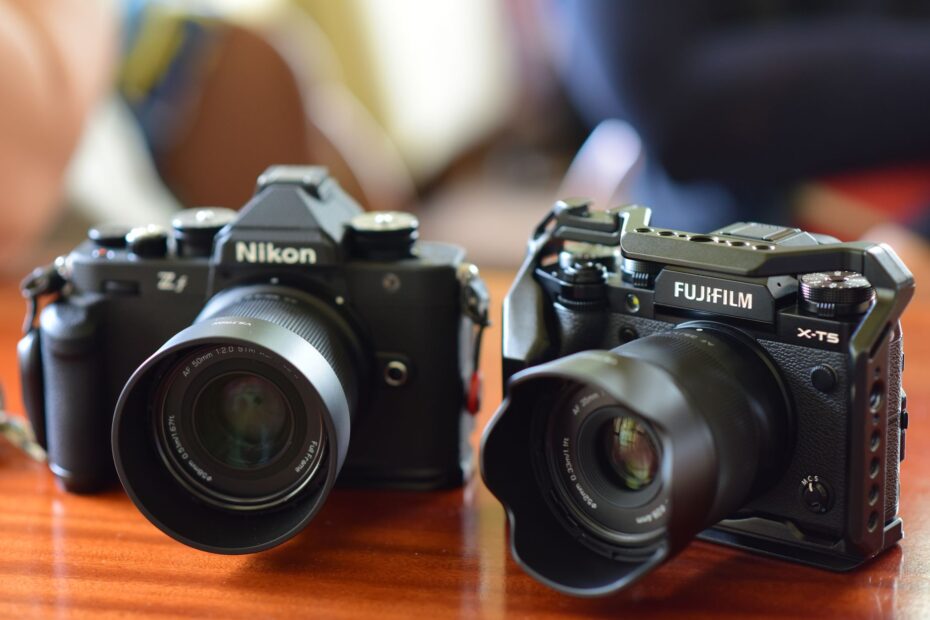
An interchangeable-lens mirrorless body and a fixed-lens compact serve distinctly different shooting needs. You gain lens flexibility, manual settings, and stronger low-light options with mirrorless gear, while your point-and-shoot keeps shooting simple, small, and ready for a birthday dinner or day trip.
Your choice depends on image sensor size, lens needs, carrying habits, and the subjects you photograph, from family snapshots to travel scenes, sports, and video.
Two Camera Designs Serve Different Priorities
The lens arrangement separates these camera types more than any body shape or brand name. A point-and-shoot camera, also called a compact camera, keeps its lens attached permanently. You turn it on, frame with the rear screen, and take a photo without carrying extra glass.
A mirrorless camera uses an interchangeable-lens system and leaves out the reflex mirror and optical viewfinder found inside a DSLR. Instead, you compose through a rear screen or an electronic viewfinder (EVF). Your lens choice changes field of view, reach, background blur, and low-light performance.
| Camera type | Lens design | What you prioritize |
|---|---|---|
| Point-and-shoot camera | Your built-in fixed lens stays attached. | You carry less gear and shoot with less setup. |
| Mirrorless camera | Your interchangeable lens changes by subject. | You gain creative control and room to grow. |
| DSLR | Your interchangeable lens mounts on a mirrored body. | You use an optical viewfinder and a larger body. |
Neither category wins in every situation. A fixed-lens compact keeps your setup light, while a mirrorless body gives you more choices after a scene calls for a wider view, longer zoom, or brighter aperture.
That difference between mirrorless and point-and-shoot cameras becomes clear the moment your subject changes. A child across a soccer field, a bird in a tree, and a dim restaurant portrait each ask different things from your camera.
Lens Design Changes Your Daily Shooting Options
One built-in zoom handles most point-and-shoot camera duties. Its focal range stays the same because the lens never leaves the body. You know exactly what fits in your bag and how far your optical zoom reaches before leaving home.
Mirrorless systems accept separate lenses for wide scenes, close portraits, wildlife, macro work, and distant sports. Canon, Nikon, Sony, and Fujifilm each sell mirrorless lens mounts with their own lens selections. Your body stays the same, but its purpose shifts with the lens attached.
| Feature | Point-and-shoot camera | Mirrorless camera |
|---|---|---|
| Lens | You use one fixed lens, sometimes with optical zoom. | You swap lenses for wide, telephoto, macro, or portrait work. |
| Image sensor size | You may get a small sensor, though premium compacts vary. | You may get a larger sensor, though formats vary. |
| Portability | You carry many models in a pocket or small bag. | You carry a body plus at least one lens. |
| Controls | You rely more on automatic modes. | You access manual exposure controls and custom buttons. |
| Viewfinder | You compose through a rear screen on many models. | You use a rear screen and, on many models, an EVF. |
| Low-light potential | You depend on lens brightness and sensor size. | You pair a larger sensor with a bright lens. |
| Practical fit | You want quick photos with little setup. | You want to learn and photograph varied subjects. |
Premium Compacts Fill a Narrow Middle Ground
Small cameras are not automatically basic cameras. A Sony RX100 series model pairs a larger-than-phone sensor with a compact zoom. A Ricoh GR uses a large APS-C sensor and a fixed wide lens. You get serious image quality without a lens bag, though your lens choice stays fixed.
Entry-level compacts sit at the opposite end of the category. Their smaller sensors, simple controls, and long built-in zooms suit daylight vacations and family outings. Heavy cropping and dark indoor scenes expose their limits faster than they do with larger-sensor cameras.
- Fixed lens setup gives you one ready-to-use focal range from the moment you switch on the camera.
- Interchangeable lens mount lets you match focal length and aperture to a specific subject.
- Larger sensor area gathers more light and leaves more room for editing bright skies and dark shadows.
- Manual exposure controls let you choose shutter speed, aperture, and ISO instead of accepting the camera setting.
The compact camera vs mirrorless choice gets simpler after you name the photographs you want. Your built-in zoom works well for varied daylight scenes, while an interchangeable lens mount gives you a wider range of specialized options.
Sensor Size and Exposure Controls Shape Image Quality
A 24mm lens frames a broad city street, while a 200mm lens brings a distant bird closer in the frame. Mirrorless systems from Canon, Nikon, Sony, and Fujifilm accept lenses built for those distinct jobs. Your compact camera’s built-in zoom covers a set range, which feels freeing or limiting based on the scene.
More Sensor Area Leaves More Editing Room
More sensor area gathers more light at the same shutter speed and aperture. A larger image sensor size can produce cleaner files at higher ISO settings, retain more detail in bright skies and dark shadows, and make background blur easier at portrait distances.
Your result still depends on the full setup. A premium compact with a bright f/1.8 lens can outperform an entry mirrorless body paired with a dim kit zoom during an indoor restaurant photo. Sensor formats vary across both categories, so the body label does not settle every image-quality question.
A 1-inch sensor, APS-C sensor, and full-frame sensor do not gather the same amount of light. That physical difference matters in dim rooms, at sunset, and during indoor events. You get more flexibility from a larger sensor, but a bright lens also matters.
Manual Settings Give You More Control Over Motion
Automatic mode selects shutter speed, aperture, and ISO for you. That works well during a quick family moment, yet it may choose a slow shutter speed that blurs a moving child. A small sensor can also show more visible noise after the camera raises ISO in dim light.
Mirrorless bodies give you direct access to aperture, shutter speed, ISO, raw files, and programmable buttons. You can set 1/1000 second for a soccer player, open a lens to f/1.8 for a portrait, or record raw files for more editing latitude later.
- Fast shutter speed freezes motion from running children, birds, athletes, and pets.
- Wide aperture lens lets more light reach the sensor and softens the background behind a portrait.
- Lower ISO setting keeps noise lower where the light allows it.
- Raw file capture retains more image data for exposure and color adjustments after shooting.
Those settings take practice, but they explain why a mirrorless camera for beginners appeals to photographers who enjoy learning. Your compact remains easier for moments where you want the camera to choose the exposure without slowing you down.
Autofocus, Composition, and Video Favor Mirrorless Bodies
Exposure control solves only part of a difficult photo. Framing and focus become the next limits, especially with moving subjects. Many compact cameras rely only on a rear screen, which can look washed out in bright noon sun.
Most mirrorless models add an electronic viewfinder that places the scene against your eye. The EVF also shows a live preview of exposure, white balance, and depth of field before you press the shutter. You gain a clearer view of the image the camera is preparing to record.
Subject Tracking Helps With Movement
Modern autofocus systems identify faces, eyes, animals, or vehicles and follow them across the frame. Your success rate rises with moving children, dogs, birds, and field sports because the focus point does not stay in one fixed position.
Burst shooting records a run of frames during action. A mirrorless body may also pair in-body stabilization with stabilized lenses, helping you hold slower shutter speeds for handheld stills and smoother video. Those tools matter more than megapixels during fast movement.
- Eye detection autofocus keeps a face or eye in focus as your subject shifts position.
- Animal subject tracking helps keep a bird, dog, or other animal sharp during uneven movement.
- Burst frame capture records several images during a jump, swing, run, or goal.
- Image stabilization reduces shake during handheld stills and video clips at slower shutter speeds.
Video Work Benefits From Lens Flexibility
Microphone inputs, headphone monitoring, log profiles, and reliable subject tracking matter for video projects. You can switch from a wide talking shot to a close product view without moving the tripod. That lens change alters the visual feel of the scene.
Working photographers have moved heavily toward mirrorless systems for lens options, autofocus, and hybrid photo-video work. DSLRs remain capable tools, but their mirror-and-prism design makes them larger and limits the live electronic preview visible before capture.
Video also exposes a practical limitation of compact cameras. Your fixed lens may frame a room well but feel too tight for a handheld close-up. A mirrorless body lets you choose a different focal length instead of changing where you stand.
That flexibility pays off only when you are willing to carry the body and extra lenses.
Portability and Simplicity Keep Compacts Relevant
Fast autofocus has little value from a camera left at home. A compact that slips into a coat pocket stays ready at a museum, dinner table, or trail overlook. Your mirrorless kit can stay small too, but every added lens changes its weight and space needs.
Dedicated Cameras Still Serve a Purpose Beside Phones
Smartphones use computational photography to blend frames, brighten shadows, and smooth noise. A compact camera makes a stronger case through meaningful optical zoom, a larger sensor, tactile controls, or handling that keeps your fingers away from the screen.
Point-and-shoot cameras are still worth it where a phone’s digital zoom falls apart. A 10x optical zoom frames a child on a distant stage without turning detail into a soft crop. You also carry a separate battery and storage card for a full day out.
A bright built-in lens and a camera you carry can produce a sharper real photograph than a larger system sitting in a closet.
Premium fixed-lens models can outperform an entry mirrorless setup in a narrow moment. A compact with a brighter lens, longer built-in reach, or faster startup may catch a dim indoor scene before you have time to mount another lens.
Point-and-shoot vs mirrorless for travel comes down to how you pack and what you plan to photograph. Your travel camera should fit the bag you will carry for 8 hours, not the bag that looks practical at home.
Carrying less also means owning, maintaining, and budgeting for fewer accessories.
Mirrorless Systems Bring Added Cost and Responsibility
Carrying more gear leads directly to spending more on gear. A fixed-lens camera has a clear upfront figure because the body and lens arrive as one unit. A mirrorless body is only the starting expense.
Your System Budget Extends Beyond the Body
- Extra lenses add focal lengths, apertures, and bulk to your kit.
- Spare batteries matter because live screens and electronic viewfinders use power continuously.
- Memory cards need faster write speeds for high-resolution bursts and video recording.
- Bag and tripod protect your gear and steady long exposures or video clips.
- Flash and software add expense for indoor events and raw-file editing.
An inexpensive body can become the higher total cost after two lenses, extra batteries, and a bag. Set your full budget before choosing a system, rather than focusing only on the body figure.
Mirrorless Trade-Offs Stay Practical
Mirrorless camera disadvantages include added bulk after lenses enter the bag, shorter battery life on some models, more menu settings, and an exposed sensor during lens changes. Dust can land on that sensor and leave dark spots in bright skies until you clean it.
Your learning time has value too. A compact gives you fewer wrong turns, while a mirrorless body rewards practice with modes, focus settings, raw processing, and lens behavior. That extra control matters only where you plan to use it.
Battery use is another real trade-off. The rear screen and electronic viewfinder draw power whenever you compose. You may need a spare battery for a long outing, while a fixed-lens compact keeps your packing list shorter.
Real-World Subjects Point Toward the Right Camera
Those trade-offs become clearer on actual outings. A compact favors pocketability and quick framing, while a mirrorless body favors low-light performance, interchangeable lenses, and subject-specific zoom. You should base the choice on the scenes you expect to photograph.
Compact Cameras Suit Fast, Low-Fuss Days
Casual family snapshots, day trips, amusement parks, and bright vacation walks suit a fixed-lens compact. Your attention stays on the moment instead of lens changes, exposure settings, or a shoulder bag.
A 24-200mm travel zoom, for example, can frame a wide building facade and a distant boat from the same spot. That range suits your trip where a small bag and quick framing matter more than shallow depth of field.
Street scenes and meals also reward a small camera that does not draw much attention. You pull it out, compose, and put it away in seconds. Portability changes how frequently your camera comes with you.
Mirrorless Bodies Suit Demanding Subjects
Portraits benefit from a bright 50mm or 85mm lens, while wildlife needs long reach and quick autofocus. Your mirrorless body can use both lenses, though not at the same time. Sports, low-light events, serious travel work, and video projects gain from that flexibility.
For a school gym photo, a bright lens and fast autofocus can hold a player’s face in focus at a shutter speed that stops motion. A compact can record the moment, but its smaller sensor and dimmer zoom may force blur or visible noise.
- Family outings favor a compact where your priority is quick handling and a small bag.
- Wildlife subjects favor mirrorless gear with a long telephoto lens and subject tracking.
- Indoor events favor a larger sensor and bright lens where light levels are low.
- Travel days favor the camera that fits your walking distance, luggage space, and planned subjects.
- Video projects favor a system with audio inputs, tracking autofocus, and lens options.
Beginners Need a Camera They Will Carry and Learn
Your next step should start with a carrying test rather than a specification sheet. Put the size and weight you would truly bring on a weekend walk into a bag. A camera left behind captures nothing.
- Choose a compact where pocket size, built-in zoom, and automatic shooting matter most to you.
- Choose mirrorless gear where you want portraits, dim-light photos, lenses, and deeper control.
- Set a full budget that includes cards, batteries, lenses, and a carrying solution.
- Name your subjects such as children, wildlife, meals, travel scenes, or video clips.
- Try the controls before committing to menus and buttons you will use for years.
A mirrorless camera for beginners makes sense where learning exposure and changing lenses sounds appealing rather than irritating. Stay with a compact where reliable automatic results and daily carry matter more than system growth.
Your first dedicated camera does not need to cover every future subject. Pick the camera that handles the photographs you take now. A fixed lens teaches framing and timing, while a mirrorless system leaves room for different lenses later.
Final Thoughts
Skill and intent,not camera category,determine whether photography feels serious or casual. Your strongest choice matches the subjects you photograph, the light you face, the room in your bag, and the amount of control you will use. A fixed-lens compact favors presence and speed, while a mirrorless system favors range and creative reach.
Start with your habits, not the longest feature list. A camera that stays close during daily life will record more moments than a larger system that stays on a shelf. Your own photographs will show whether portability or lens flexibility matters more.
FAQ
What is the main difference between a mirrorless camera and a point-and-shoot camera?
Interchangeable lenses define mirrorless systems, whereas point-and-shoot models rely on a fixed built-in lens. You can adapt a mirrorless body for portraits, wildlife, macro work, or video with different lenses, while a compact gives you one ready-to-use focal range in a smaller package.
Are mirrorless cameras better than point-and-shoot cameras for image quality?
Mirrorless cameras may deliver stronger image quality because many use larger sensors and accept bright lenses. Your result still depends on the lens, exposure, autofocus, and lighting. A premium compact with an f/1.8 lens can outperform an entry mirrorless body paired with a dim kit zoom.
Can you change lenses on a point-and-shoot camera?
No. A point-and-shoot camera uses a fixed lens attached to its body. You choose its built-in focal range at purchase, while a mirrorless camera lets you mount separate wide, telephoto, macro, and portrait lenses.
What is the disadvantage of a mirrorless camera?
Higher system costs, extra gear, shorter battery life on some models, and more settings can complicate ownership. Your sensor is also exposed during lens changes, so dust can reach it more easily than on a fixed-lens compact camera.
Are point-and-shoot cameras still worth it?
Optical zoom, physical controls, larger-than-phone sensors, and pocketable bodies still make these cameras useful for daily carry. You get the strongest value from a compact that solves a phone limitation rather than repeating the same focal range.
Which camera type is better for travel and everyday photos?
A point-and-shoot camera suits travel and everyday photos where your priority is a pocket-sized body, built-in zoom, and quick operation. You may prefer a mirrorless camera for travel where low-light work, portraits, wildlife, or video matter enough to justify extra lenses.