Whether you’re hopping into a Monday morning standup, building a YouTube channel, or streaming late-night gameplay, the jump from 1080p to 4K changes how your footage feels. Faces read cleaner, slides stay legible, and your room’s background gets a real sense of depth. The trick is matching the camera to the job, not chasing the highest headline spec. The list below covers 4K webcams, a handheld camcorder, and a wearable POV option, so you can match gear to workflow.
Your Options, Compared
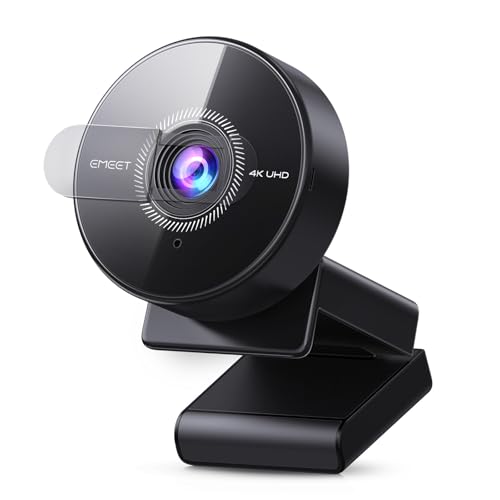
EMEET C950 4K Webcam with PDAF Autofocus

EMEET NOVA 4K Webcam with Dual Mics

EMEET C960 4K Webcam with 73° FOV

EMEET S600L 4K Streaming Webcam with Ring Light

Peryoua 4K Ultra 80MP Camcorder Vlogging Camera

EMEET C100 2K Webcam with Privacy Cover
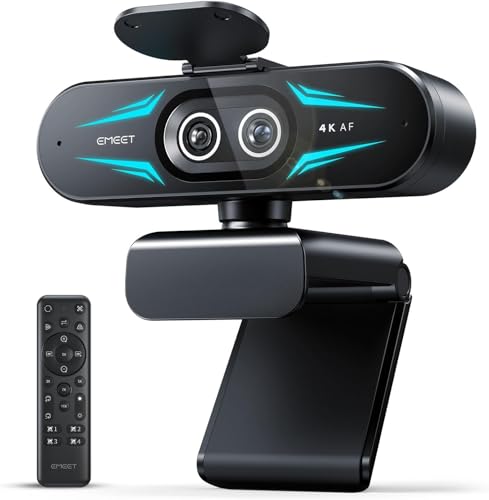
EMEET C60E Dual-Camera 4K Webcam with 11X Zoom

EMEET S600 4K Streaming Webcam with Sony Sensor

EMEET Piko Dual-Camera 4K Webcam

acgiewo 4K Mini Body Camera POV Action
A Closer Look At Each Pick
The C950 sits in that sweet spot where most remote workers live: meetings all day, occasional demos, and the occasional webcam audit from your boss. It records at 4K resolution with PDAF autofocus, which is short for Phase Detection Auto Focus, a system that locks onto faces quickly so you don’t drift into soft focus mid-sentence.
Compared with the EMEET NOVA reviewed next, this one runs a leaner build without dual omni mics, so it leans on your computer’s audio a touch more. Owners commonly pair it with a USB headset anyway, and for many home offices that’s a non-issue. The clip-on mount keeps it steady on most monitors.
Bright Spots
- PDAF autofocus holds your face sharp during frequent repositioning.
- Built-in mic cuts out the extra accessory for quick calls.
- 4K resolution at 30 frames per second reads clean on most laptops.
- CMOS sensor handles low-light home offices better than older webcams.
- Plug-and-play USB setup means no driver headaches for mixed-platform teams.
Points To Note
- Single onboard mic limits audio quality for podcast-style recording.
- You may find low-light rooms need a small key light for the cleanest result.
Who Will Love This
Daily remote professionals who live in video meetings and want a 4K camera they can clip on and forget.
Where Another Pick Suits Better
Streamers who care about richer audio should look at the EMEET NOVA, which adds dual omni microphones.
Step up from the C950 and you land at the NOVA, which doubles down on audio with dual omni-directional microphones that pick up your voice from a wider arc. That matters for teachers pacing in front of a whiteboard or presenters who don’t want to babysit a headset.
The 4K output stays sharp at 30 frames per second, and the PDAF autofocus system keeps you in focus without the hunting you sometimes see on cheaper lenses. Unlike the C950’s single-mic design, this model treats audio as a first-class feature, not an afterthought. For most lecture halls and small studios, the pickup range is generous.
A Strong Showing
- Dual omni mics capture natural voice across a wider area.
- CMOS sensor maintains color and detail under typical room lighting.
- PDAF autofocus reacts quickly when you stand up or move a step back.
- 4K clarity helps slide presentations and product walk-throughs feel more readable.
Things To Consider
- Background noise in busy environments can still compete with voice pickup.
- Higher feature set comes with a steeper commitment than the entry-level C950.
- You may find the field of view too tight for full-room demos.
Made For
Educators and presenters who want a 4K webcam that handles both picture and voice without extra gear.
Not Your Match When
If you mostly run one-on-one calls from a quiet desk, the EMEET C950 will save you money and work just as well on the video side.
The C960 brings a measured 73° field of view, which frames a single speaker without dragging in the entire room. For remote team meetings where one person talks at a time, that tighter crop keeps attention where it should be.
PDAF autofocus and dual omni mics carry over from the NOVA lineage, so video and audio both pull their weight. Compared with the C950’s wider capture, this one trims the edges. The 4K resolution at 30 frames per second still delivers detailed footage for slides, whiteboards, and one-to-one coaching calls.
Positive Takeaways
- 73° field of view frames a single subject with minimal background distraction.
- Dual omni microphones capture voice clearly without a headset.
- PDAF autofocus holds steady when you lean in or back away from the lens.
- Compact body fits cleanly on most laptop lids and external monitors.
Worth Noting
- The 73° crop can feel narrow if you regularly share the frame with a second person.
- Lacks the larger Sony sensor found in the S600 model reviewed later in the list.
Key Specs
Right Fit For
Remote team members and consultants who want a balanced 4K webcam with cleaner framing than a wide-angle lens offers.
Skip It When
You want a much larger imaging sensor and richer color depth; in that case, the EMEET S600 with its Sony 1/2.55″ sensor is worth the look.
Solo creators know the pain of looking half-asleep on stream because the room lights are wrong. The S600L solves that with a built-in ring light that auto-balances exposure alongside the 1/2″ sensor, so faces stay lit without manual tinkering.
Where the C950 and C960 stick to plain webcam duties, this one leans into content creation with 0.2-second PDAF focusing speed. That matters during unboxings, recipe videos, or any format where your hands fly between the camera and the table. It also helps in mid-afternoon streams when the natural light shifts and you cannot stop to adjust.
Points In Its Favor
- Integrated ring light replaces a separate streaming accessory.
- 0.2-second PDAF keeps moving subjects sharp during demos.
- Larger 1/2″ sensor gathers more light in dim home studios.
- Auto exposure balance avoids overexposed hot spots when the ring light kicks in.
Trade Offs
- Ring light adds bulk compared with the slimmer C960 body.
- Built-in light is helpful but cannot fully replace a strong key light for cinematic work.
Whose Shelf It Belongs On
Solo streamers, beauty reviewers, and tutorial creators who want all-in-one lighting without a separate desk setup.
Look Elsewhere When
You already run a multi-point lighting rig and just need a clean sensor; the EMEET S600 will give you the imaging without the redundant light.
Not every video camera lives behind a monitor. This Peryoua camcorder steps out into the world as a handheld unit, with an 80MP sensor rating and 4K capture at 30 frames per second. It also works as a plug-in webcam, which is a quiet bonus for hybrid creators who record at a desk one day and a kitchen the next.
Unlike the EMEET webcams above, this is a real handheld form factor with an 18X digital zoom, so you can frame a kid’s recital or a travel vlog without swapping lenses. The trade-off is size; it will not clip onto a laptop lid the way the C950 does. Beginners commonly appreciate that all-in-one simplicity.
What Earns Its Place
- Handheld form factor works where a clip-on webcam cannot reach.
- 80MP sensor rating and 4K capture suit family and travel vlogs.
- Doubles as a USB webcam for hybrid creators.
- 18X digital zoom helps with distant subjects like school performances.
Points To Keep In Mind
- Digital zoom reduces sharpness compared with optical zoom lenses.
- Larger body makes desk-mount streaming less convenient than the EMEET webcams.
- Not the right tool if your workflow depends on tiny, low-profile hardware.
Quick Facts
Best Suited To
First-time vloggers and family videographers who want one device that covers both handheld shoots and quick webcam sessions.
A Better Fit Elsewhere
Streamers who never leave their desk should stick with a clip-on webcam like the EMEET S600L for a tidier setup.
Not every workspace needs full 4K, and the C100 leans into that truth. It records at 2K resolution with fixed focus between 12 and 40 inches, which is the typical distance between your face and a laptop on a desk. No autofocus hunting means the picture stays put.
A rotating privacy cover and metal clip set this webcam apart from the rest of the list. The cover gives peace of mind in shared rooms, dorms, or home offices where cameras get bumped. The metal clip holds firm on thicker monitor bezels, where plastic clips sometimes flex.
Notable Gains
- Rotating privacy cover lets you physically block the lens.
- Metal clip grips thicker monitor bezels securely.
- Fixed focus between 12 and 40 inches keeps the picture steady.
- Lower resolution reduces bandwidth strain on older computers.
Less Ideal Details
- 2K resolution is below the 4K standard across the rest of this list.
- Fixed focus struggles outside the 12 to 40 inch sweet spot.
Perfect Match For
Students, home-office workers, and shared-space setups who value privacy and a sturdy mount over 4K resolution.
Reach For A Different Pick When
You need native 4K detail; the EMEET C960 delivers that with a tighter 73° field of view at a similar desk-friendly footprint.
The C60E is a bold design choice: two cameras sharing one body, sharing a 1/2.8″ CMOS 4K sensor. The wide-angle gray lens captures the full scene with near focus, while the telephoto blue lens locks in close-ups at roughly 13.8 inches away, which is ideal for product reviews and tutorials.
That dual setup gives creators a real workflow edge over single-lens rivals like the EMEET C950 or NOVA. Add the 11X hybrid zoom, RGB lighting accents, and remote control, and this webcam starts behaving like a small production studio. Two onboard mics round out the package so audio does not lag behind the visuals.
Positive Points
- Dual-camera design lets you switch between wide and close-up framings instantly.
- 11X hybrid zoom reaches small subjects without losing 4K resolution.
- RGB lighting adds a creative accent for streaming overlays.
- Remote control lets you adjust framing without touching the camera mid-call.
- Two onboard microphones cover voice pickup across the desk.
Room For Improvement
- Feature-heavy build costs more than the basic C950 and C960 models.
- Software learning curve is steeper for first-time streamers.
- Telephoto close-up mode works best at the recommended 13.8 inch distance.
Feature Snapshot
Who Should Grab It
Product reviewers, tutorial creators, and streamers who need both wide and close-up framings from one webcam.
Where A Sibling Pick Shines
Solo presenters who only need a single fixed frame will find the EMEET S600L simpler to set up and easier on the wallet.
The S600 is the S600L without the ring light, which sounds minor until you realize the imaging pipeline carries a Sony 1/2.55″ sensor. Sony sensors tend to deliver cleaner color depth and lower noise in dim rooms, and that shows up most during late-night streams and dimly lit home studios.
Compared with the EMEET C960, the S600 targets creators more deliberately. PDAF autofocus and 4K at 30 frames per second keep up with content workflows, and 1080p at 60 frames per second gives game streamers a smoother motion option. For most desks without a separate light rig, the sensor does the heavy lifting.
Useful Touches
- Sony 1/2.55″ sensor improves color accuracy in mixed lighting.
- PDAF autofocus stays locked during frequent repositioning.
- 1080p at 60 frames per second supports smoother gameplay streaming.
- Lower noise profile reduces grainy footage in dim rooms.
Some Limits To Know
- No built-in light means you still need a desk lamp or window for ideal results.
- Priced above entry-level options like the C950.
Feature Rundown
Built With In Mind
Aspiring streamers and content creators who want premium sensor quality and are willing to add their own lighting.
Swap It Out When
You prefer a webcam that brings its own lighting; in that case, the EMEET S600L keeps the same sensor family but adds the ring light.
Like the C60E reviewed above, the Piko pairs a wide-angle camera with a telephoto camera on a single 4K body. The wide-angle side frames you and the room naturally, while the telephoto side steps in for product close-ups and detail shots during demos.
The Piko targets creators who bounce between formats: cooking videos, makeup tutorials, unboxings. Where the C60E leans into RGB lighting and a remote control, the Piko keeps the package tighter for everyday streaming and teaching. Owners commonly appreciate not having to swap lenses or cameras mid-session.
Practical Advantages
- Dual cameras cover wide and close-up framings in one device.
- Wide-angle lens keeps you and your environment naturally framed.
- Telephoto lens delivers sharp detail shots for product demos.
- 4K resolution holds up across both camera lenses.
Possible Compromises
- Telephoto lens requires careful distance adjustment for ideal focus.
- Less lighting flair than the C60E with RGB accents.
The Right Fit
Dynamic streamers and tutorial creators who need framing flexibility without buying two separate webcams.
Consider Something Else When
You want more flair on stream; the EMEET C60E layers RGB lighting and a remote control on top of the dual-camera concept.
The acgiewo mini body camera steps away from desks entirely. It records 4K at 30 frames per second through a wide-angle lens, which suits first-person video for cycling, hiking, travel, and hands-free POV cooking. A switchable 16:9 landscape and 9:16 portrait mode helps with both YouTube and short-form vertical uploads.
Where every other pick on this list lives near a USB port, this one mounts to a helmet, a jacket, or a chest harness. The trade-off is clear: you lose desk-friendly conveniences and gain freedom of movement. Owners commonly use it as a complement to a desk webcam rather than a replacement.
The Practical Payoff
- Wide-angle lens captures immersive first-person footage.
- Switchable 16:9 and 9:16 modes cover landscape and vertical platforms.
- Compact body mounts to helmets, jackets, and harnesses.
- 4K at 30FPS keeps action footage sharp enough for online sharing.
Where It Is Less Suited
- Not designed for desk-based video conferencing.
- Wide-angle lens exaggerates close-up distortion.
- Battery life depends heavily on resolution and ambient temperature.
Spec Overview
Who It Suits Best
Outdoor creators, travelers, and POV hobbyists who need a wearable camera to capture footage beyond a desk.
Another Choice May Suit
For desk-based streaming and meetings, the EMEET C950 or C960 give you a clearer, more flattering image with built-in mics.
What Matters Most Before Choosing 4k Cameras For Video
The right 4K camera for video starts with the workflow, not the spec sheet. Webcams like the EMEET C950, NOVA, and S600 shine in meetings and live streams because they clip onto a monitor and run on USB power. Handheld camcorders like the Peryoua reach places a clip-on webcam cannot, while wearable POV cameras trade desk convenience for hands-free footage.
Resolution Versus Frame Rate
4K resolution at 30 frames per second suits most online video because the footage looks crisp and most platforms cap playback at 30FPS anyway. For gameplay streaming or fast motion, 1080p at 60FPS delivers smoother movement, which is why the EMEET S600 supports both modes. PDAF, or Phase Detection Auto Focus, is the focus system you want for moving subjects, since contrast-based systems can hunt for focus during demos.
Sensor Size And Low Light
A larger sensor gathers more light, which matters in dim rooms and late-night streams. The EMEET S600L’s 1/2″ sensor and S600’s Sony 1/2.55″ sensor handle that workload better than smaller sensors, so you spend less time tinkering with exposure settings. For most home offices, a moderate sensor paired with a small desk light will outwork a flagship sensor in a cave.
Audio And Field Of View
Dual omni microphones, like those on the EMEET NOVA and C960, capture natural voice without forcing you to wear a headset. Field of view, or FOV, controls how much the camera frames: 73° suits a single subject, while dual-camera options like the C60E and Piko cover both wide and close-up framings without swapping gear.
Form Factor And Mounting
Webcams clip to monitors and stay out of the way. Camcorders fit a hand and travel with you. Body cameras strap on and capture whatever you see. Picking the right form factor matters as much as picking the right sensor, because the camera that lives in your workflow is the one you will actually use.
Key Considerations Across These Picks
Common Buying Slip Ups
The most common mistake is chasing 4K resolution without checking whether the platform and bandwidth support it. Many video calls compress 4K streams anyway, so a clean 1080p sensor can look just as good on screen. Another trap is ignoring audio: a great 4K picture with muddy onboard sound feels half-finished, which is why models like the EMEET NOVA and C960 prioritize dual mics.
When Paying More Pays Off
Higher-tier models earn their keep through better sensors, smarter autofocus, and dual-camera flexibility. The EMEET S600’s Sony sensor reduces noise in dim rooms, the C60E’s dual-lens setup saves a second camera purchase, and the S600L’s ring light removes one accessory from your desk. The upgrade is worth it when your workflow leans on those specific strengths.
Frequently Asked Questions
Do 4K webcams actually look better than 1080p on video calls?
You may notice the difference most on larger external monitors where your face fills more of the screen. On small laptop displays at typical viewing distance, the gap narrows, but 4K still gives sharper textures and cleaner edges during close-ups.
What is PDAF autofocus and why does it matter?
PDAF stands for Phase Detection Auto Focus, a system that locks onto subjects quickly and holds focus even when you shift position. For demos and tutorials where you move between the lens and the table, that stability matters more than peak resolution.
Can a webcam replace a camcorder for vlogging?
A webcam works well for desk-based talking head content, but it cannot follow you outdoors or to events. The Peryoua camcorder covers handheld shoots while doubling as a USB webcam, and the acgiewo body camera handles wearable POV footage.
Do I need a ring light if my webcam already has one built in?
A built-in ring light helps with face lighting for solo streams, but it cannot fully replace a multi-point studio setup. For cinematic work, you will still want a key light and a softer fill.
How important is sensor size for a 4K webcam?
Sensor size influences how clean the image looks in low light and how well it handles color depth. Larger sensors, like the Sony 1/2.55″ in the EMEET S600, produce less grain and richer color than smaller sensors in dim rooms.
Wrap Up
Pick the camera that matches the room you record in, the platform you publish to, and the amount of gear you actually want to maintain. Webcams like the EMEET C950 and C960 cover most desk work, while the S600L, C60E, and S600 step up for serious creators. The Peryoua camcorder and acgiewo body camera handle everything outside the desk. Start with the workflow, and the right 4K camera for video usually picks itself.