APS-C lenses keep gaining ground because they pair smaller, lighter bodies with glass that punches well above its weight. Whether you’re switching from a kit zoom, building out a Sony E-mount kit, or hunting for a cinematic look on a budget, this roundup covers the angles worth knowing in 2026.
The Picks In Brief
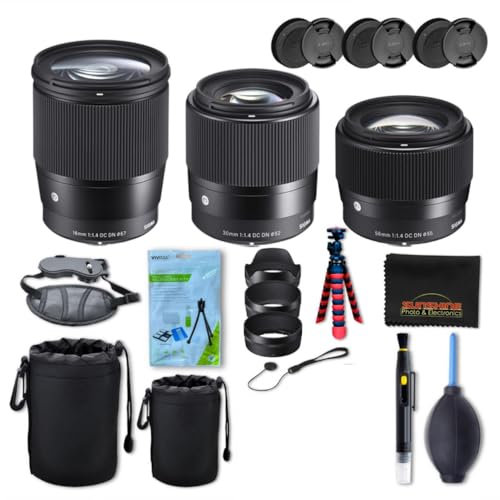
Sigma 16mm + 30mm + 56mm f1.4 DC DN Contemporary Lens for Sony E

Canon EF 50mm f/1.8 STM Lens (Black)

Canon EF-S 24mm f/2.8 STM Lens

VILTROX AF 15mm F1.7 APS-C Wide-Angle Prime Lens for Sony E-Mount

VILTROX AF 25mm F1.7 APS-C Ultra Compact Prime Lens for Sony E-Mount

VILTROX AF 25mm F1.7 Air E-Mount APS-C Lens for Sony

SIRUI Sniper 16mm + 75mm AF Lens Set F1.2 APS-C (Black)

SIRUI Sniper 16mm AF F1.2 Wide Angle APS-C Cine Lens (Black)

SIRUI Sniper 75mm Autofocus F1.2 Telephoto APS-C Cine Lens (White)

VILTROX AF 35mm F1.7 Air APS-C Portrait Prime Lens for Sony E-Mount
The Strengths Of Each Pick
Buying three Sigma f/1.4 DC DN Contemporary primes as a set is the shortcut most Sony E-mount APS-C shooters end up taking anyway. The trio covers wide (16mm), standard (30mm), and short tele (56mm), and all three share the same bright f/1.4 maximum aperture (the widest opening the lens can achieve, which controls how much light hits the sensor). For everyday walkaround use, that means you’re never stuck waiting for enough light or shallow enough background blur.
Sigma bundles the lenses with a Sunshine Photo accessories kit and a four-year USA manufacturer warranty, which adds a layer of confidence to a kit you’ll likely carry for years. If you’ve been piecing together f/1.8 zooms or kit glass and want to jump straight to a low-light-friendly kit, this trio removes the guesswork.
Good Reasons To Consider
- Three fast f/1.4 primes cover the most-used focal lengths in a single purchase, which simplifies kit planning.
- Low-light shooting improves noticeably across the board, since each lens gathers much more light than a typical kit zoom.
- Shallow depth of field (the zone of sharp focus in front of and behind your subject) for portraits and street scenes is consistent across all three focal lengths.
- Four-year manufacturer warranty plus accessories bundle reduces the risk of going all-in on Sigma glass.
- Compact enough to carry two at a time in a small sling, depending on your shooting style.
Worth Noting
- Three lenses means three things to clean, store, and protect, which adds bag weight over time.
- No image stabilization is listed across the set, so you may rely on in-body stabilization or higher ISO for handheld low-light work.
- Focal-length gaps exist between 16, 30, and 56mm, so zoom-style flexibility still requires a separate lens.
Who It Suits Best
Owners of Sony APS-C bodies who want a do-it-all f/1.4 kit without buying each lens separately over time.
Where Another Pick Suits Better
If you mostly shoot one type of content and want the lightest carry, the VILTROX AF 25mm F1.7 APS-C Ultra Compact Prime is a leaner single-lens alternative.
The Canon EF 50mm f/1.8 STM is the lens most DSLR owners eventually mount and never take off. On an APS-C body, that 50mm focal length lands closer to an 80mm equivalent, which is portrait territory, and the f/1.8 aperture gives you real background separation without breaking the bank. STM (Stepping Motor) autofocus keeps focusing quiet and reasonably quick for stills and basic video.
It pairs with Canon’s EOS DSLR line, so anyone running a Rebel, 70D, 80D, or 7D Mark II gets a proper creative step up from a kit zoom. Compared with the Sigma trio above, this lens is a single, dedicated portrait tool at a far lower entry cost.
What Earns Its Place
- Lightweight build makes it easy to carry all day on walks or trips.
- f/1.8 aperture produces noticeably creamy background blur on APS-C bodies.
- STM focusing is smooth for video and quiet for events.
- Low entry cost for a first quality prime lens.
Trade Offs
- Plastic mount construction is a commonly reported durability weak spot over years of heavy use.
- No image stabilization, so handheld shots at low shutter speeds may blur.
- On APS-C bodies the 50mm field of view can feel tight indoors.
Right Fit For
First-time prime lens shoppers with a Canon EOS DSLR who want a clear step up from their kit zoom.
Consider Something Else When
Mirrorless Sony shooters should look at the VILTROX AF 35mm F1.7 Air APS-C Portrait Prime, which suits similar framing on E-mount.
The Canon EF-S 24mm f/2.8 STM is a pancake lens, meaning it sits nearly flush against the camera body. On an APS-C Canon it behaves like a 38mm full-frame equivalent, which is comfortable for street photography, food shots, and environmental portraits. It is also Canon’s lightest EF-S lens, so it barely registers in a small bag.
If you carry a Canon Rebel or similar entry-level body and want something thinner than a kit zoom, this is a friendly upgrade. Compared with the EF 50mm above, the 24mm gives you a wider view indoors without losing the prime-lens benefits.
Reasons It Performs
- Extremely slim profile keeps the camera pocketable.
- f/2.8 maximum aperture balances low-light use with compact size.
- STM motor supports smooth, quiet focusing.
- Useful 38mm equivalent focal length for everyday scenes.
Things To Consider
- f/2.8 is less shallow than the 50mm f/1.8 for portraits.
- EF-S mount limits it to Canon APS-C DSLRs only, not full-frame or mirrorless.
- Build feels light in the hand, which some shooters find less reassuring.
Made For
Travelers and street photographers with a Canon APS-C DSLR who want a thin everyday lens.
Look Elsewhere When
Sony E-mount shooters wanting similar compact carry should consider the VILTROX AF 25mm F1.7 Air E-Mount APS-C Lens for Sony.
VILTROX built this 15mm f/1.7 for Sony E-mount APS-C cameras like the ZV-E10, FX30, a6400, a6600, and a6700. The ultra-wide field of view, roughly an 84.9° angle, fits more of the scene into the frame, which matters in tight interiors, travel vlogs, and architecture. Vloggers especially benefit because the lens keeps both the face and the environment in frame without stepping back.
Where the Canon pancake above trades aperture for slimness, this VILTROX gives you an extra-wide view and a fast f/1.7 aperture at the same time. It is the widest-angle prime on this list, and one of the few truly designed for APS-C E-mount video work.
Key Advantages
- Ultra-wide framing captures travel scenes and interiors without backup distance.
- f/1.7 aperture supports low-light vlogging and indoor content.
- Autofocus designed for Sony’s APS-C mirrorless bodies, including ZV-E10 vlogging models.
- Lighter carry than carrying both a wide zoom and a prime.
Where It May Fall Short
- 15mm distortion on faces at close range is noticeable in selfies.
- No optical stabilization listed, so handheld video may show some shake.
- Ultra-wide framing can feel too wide for traditional portrait framing.
Key Specs
Best Suited To
Vloggers and travel shooters who want one wide lens for Sony APS-C bodies.
A Better Fit Elsewhere
Portrait-focused shooters will find tighter framing and stronger background blur in the SIRUI Sniper 75mm Autofocus F1.2 Telephoto APS-C Cine Lens.
The VILTROX AF 25mm F1.7 APS-C is a friendly standard prime (a fixed focal length lens that mimics the natural field of view of human vision) for Sony APS-C bodies. The 25mm focal length behaves like roughly a 37mm full-frame equivalent, which works well for everyday scenes, food, and casual portraits. With nine circular aperture blades (the metal flaps that open and close to let light in), background blur stays smooth and round.
Compared with the 15mm wide above, this lens gives you a more natural walking-around focal length and tighter subject framing. It is also small enough to stay mounted on a ZV-E10 or a6700 as a daily shooter.
The Practical Payoff
- Compact body suits small Sony APS-C mirrorless cameras.
- f/1.7 aperture gathers enough light for indoor and evening shots.
- Quiet STM stepping motor (a small, precise focusing motor) supports video autofocus.
- Useful 37mm-equivalent framing for everyday content.
Some Limits To Know
- No weather sealing is listed, so rain shooting needs caution.
- 25mm may feel narrow for tight indoor vlogging setups.
- Plastic exterior finish is a commonly reported wear point over time.
Who Should Grab It
Everyday Sony APS-C shooters who want a single versatile prime to leave mounted.
Skip It When
Creators who want even lighter carry and a similar field of view should look at the VILTROX AF 25mm F1.7 Air E-Mount APS-C Lens, which trims further weight.
The Air version of the VILTROX 25mm trims weight down to roughly 180g, which makes long shooting days noticeably easier on your wrist. You still get the same 25mm focal length and f/1.7 aperture as the standard 25mm above, so the optical behavior feels familiar. The trade-off comes in build materials and possibly some handling refinements.
For travel and street content where every gram matters, the Air lens earns its name. Compared with the Sigma trio or the SIRUI cine primes, this is the lightest pick on the list at a similar focal length.
Useful Strengths
- 180g body weight reduces fatigue on long walks.
- Same f/1.7 aperture as the standard 25mm for low-light reach.
- 25mm focal length works for portraits and environmental framing.
- STM autofocus keeps video focusing smooth.
- Fits Sony APS-C mirrorless bodies natively.
Less Ideal Details
- Lighter build may feel less solid to shooters used to metal-barrel lenses.
- No image stabilization listed for handheld low-light video.
Quick Facts
Perfect Match For
Travelers and street content creators who want a featherweight Sony E-mount prime that stays on the body.
Reach For A Different Pick When
Shooters wanting tighter portrait reach and shallower depth of field should consider the SIRUI Sniper 75mm Autofocus F1.2 Telephoto APS-C Cine Lens.
The SIRUI Sniper 16mm + 75mm set is built for hybrid shooters who want one wide and one tight cine-style prime at f/1.2. The 16mm handles vlogs, travel, and architecture, while the 75mm steps in for portraits and detail shots. Both share the same f/1.2 maximum aperture, so the depth-of-field character stays consistent when you cut between them in editing.
Where the Sigma trio offers three f/1.4 lenses for photo-leaning work, the SIRUI set leans into cinematic aperture and dual-purpose framing. If you produce video and stills on the same shoot, having matched glass saves time.
What Stands Out
- f/1.2 aperture produces very shallow depth of field for cinematic video.
- Wide-to-tele focal range covers most run-and-gun scenarios.
- Autofocus designed for Sony APS-C mirrorless bodies.
- Two-lens kit is more bag-friendly than carrying three primes.
Practical Considerations
- f/1.2 demands careful focusing, especially for moving subjects in dim light.
- Larger front elements than typical pancake primes mean a bigger carry footprint.
- Heavier glass can wear on small gimbals without rebalancing.
Whose Shelf It Belongs On
Hybrid photo and video creators who want two f/1.2 primes for Sony APS-C.
Swap It Out When
Travelers who want lighter gear may prefer the single VILTROX AF 15mm F1.7 APS-C Wide-Angle Prime for Sony E-Mount.
The single-lens version of the SIRUI 16mm f/1.2 wide cine prime is the wide half of the set above. It behaves like a roughly 24mm full-frame equivalent, so it keeps you and your environment in frame during selfie-style vlogging. The f/1.2 aperture pulls in significant light for indoor filming and produces creamy backgrounds when you get close to a subject.
Compared with the VILTROX 15mm f/1.7 above, this lens trades a touch of width for an extra stop of light gathering, which matters in dim rooms and evening city scenes.
Practical Pluses
- f/1.2 aperture supports indoor vlogging without harsh lighting.
- 16mm focal length keeps wide framing for travel and architecture.
- Autofocus designed for Sony E-mount APS-C bodies.
- Cine-style rendering suits video-first creators.
Things To Weigh
- Wide close-up framing can exaggerate facial features at arm’s length.
- No image stabilization listed, so handheld vlogs benefit from a gimbal.
- Heavier than typical wide primes, which adds bag weight over time.
Built With In Mind
Vloggers and short-form video creators filming on Sony APS-C bodies in mixed lighting.
Where A Sibling Pick Shines
Portrait shooters needing tighter reach should pair this wide with the SIRUI Sniper 75mm Autofocus F1.2 Telephoto APS-C Cine Lens.
The SIRUI Sniper 75mm f/1.2 is the telephoto half of the cine pair above, sold separately for shooters who only need the long end. On APS-C it behaves like a roughly 113mm full-frame equivalent, which is comfortable headshot territory. The f/1.2 aperture keeps backgrounds buttery and gives you room to work in lower light without cranking ISO.
If you compare this with the Canon EF 50mm f/1.8 from earlier in the list, the SIRUI gives you a longer reach and a wider aperture for similar portrait work, though on Sony E-mount instead of Canon EF.
Positive Takeaways
- 75mm focal length compresses backgrounds for flattering portraits.
- f/1.2 aperture produces very shallow depth of field.
- Comfortable working distance for headshots and fashion work.
- Autofocus designed for Sony APS-C mirrorless cameras.
Potential Drawbacks
- Longer focal length needs steadier hands or stabilization for handheld video.
- f/1.2 focusing is less forgiving on off-center subjects.
- White finish shows dust and smudges more readily than black barrels.
Feature Snapshot
The Right Fit
Portrait and fashion shooters using Sony APS-C bodies who want very shallow depth of field.
Not Your Match When
Travel shooters who need flexibility in one lens will prefer the SIRUI Sniper 16mm + 75mm AF Lens Set, which adds the wide end.
The VILTROX AF 35mm F1.7 Air rounds out the list with a versatile standard framing, roughly a 52mm full-frame equivalent on APS-C. That sits between the VILTROX 25mm and the SIRUI 75mm in field of view, making it a natural everyday carry for portraits, street, and casual video. STM autofocus keeps focusing quiet enough for run-and-gun vlogging.
It complements rather than competes with the other VILTROX entries above, since 35mm on APS-C sits closer to a “normal” human-eye feel. If you want one do-most-things lens on a Sony APS-C body, this is a sensible place to land.
Where It Helps
- 35mm focal length offers natural, versatile framing on APS-C.
- f/1.7 aperture gives usable background blur for portraits.
- STM stepping motor supports smooth video autofocus.
- Compatible with common Sony APS-C bodies like ZV-E10 II, a6700, a6600, a6400, and FX30.
Minor Gripes
- f/1.7 is one stop narrower than the SIRUI cine primes, so background blur is less extreme.
- No weather sealing listed for outdoor shooting in rain.
Feature Card
Who Will Love This
Everyday Sony APS-C shooters who want one general-purpose prime for portraits, street, and casual video.
Another Choice May Suit
Photographers seeking a brighter cine-style look should consider the SIRUI Sniper 75mm Autofocus F1.2 Telephoto APS-C Cine Lens for tighter portrait reach.
What To Weigh Before Buying Aps C Lenses
Match the Mount First
Every lens on this list is built for a specific mount, meaning the physical and electronic connection between lens and camera. Sony E-mount APS-C, Canon EF-S, and Canon EF each fit different bodies, so confirming compatibility saves a return trip. Mixing systems usually requires an adapter, which can slow autofocus or limit features.
Understand Focal Length Equivalents
On an APS-C sensor, focal lengths look tighter than on a full-frame camera because the smaller sensor crops the image. A 50mm lens behaves closer to an 80mm field of view, which is why portrait shooters often reach for 50mm or 75mm APS-C primes. Knowing your equivalent field of view helps you choose a lens that matches how you actually frame shots.
Prioritize Aperture for Your Scenarios
Bright f/1.2 to f/1.7 apertures help indoors, at dusk, and for shallow depth of field. Slower f/2.8 lenses stay compact and lightweight, which matters on long days. Choosing the widest aperture (the lowest f-number, letting in the most light) that fits your main use case balances low-light ability with carry comfort.
Think About Stabilization and Autofocus
Most APS-C primes in this roundup rely on in-body stabilization or higher ISO for handheld video. STM (Stepping Motor) autofocus designs generally focus quietly and smoothly for video, while older ring-type motors can be slower or louder. Matching motor type to your main use case avoids surprises in the field.
Key Considerations Across These Picks
Where Shoppers Go Wrong
A common mistake is buying a lens for a mount you don’t have. Always verify EF, EF-S, or E-mount before ordering. Another pitfall is choosing an aperture that doesn’t match your shooting light: indoor vloggers benefit from f/1.7 or wider, while outdoor shooters can live with f/2.8 for portability.
Where The Extra Money Goes
Higher-tier cine lenses like the SIRUI Sniper pair spend money on f/1.2 apertures, autofocus motors tuned for video, and matching optical character between lenses. The Sigma trio costs more up front because you’re buying three f/1.4 lenses together. For photo-leaning shooters, that trio can replace several zooms; for video creators, the SIRUI pair covers wider creative framing at a steeper price.
Frequently Asked Questions
What does APS-C mean for a lens?
APS-C is a smaller-than-full-frame sensor size, so lenses designed for it produce a tighter field of view at the same focal length. APS-C-specific lenses are usually smaller and lighter than their full-frame counterparts.
Can I use these lenses on a full-frame camera?
Most of these are APS-C-only designs, so they will crop the image on a full-frame body or work in crop mode. For full-frame use, look for lenses marked FE, EF, or full-frame compatible.
Is f/1.4 a lot better than f/2.8?
Yes, in low light, since f/1.4 lets in roughly four times as much light as f/2.8. It also creates noticeably shallower depth of field, which matters for portraits but can be tricky for landscapes.
Do I need image stabilization in an APS-C prime?
Many APS-C bodies include in-body stabilization, which covers handheld stills and video. If your camera does not, look for lenses with optical stabilization or plan for a tripod or gimbal.
Are STM and other autofocus motors different?
Yes. STM (Stepping Motor) lenses focus quietly and smoothly for video, while linear or ring-type motors can focus faster for action stills. Matching the motor to your main use case improves results.
The Takeaway
Picking the right APS-C lens comes down to matching mount, focal length, and aperture to the way you actually shoot. The Sigma trio covers photo-leaning Sony shooters end to end, the Canon primes give DSLR owners a friendly entry point, and the VILTROX and SIRUI options fill modern E-mount video and portrait needs. Whichever lens fits your kit, the glass on this list should keep your camera earning its keep for years.