Picking a telescope for astrophotography feels harder than it should, because the gap between a quick backyard peek and a serious imaging session is enormous. You want glass that pulls in faint nebulae, a mount steady enough for long exposures, and an optical tube that won’t fight your camera for every photon. The picks below cover everyone from first-night beginners to dedicated deep-sky imagers, with honest trade-offs called out along the way.
Your Options, Compared

Askar 71F Flat-Field Telescope 71mm F6.9 ED Glass Refractor OTA

HUGERSTAR 90mm Aperture 600mm Refractor Telescope for Beginners
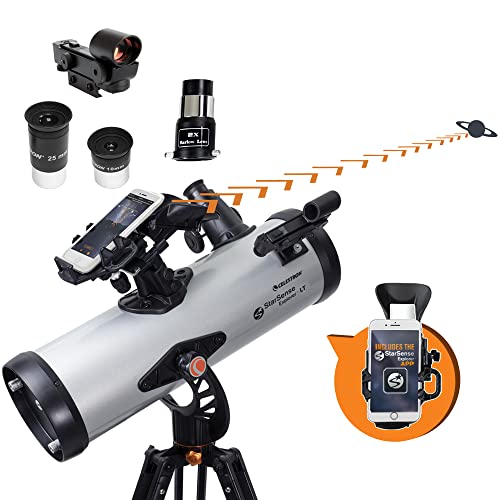
Celestron StarSense Explorer LT 114AZ Newtonian Telescope

HUGERSTAR 80mm Aperture 500mm Refractor Telescope for Beginners

HUGERSTAR 90mm Aperture 600mm Refractor Telescope

HUGERSTAR 90mm Aperture 800mm Refractor Telescope

SVBONY SV503 102mm F7 ED Refractor Telescope

Skyoptikst 114mm Newtonian Reflector Mirror 900mm Focal Length
The Strengths Of Each Pick
The Askar 71F is built for imagers who want flat, corrected stars across a full-frame sensor without dragging a heavy triplet around. Its 71mm aperture (the diameter of the front lens, which controls how much light the scope gathers) and f/6.9 focal ratio (focal length divided by aperture, where lower numbers mean wider, brighter images) come from a quadruplet air-spaced APO design, meaning four lens elements separated by small air gaps to minimize false color. The 230mm Vixen-style dovetail (a standardized mounting bar that slides into compatible saddles) drops onto most mid-range mounts without adapters.
You notice the weight first. At roughly 2.5kg for the tube, it sits comfortably on a small equatorial mount (a tracking head aligned to Earth’s rotational axis so stars stay centered in long exposures) for a full night of guiding. Owners commonly pair it with a dedicated astro camera for wide-field nebula work, where the flat field keeps stars round all the way to the corners. Compared to the lighter HUGERSTAR refractors in this list, this is a clear step up in optical ambition and price.
A Strong Showing
- Quadruplet APO design delivers flat field across full-frame sensors
- ED glass (extra-low dispersion glass that reduces color fringing) keeps chromatic aberration well controlled for tight star clusters
- Compact 2.5kg tube fits on lightweight equatorial mounts
- Integrated Vixen dovetail saves you buying a separate plate
- Air-spaced optics tend to stay clean with routine dust wipes
Trade-Offs
- No mount, finder, or camera included, so the total cost climbs fast
- 71mm aperture gathers less light than the 90mm and 102mm scopes here
- Needs a flat-field calibration frame for best corner sharpness
Who Will Love This
Dedicated deep-sky astrophotographers who already own a mount and camera and want a wide-field APO that travels well.
Look Elsewhere When
The SVBONY SV503 is a friendlier budget if ED glass matters more than quadruplet correction and you don’t need a flat field across full-frame.
HUGERSTAR positions this 90mm refractor as a grab-and-go starter with everything in the box, including a tripod, phone adapter, moon filter, carry bag, and moon phase guide. The 90mm aperture pulls in solid views of the lunar surface, Jupiter’s bands, and Saturn’s rings, while the 600mm focal length keeps the scope forgiving for first-time users. Fully multi-coated lenses (optical surfaces treated with multiple anti-reflection coatings) improve light transmission so dimmer targets don’t look gray.
For backyard sessions, the kit feels friendly. Setup is straightforward, the phone adapter lets you snap quick lunar pictures without a dedicated camera, and the moon filter tames glare when the disc fills the eyepiece. The honest read: this is a visual and casual imaging scope, not a long-exposure workhorse. The tripod is the usual weak point, and you’ll want to upgrade before doing serious planetary photography.
Notable Gains
- Generous accessory bundle removes guesswork for new users
- 90mm aperture gathers noticeably more light than 70mm or 80mm scopes
- Short 600mm focal length gives a wider field, easier for locating targets
- Phone adapter makes lunar snapshots simple
Points To Note
- Stock tripod is the limiting factor for steady planetary views
- Phone-held images rarely match what dedicated astro cameras capture
- Not built for long-exposure deep-sky imaging
Made For
Beginners, families, and casual backyard observers who want a complete kit to start learning the night sky.
Skip It When
The Celestron StarSense Explorer LT 114AZ is a smarter pick if you want guided object-finding built into the mount.
The StarSense Explorer LT 114AZ solves the most common beginner problem: finding things. Dock your phone in the holder, launch the app, and on-screen arrows point you toward targets as the scope analyzes star patterns overhead. The 114mm Newtonian reflector (a design using mirrors instead of lenses, which gives more aperture for less money) collects noticeably more light than 80mm or 90mm refractors in this list, which pays off for deep-sky brightness.
The alt-azimuth mount (up-down, left-right movement, simpler than equatorial but less suited to long exposures) is easy to set up in a driveway or on a patio. Where the scope loses points is tracking: this is a visual and basic imaging instrument, so stars will drift during exposures longer than a few seconds. For moon, planets, and short-snapshot deep-sky work, it’s a confidence-building pick that gets out of your way.
Bright Spots
- StarSense app makes finding targets almost foolproof
- 114mm aperture beats most refractors in this price band for light grasp
- Setup takes only a few minutes out of the box
- Newtonian design gives wide-field views of larger deep-sky targets
Worth Noting
- Alt-az mount limits long-exposure astrophotography
- Newtonian optics need occasional collimation (mirror alignment), which can feel intimidating at first
- Bulkier than the travel-friendly refractor picks above
Right Fit For
Visual observers and beginners who want app-guided targeting without learning star charts first.
Consider Something Else When
The SVBONY SV503 fits better if your priority is long-exposure deep-sky imaging with ED glass color correction.
This 80mm refractor is the lightest, most portable entry in HUGERSTAR’s lineup, and the included backpack keeps everything together for road trips and camping. With a 500mm focal length, the scope leans toward low-power, wide-field views: think open star clusters, the Milky Way, and lunar craters as a whole disc rather than close-up planetary detail. The fully multi-coated optics improve contrast over entry-level scopes that skip coatings.
You’ll find this scope shines at casual observing rather than serious imaging. The accessory kit covers the basics, including a phone adapter and a small tripod, but the tripod is the obvious compromise when wind kicks up. For cabin weekends or backyard family nights, it’s a friendly grab-and-go setup. If you want a noticeably bigger light bucket, the 90mm HUGERSTAR above pulls in more photons for a similar price tier.
A Few Highlights
- Compact tube and backpack make transport painless
- Short 500mm focal length gives forgiving wide-field views
- Coated optics improve contrast over cheaper uncoated scopes
- Family-friendly setup with phone adapter included
Small Caveats
- 80mm aperture gathers less light than the 90mm siblings above
- Stock tripod limits useful magnification in breezy conditions
- Not a strong long-exposure imaging platform
Best Suited To
Travelers, casual campers, and families who want a backpack-friendly refractor for relaxed observing sessions.
A Better Fit Elsewhere
The HUGERSTAR 90mm refractor makes more sense if your backyard sees more use than your trunk and you want more light grasp.
Where this 90mm refractor stands out is the focal length to aperture balance, which translates to bright, sharp lunar and planetary views without demanding expert collimation. The 600mm focal length keeps magnification ranges flexible: swap eyepieces to move from wide-field star clusters to tighter views of Jupiter’s cloud bands. Fully multi-coated optics help maintain image clarity across the field.
For the price tier, this is a confident visual and casual imaging pick. The bundle typically includes eyepieces and a phone adapter so you can capture quick videos of the moon through the eyepiece. The trade-off is the same as most entry-level packages: the included tripod and mount are functional but not inspiring, and you’ll likely replace them within a year.
Where It Delivers
- 90mm aperture gives noticeably brighter views than 80mm scopes
- 600mm focal length suits both wide-field and medium-magnification targets
- Coated optics improve contrast over entry-level uncoated lenses
- Phone adapter unlocks casual lunar and planetary snapshots
Honest Caveats
- Stock mount and tripod limit high-magnification steadiness
- Long-exposure imaging needs a tracking mount you provide separately
- Chromatic aberration on bright targets is more visible than on ED glass scopes
Key Specs
Perfect Match For
Visual observers and budget-conscious beginners who want a clear step up from 70mm or 80mm starter scopes.
Swap It Out When
The SVBONY SV503 is the smarter call if you want ED glass and plan to do deep-sky imaging.
The longer 800mm focal length on this 90mm HUGERSTAR makes it a planetary specialist in a lineup dominated by wide-field options. With a 3X Barlow and dual eyepieces, useful magnification climbs into the range where Saturn’s rings separate and lunar craters reveal their structure. The f/8.89 focal ratio is a slightly tighter image scale than the 600mm siblings, which helps isolate detail on small targets.
Compared to the HUGERSTAR 600mm models above, this scope trades wide-field comfort for tighter views. That suits backyard observers who mainly chase planets and the moon rather than sprawling nebulae. Same trade-off as before: the included mount is fine for visual use, but if you plan to image, plan on upgrading to a tracking equatorial head.
What Works In Its Favor
- Long focal length produces larger planetary and lunar images
- Higher useful magnification for surface detail on bright targets
- Multi-coated lenses keep contrast strong under typical suburban skies
- Compatible with standard 1.25-inch accessories
Things To Consider
- Narrower field of view makes finding deep-sky targets harder
- Higher magnifications amplify tripod shake from the stock mount
- Color fringing on bright objects is more visible than on ED glass scopes
Who Should Grab It
Lunar and planetary observers who prioritize detail over wide-field deep-sky framing.
Another Choice May Suit
The Celestron StarSense Explorer LT 114AZ pulls in more light and offers app-guided finding if you want a bigger aperture and easier targeting.
The SV503 is where this list starts to feel like a real imaging instrument. The 102mm aperture is the largest in the refractor group, and the S-FPL51 ED glass element (a specific type of extra-low dispersion glass that limits false color) noticeably reduces the purple fringing that plagues cheaper achromats (basic two-element lenses that don’t correct for color). The 714mm focal length and f/7 focal ratio land in the sweet spot for deep-sky framing and wide-field lunar work.
Fully multi-coated optics push light transmission up and reflections down, which is what you want during long exposures. SVBONY’s doubler (an optional 1.4x focal extender sold separately) gives you flexibility to push focal length when planetary targets come around. The tube balances nicely on mid-size equatorial mounts, and the visual performance holds up under suburban skies. You do need a mount, finder, and diagonal (a mirror or prism that bends light 90 degrees for comfortable viewing angles) added separately, so plan the budget accordingly.
A Few Strong Suits
- S-FPL51 ED glass keeps chromatic aberration well controlled
- 102mm aperture is the largest in this refractor group
- f/7 focal ratio balances wide-field framing with useful magnification
- Strong imaging performance for the price tier
Practical Considerations
- Mount, finder, and diagonal not included
- Heavier tube demands a sturdier mount than the HUGERSTAR picks
- Optional SVBONY doubler adds cost for planetary imaging
Quick Facts
Built With In Mind
Amateur astrophotographers upgrading from a starter refractor who want ED glass color correction without quadruplet prices.
Reach For A Different Pick When
The Askar 71F is the better call if you need full-frame flat-field correction for serious deep-sky imaging sessions.
This listing is for hobbyists who want to build, not buy. The Skyoptikst primary mirror (the large curved mirror at the back of a Newtonian that gathers and focuses light) is a 114mm Newtonian component with a 900mm focal length and a stated surface accuracy of 1/10λ (a measure of how closely the mirror’s shape matches a perfect curve, where smaller fractions indicate tighter tolerances). The enhanced aluminum coating is rated to reflect 92% of incoming light across the visible and near-infrared range.
You’ll need a secondary mirror (the small angled mirror that redirects light out the side of the tube), a focuser, a spider mount (the thin support that holds the secondary mirror inside the tube), and an optical tube to make a working scope. This is a parts-bin pick, so the audience is narrow: tinkerers and DIY builders who already own or are planning to assemble a reflector. If you want a working telescope out of the box, every other pick on this list is the right answer.
Real Benefits
- 114mm aperture for the cost is hard to match in a finished scope
- 1/10λ surface accuracy supports sharp planetary and lunar imaging
- Enhanced aluminum coating hits 92% reflectance across visible and near-IR
- DIY-friendly for builders making custom Newtonians
What To Weigh
- Mirror only, no tube, focuser, secondary mirror, or mount
- Aluminum coatings need refreshing every several years in humid climates
- DIY assembly adds setup time and learning curve
The Right Fit
DIY telescope builders and tinkerers willing to source the rest of the optical tube assembly themselves.
A Better Fit Elsewhere
The Celestron StarSense Explorer LT 114AZ is the better pick if you want a finished 114mm Newtonian with a working mount and app guidance included.
Matching Aperture, Mount, And Glass To Your Nights
Aperture drives what you can see. A larger front lens or mirror gathers more photons, which means fainter nebulae show structure and dimmer stars become countable. For visual observing under suburban skies, 80mm refractors handle the moon, planets, and brighter clusters comfortably. Serious deep-sky observers typically step up to 114mm Newtonians or 102mm ED refractors for the brightness boost. Astrophotography adds a second demand: the mount matters as much as the glass. Long exposures need an equatorial head that tracks the sky, otherwise stars trail in seconds.
Focal length shapes how you frame targets. Short focal lengths around 500mm to 700mm favor wide-field nebulae and big open clusters. Longer focal lengths from 800mm to 1200mm give tighter planetary and lunar detail but narrow your field of view, which makes finding and framing harder. Pick a focal length that matches your favorite targets before you fall in love with aperture alone.
Optical quality determines image sharpness. Achromatic refractors deliver bright views but show purple halos around bright stars and the moon. ED glass scopes (extra-low dispersion glass) correct that color fringing, and triplet or quadruplet APO designs push correction further for full-frame cameras. If your budget allows, ED glass pays back every clear night you use it, especially under suburban light pollution where contrast already takes a hit.
Eyepieces, Cameras, And What Most Shoppers Miss
Pitfalls Worth Sidestepping
The biggest trap is buying a beautiful optical tube and pairing it with a wobbly tripod. Magnification amplifies shake, and a shaky view at 150X feels worse than a steady view at 75X. Plan your mount spend alongside the scope, not after. Another common miss is ignoring the back-focus requirement (the distance behind the telescope needed for a camera to reach focus, which varies by scope). Some refractors need extra extension tubes for camera adapters, and discovering that at 11pm on a clear night is annoying. Finally, beginners often chase magnification numbers. Useful magnification tops out at roughly twice the aperture in millimeters, and beyond that you get empty magnification that reveals no new detail.
Where The Extra Money Goes
Stepping from an achromatic refractor to an ED or APO scope pays for tighter color correction and flatter fields, which matters most for imaging with full-frame sensors. A premium mount adds tracking accuracy, which lets you stack longer exposures for cleaner deep-sky images. Better coatings lift light transmission and cut internal reflections, which improves contrast on faint targets. None of these upgrades matter equally for every user, and that’s the honest read: figure out which constraint hits your nights first, then spend there.
Frequently Asked Questions
What aperture do you really need for deep-sky astrophotography?
A 102mm refractor or 114mm Newtonian is a sensible starting point for deep-sky work. Smaller apertures can capture bright targets like the Orion Nebula and Andromeda Galaxy, though fainter nebulae benefit from every extra millimeter of light grasp.
Can you do astrophotography with an alt-azimuth mount?
Short exposures under a few seconds work fine on an alt-az mount, but stars drift during longer exposures because the mount doesn’t compensate for Earth’s rotation. Equatorial mounts are the standard for serious long-exposure imaging.
Are ED glass refractors worth the extra cost?
If you image bright stars, the moon, or planets with a color camera, ED glass removes the purple fringing you get from achromats. Visual observers under moderate light pollution also notice the improved contrast, especially on bright targets.
What’s the difference between focal length and focal ratio?
Focal length is the distance light travels inside the scope to reach focus, measured in millimeters. Focal ratio is focal length divided by aperture, where lower numbers mean wider, brighter images suited to deep-sky work.
Do Newtonian reflectors need regular maintenance?
Newtonians need occasional collimation, which is the alignment of the primary and secondary mirrors, because transport and temperature shifts nudge them out of alignment. The process takes a few minutes with a collimation tool and becomes routine quickly.
Closing Remarks
Astrophotography telescopes cover a wide spectrum, from casual 80mm refractors to quadruplet APOs designed for full-frame cameras. Match the scope to the targets that excite you, budget honestly for the mount and accessories, and you’ll spend clear nights enjoying the view rather than fighting the gear.