There comes a moment in every homeowner’s or mechanic’s life when you need to look inside something you can’t take apart. A borescope camera solves that exact frustration, threading a tiny light-bearing probe into wall cavities, drain lines, engine blocks, and firearm barrels so you can diagnose without guessing. If you’re a DIYer, a vehicle tech, a plumber, a hunter who takes barrel care seriously, or someone who just wants to find that lost item behind the washing machine, this category earns its place in your toolbox. We’ve narrowed ten solid contenders worth considering for 2026, covering rigid rifle scopes, articulating automotive probes, long-reach drain snakes, and dual-lens hybrids.
A Side-By-Side Look

Teslong Rigid Rifle Borescope 0.2in Rod 26in 4.5in HD Screen

FOXWELL 2-Way 220° Articulating Borescope Camera 1080P FHD

Teslong NTG500H Rigid Rifle Borescope with 5″ Monitor

2-Way Articulating Borescope 0.24in Probe Endoscope for Auto Engine
Teslong 50FT USB C Borescope Camera for iPhone 15/16/17 Android
Teslong MS450 50FT Dual Lens Drain Pipe Snake Camera
Teslong Dual Lens 50FT Sewer Camera for Drain & Plumbing
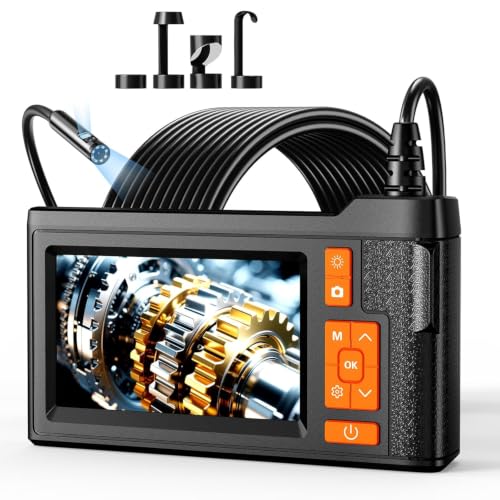
Dual Lens Borescope Inspection Camera 4.3″ HD Screen 1080P

Dual Lens Borescope Camera 33FT 4.3″ HD Screen 1080P
Triple Lens Borescope 5″ IPS Screen 1080P 50FT Cable
Why These Options Stand Out
This Teslong unit trades flexibility for precision, which is exactly what rifle owners want when peering down a barrel. The 0.2-inch rigid rod slips cleanly into .20 caliber and larger bores, while the 26-inch insertion length covers most hunting and target rifles from muzzle to chamber. A built-in 4.5-inch HD display and onboard microSD storage mean there is no phone or app required, so you set it up at the bench and start inspecting within seconds.
For reloaders and gun owners who care about throat erosion, copper fouling, or cleaning regimen feedback, this format delivers a focused, repeatable view. The trade-off is obvious, though, because a rigid rod has zero forgiveness for off-axis barrel geometry.
Advantages To Know
- Standalone operation with onboard screen, no phone dependency at the bench.
- 0.2-inch slim rod designed to enter small rifle bores from .20 caliber upward.
- 26-inch reach suits most sporting and hunting-length firearm barrels.
- Onboard microSD recording lets you save still images and video for later review.
Things To Consider
- Rigid rod won’t navigate curves, so it’s strictly for straight-line barrel work.
- 4.5-inch screen is portable but small compared to the Teslong NTG500H’s 5-inch display.
Right Fit For
Firearm owners who want a dedicated, phone-free barrel inspection tool for their reloading bench.
Skip It When
You need a flexible probe for engines, walls, or drains, in which case the FOXWELL 2-Way 220° Articulating Borescope suits that role better.
The FOXWELL articulating probe earns its place for one simple reason: it actually reaches where your eyes can’t. Unlike the rigid Teslong rifle scopes above, this camera’s tip bends up to 220 degrees in two directions, letting you peek behind engine components, inside spark plug wells, or around ductwork corners. The 0.24-inch probe diameter is on the slim side of the category, which matters when you’re threading it past exhaust manifolds or through tight valve covers.
1080P full HD imaging keeps fine details legible on the paired display, and an integrated LED light brightens whatever the camera finds. This is the pick for mechanics who want a probe that thinks around corners, not just into them.
What Earns Its Place
- 220-degree two-way articulation unlocks inspection angles straight probes cannot reach.
- Slim 0.24-inch probe diameter slips into spark plug holes and narrow engine gaps.
- 1080P HD sensor paired with LED illumination for darker cavities.
Worth Noting
- Cable length isn’t listed in the source, so verify it suits your typical inspection depth.
- Articulation adds mechanical complexity and a slightly higher learning curve than fixed-tip probes.
Built With In Mind
Auto technicians and serious hobbyists who regularly diagnose inside engine bays, dashboards, or HVAC ductwork.
Consider Something Else When
You mostly inspect long, straight drains rather than tight cavities, in which case the Teslong MS450 50FT Drain Pipe Snake Camera is a better fit.
Teslong’s NTG500H is essentially the grown-up sibling of the first pick on this list. You still get a 26-inch rigid probe built for rifle barrels, but the screen grows to 5 inches and gains a close-focusing camera head that helps when you’re evaluating small surface details like rifling wear or carbon scoring. Reloaders who share inspection results with friends or document their cleaning routine will appreciate the larger, easier-to-see image.
Like the smaller Teslong, this one runs independently with no app dependency. If you spend serious time at the reloading bench, the extra screen real estate reduces eye strain over long sessions.
Everyday Perks
- 5-inch HD color monitor offers a larger, easier-to-share view than 4.5-inch alternatives.
- Close-focusing camera head helps reveal fine barrel surface details.
- Standalone design keeps your phone free for notes or reference material.
Trade Offs
- Rigid rod, like the smaller Teslong, is unsuited for non-barrel inspections.
- Larger screen adds a bit more bulk for transport to the range or bench.
Key Specs
Whose Shelf It Belongs On
Reloading hobbyists and bench shooters who want a step up in screen size and detail clarity over entry-level rifle scopes.
A Better Fit Elsewhere
You need a flexible camera for cars or drains, in which case the FOXWELL 2-Way 220° Articulating Borescope is the better match.
This LumenScope articulating borescope takes aim squarely at home mechanics who want flexibility without paying for the highest articulation spec on the market. The probe head pivots 210 degrees in two directions and locks at any angle you choose, while a 5.3-foot semi-rigid cable gives you decent reach for under-hood work without dragging extra length around the garage. A 0.24-inch tip keeps the probe slim enough for spark plug ports and tight valve cover gaps.
It’s positioned for people who don’t need the absolute maximum articulation angle but do want a bendable tip that locks in place when you find the angle you need. The honest read is that this lands in the practical, no-frills zone for weekend auto work.
Benefits That Matter
- Two-way 210-degree articulating head with angle-lock for hands-free viewing.
- 5.3-foot flexible cable balances reach with manageable handling.
- Compact 0.24-inch diameter for tight engine bay entry points.
- No-app operation simplifies setup at the workbench.
Points To Keep In Mind
- 210-degree articulation is slightly less than the FOXWELL’s 220-degree range.
- Semi-rigid cable prefers gentle curves, so deep drain runs aren’t its strength.
Best Suited To
Weekend auto DIYers who want a bendable tip and don’t need extreme articulation angles for professional engine diagnostics.
Look Elsewhere When
You need to push deep into drain lines or sewer runs, in which case the Teslong MS450 50FT Drain Pipe Snake Camera is a more appropriate tool.
Phone-first inspectors who already carry a modern USB-C device will appreciate this Teslong’s direct-plug simplicity. There is no separate screen, no battery pack, and no WiFi pairing step, just connect it to a recent iPhone or Android and the camera feed appears through the companion app. The 50-foot cable extends your reach into wall cavities, attic runs, or longer drain sections, and the IP67 waterproof probe rating means it survives encounters with moisture that would kill lesser scopes.
The trade-off is flexibility versus rigidity: a long semi-rigid cable bends but won’t push as forcefully as a professional sewer camera. Pairing it with a drain snake helps it navigate stubborn pipe sections.
A Few Highlights
- 50-foot cable reaches further than most general-purpose DIY scopes.
- IP67-rated waterproof probe handles damp or briefly submerged inspections.
- USB-C direct connection keeps setup fast and power-free.
- Works with iPhone 15/16/17 and Android USB-C devices without extra hardware.
Honest Caveats
- Semi-rigid cable bends but doesn’t push with the force of a professional sewer camera.
- Phone dependency means your phone is occupied during inspections.
Quick Facts
Who Should Grab It
DIYers with a USB-C phone who want long reach without carrying a separate display unit.
Swap It Out When
You prefer a dedicated screen or dual-lens viewing, in which case the Teslong Dual Lens 50FT Sewer Camera for Drain & Plumbing Inspection is the better match.
The Teslong MS450 takes the dual-lens concept and points it squarely at drain lines. A forward-facing camera lets you see what lies ahead, while a second lens captures the pipe walls, which is critical when you’re looking for cracks, root intrusions, or partially collapsed sections. The 50-foot cable gives you enough reach for main line inspections on most residential properties.
Like other long-reach Teslong models, this one is best paired with a drain snake to push through stubborn sections, since the semi-rigid cable bends but won’t force its way past blockages on its own. For plumbers and homeowners hunting for the source of a clog, dual-lens visibility shortens the diagnostic process considerably.
Well-Handled Touches
- Dual-lens design shows both forward path and pipe walls simultaneously.
- 50-foot reach handles main residential drain line inspections.
- IP67 waterproof probe tolerates submerged drain work.
Minor Gripes
- Drain snake recommended separately for navigating blockages.
- Cable is semi-rigid, so sharp 90-degree pipe bends are challenging.
Perfect Match For
Homeowners and small-scale plumbers diagnosing residential drain and sewer line issues before calling a service.
Reach For A Different Pick When
You specifically want a split-screen view on a built-in monitor, in which case the Teslong Dual Lens 50FT Sewer Camera is a more direct option.
This Teslong upgrade over the MS450 adds a true split-screen display, letting you watch both camera feeds at once on the built-in monitor. A front camera with 6 LEDs handles the path-forward view, while a side-facing camera with 1 LED inspects pipe walls as you push the cable through. The 50-foot semi-rigid cable is built to traverse straight PVC drains where clogs, cracks, or root intrusions are most likely hiding.
Notably, it requires no phone or WiFi connection, so the entire kit is self-contained and easy to grab when a drain emergency hits at 9 p.m. That standalone convenience is genuinely useful in real-world plumbing chaos.
Strong Points
- Split-screen view shows forward path and pipe walls simultaneously.
- Standalone monitor with no phone or WiFi dependency.
- 50-foot semi-rigid cable targets straight PVC drain lines.
- Dual LED lighting (6 forward, 1 side) keeps both views illuminated.
Soft Spots
- Semi-rigid cable struggles with sharp pipe bends or fully blocked drains.
- Best paired with a drain snake, sold separately.
Feature Snapshot
Who Will Love This
Homeowners and handymen who want a fully standalone drain camera with simultaneous forward and side visibility.
Not Your Match When
You need articulating flexibility around engine components, in which case the LumenScope 2-Way Articulating Borescope is the better choice.
The GinoCaco dual-lens inspection camera brings the dual-view trend to a more compact 4.3-inch format. You get both a forward and a side camera on the same probe, which is genuinely useful when you’re inspecting engine bay crevices, wall cavities, or appliance interiors where the angle of interest may shift mid-inspection. Switching between lenses happens with a long-press of the photo button, so you don’t have to swap probe heads or fiddle with extra hardware.
There is no WiFi, no app, and no smartphone in the loop, which simplifies the workflow considerably. For around-the-house inspections where you’d rather not hand your phone over to grease and dust, this standalone design hits a practical sweet spot.
Key Advantages
- Dual front and side cameras on one probe head reduce camera swapping.
- 1080P photo and video recording for documentation and review.
- 4.3-inch built-in screen means no phone required.
- No-app operation simplifies setup in greasy or dusty workspaces.
Small Caveats
- Side-camera switching requires a 3 to 5 second button hold, which trips up first-time users.
- 4.3-inch screen is smaller than the Teslong NTG500H’s 5-inch monitor.
Made For
Home workshop tinkerers who want dual-lens versatility in a compact, standalone package for general inspection tasks.
Another Choice May Suit
You need a much longer 50-foot reach for drain runs, in which case the GinoCaco Triple Lens Borescope with 50FT Cable offers that plus an extra lens.
Not every inspection demands 50 feet of cable, and this GinoCaco fills the middle ground nicely. The 33-foot semi-rigid cable reaches far enough for engines, wall gaps, HVAC ducts, and most under-sink scenarios, without the bulk and tangling risk of longer industrial reels. The dual-lens probe gives you both forward and side views on a 4.3-inch HD screen with 1080P photo and video capture.
Pre-bending the cable before insertion into curved areas is recommended, which is a small habit worth picking up. Sharp 90-degree pipe bends and fully blocked drains remain beyond its reach, but for general around-the-home use, the size feels right.
What It Does Well
- 33-foot semi-rigid cable balances reach with manageable handling.
- Dual front and side cameras reduce the need to reposition the probe.
- 1080P photo and video capture for documenting findings.
- 4.3-inch built-in screen keeps the workflow phone-free.
Possible Compromises
- Sharp 90-degree pipe bends and fully blocked drains are not recommended.
- Cable must be pre-bent for curved insertions, adding a habit to learn.
At A Glance
The Right Fit
Generalists who want moderate reach and dual-lens flexibility for cars and home inspections without dragging around 50 feet of cable.
Where A Sibling Pick Shines
Your work centers on long drain or sewer runs, in which case the Teslong Dual Lens 50FT Sewer Camera is the better tool.
The GinoCaco triple-lens borescope takes the dual-lens concept one step further, adding a third viewing angle on the same probe head for even more flexibility during inspections. The 5-inch IPS screen is the largest display on this list, with wider viewing angles and better color reproduction than standard TN panels, which helps when you’re sharing the view with someone else over your shoulder.
The 50-foot cable targets heavier jobs like drain runs, deep engine work, and inspections behind walls. Pressing the photo button for several seconds switches between cameras, and the design philosophy remains the same: standalone operation, no apps, no WiFi pairing. For people who want maximum viewing flexibility in one tool, this rounds out the list nicely.
Practical Advantages
- Triple lens design offers more viewing angles than dual-lens alternatives.
- 5-inch IPS screen delivers wider viewing angles and richer color.
- 50-foot cable supports long drain, wall, and engine inspections.
- 1080P photo and video capture built in.
- No-app, standalone operation simplifies setup.
Where It Is Less Suited
- Long-press camera switching can confuse first-time users.
- Larger screen and longer cable add overall kit bulk compared to compact picks.
Feature Rundown
Who It Suits Best
Versatile inspectors who want maximum lens flexibility and a large standalone screen for varied drain, engine, and wall work.
Where Another Pick Suits Better
Your inspections stay within rifle barrels only, in which case the Teslong NTG500H Rigid Rifle Borescope is purpose-built for that exact job.
What To Weigh Before Choosing a Borescope Camera
Match the Probe to the Job
Rigid probes deliver straight, distortion-free views ideal for firearm barrels and short, fixed-depth inspections. Flexible semi-rigid cables reach into walls, drains, and engine bays where straight lines won’t work. Articulating probes add the ability to bend the camera tip around corners, which matters when you’re working in engine compartments or behind appliances. For rifle work, rigid wins; for home and auto versatility, flexible or articulating wins.
Decide Between Built-In Screen and Phone Connection
Self-contained units with built-in screens let you leave your phone in your pocket, work in greasy or wet environments without worry, and get started the moment you power on. Phone-connected scopes save on bulk and use the large display you’re already carrying, but tie up your phone during inspections and depend on app compatibility. If you work in conditions that would damage a phone, standalone is the practical call.
Cable Length and Waterproofing Drive Reach
Longer cables extend your working radius into drains and crawl spaces, but they also add bulk, tangling, and storage considerations. A 33-foot cable suits most around-home tasks, while 50-foot cables target drain and sewer work. Pair longer cables with a drain snake for navigating stubborn blockages. Waterproofing ratings like IP67 protect the probe from moisture during plumbing work and outdoor inspections.
Lens Count Shapes What You See
Single-lens scopes look straight ahead, which works for many tasks. Dual-lens scopes add a side view that helps when you want to inspect pipe walls or off-axis details without repositioning the probe. Triple-lens scopes add another angle for maximum flexibility in tight or unknown spaces. More lenses mean more viewing options but also more switching habits to learn.
Common Slip Ups and Upgrade Payoffs
Pitfalls Shoppers Hit
Choosing the wrong probe rigidity ranks as the most common mistake. A flexible cable pushed into a rifle barrel flexes uselessly, while a rigid rod can’t navigate a curved engine bay. Also worth watching: overlooking waterproofing for plumbing work, picking a phone-only scope for environments where you can’t risk your phone, and underestimating how often a longer cable becomes a tangled storage headache rather than a useful feature.
Where The Extra Money Goes
Higher-tier borescopes tend to spend the budget on articulation range, dual or triple lens designs, larger IPS displays, and longer semi-rigid cables. The upgrade pays off for professionals and serious DIYers who inspect varied environments weekly. For occasional around-home use, a mid-range dual-lens unit with a built-in screen covers the most common scenarios without overspending.
Frequently Asked Questions
What is a borescope camera used for?
A borescope camera lets you visually inspect hard-to-reach spaces like rifle barrels, drain lines, engine interiors, and wall cavities without disassembly. It combines a tiny camera on a flexible or rigid probe with a light source and a display.
What is the difference between a rigid and flexible borescope?
A rigid borescope keeps the probe perfectly straight, which is ideal for firearm barrel inspections and short, direct views. A flexible or semi-rigid borescope bends around curves, reaching into drains, walls, and engine components that rigid rods cannot enter.
Do I need an articulating borescope for engine work?
Articulating borescopes help in engine bays because you can angle the camera tip around manifolds, brackets, and other obstructions. For simpler under-hood checks, a flexible non-articulating cable may still reveal plenty, depending on the task.
Are these cameras safe for plumbing use?
Waterproof probes rated IP67 or higher handle brief submersion and wet drain conditions without damage. You still want to avoid forcing the cable past sharp bends or fully blocked pipes, since mechanical stress damages any probe.
Can I use a borescope with my phone?
Several models on this list connect directly to phones via USB-C or WiFi, displaying the camera feed through a companion app. Standalone units with built-in screens offer a phone-free alternative for situations where you prefer to keep your device separate.
Wrap Up
Your best fit depends entirely on the work in front of you, since rifle owners, mechanics, plumbers, and general DIYers all need different probe shapes and lengths. Start by identifying whether you need rigid precision, flexible reach, articulating angles, or long drain-run capability. The ten options above cover the major use cases well, so once you know your typical inspection scenario, the right pick usually becomes clear.