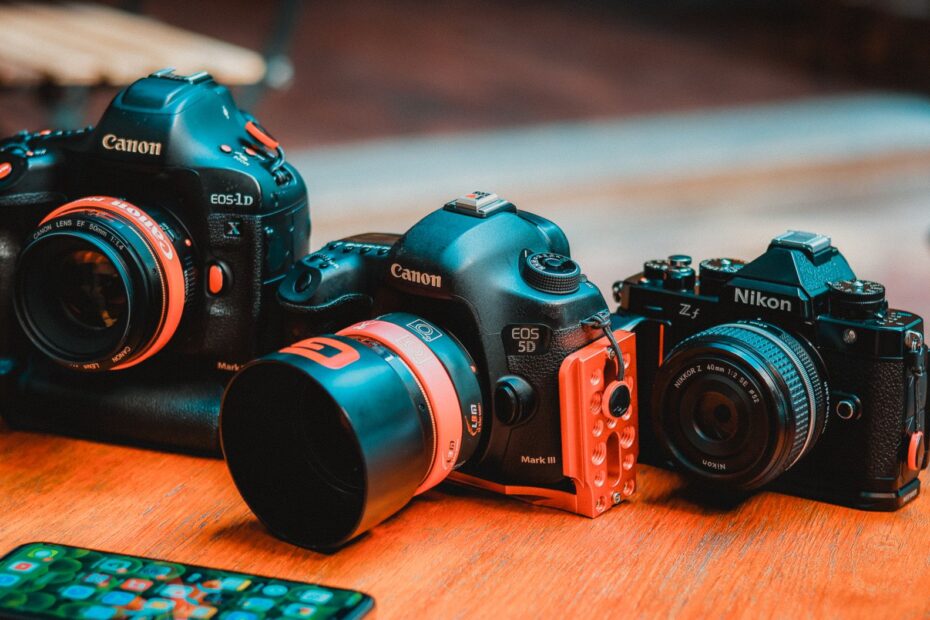
Inside these interchangeable-lens bodies, a reflex mirror and optical viewfinder direct light in a DSLR, while a mirrorless model sends it straight to the image sensor. That mechanical difference shapes your viewfinder, autofocus system, camera size and weight, battery life, and video workflow.
This comparison helps you choose a first camera body, keep an established lens kit, or plan a photo-and-video setup around the way you shoot.
The Reflex Mirror Separates the Two Designs
Light enters through your lens before it reaches a screen, viewfinder, or memory card. Inside a DSLR, a reflex mirror reflects that light upward through a prism or pentamirror. Your optical viewfinder shows the scene directly through the lens, without a live sensor display.
DSLR light path: Lens → reflex mirror → prism or pentamirror → your eye
During an exposure, the mirror swings upward so light can reach the image sensor. That movement creates the familiar shutter sound and briefly darkens the optical viewfinder. You see this blackout during burst shooting, especially with fast-moving subjects.
A mirrorless camera removes the mirror box. Light reaches the image sensor continuously, and the sensor sends a live feed to your rear screen or electronic viewfinder (EVF). Your framing view is electronic rather than reflected.
Mirrorless light path: Lens → image sensor → rear screen or electronic viewfinder → your eye
An EVF shows a small display with shooting data layered over the scene. Exposure compensation, white balance, focus peaking, and histograms can appear before you press the shutter. That preview changes how you judge a frame in bright sun, dim interiors, or mixed lighting.
Viewfinders Change What You See Before Capture
The viewfinder is the clearest everyday difference between DSLR and mirrorless cameras. An optical viewfinder shows real scene light with no display refresh, while an electronic viewfinder shows sensor output. Your preference may become obvious after only a few minutes of framing the same scene through both designs.
Optical viewing has a direct, natural look. A DSLR finder does not need display power, and it does not show digital noise in low light. But it cannot preview your final exposure or white balance before capture.
Electronic viewing shows the camera’s interpretation of the scene. Your EVF can brighten a dark street, show zebra warnings over bright highlights, and reveal a color shift from indoor lighting. That preview gives you feedback before the file reaches your memory card.
| Feature | DSLR | Mirrorless camera |
|---|---|---|
| Viewfinder type | An optical viewfinder shows reflected scene light. | An EVF shows live image sensor output and shooting data. |
| Body depth | A mirror box adds depth behind the lens mount. | No mirror box allows a shallower body design. |
| Autofocus path | A separate phase-detect module works during optical viewing. | The image sensor handles autofocus across much of the frame. |
| Battery draw | The optical finder does not need continuous screen power. | The EVF or rear screen draws power during framing. |
| Video framing | Live view varies by body generation. | Sensor-based framing is built into the design. |
| Lens history | Canon EF and Nikon F have deep used-lens stock. | Sony E-mount, Nikon Z, Canon RF, and Fujifilm X mounts add newer native lenses. |
For a long stills session, the optical finder can feel less tiring because it shows no miniature display. For photo-and-video work, an EVF gives you exposure feedback that matches the sensor’s view. Your choice comes down to direct optical viewing versus live electronic preview.
That preview informs exposure decisions, while final image quality still depends on the sensor and glass behind it.
Image Quality Relies on Sensor and Lens Choices
A missing mirror does not improve a photograph by itself. Mirrorless vs DSLR image quality depends more on sensor size, sensor generation, lens sharpness, lighting, exposure, and your technique than on the camera body style.
A 24-megapixel Canon EOS DSLR and a 24-megapixel mirrorless body can produce closely matched files with the same scene, lens, and exposure. Your full-frame sensor gathers more light than a smaller sensor at equal settings. A fast f/1.8 lens also changes background blur more than a mirror or EVF does.
Newer mirrorless bodies may show gains in high-ISO output, processing speed, and features such as in-camera focus stacking. Those gains come from newer sensors and processors. The reflex mirror is not the source of image quality.
Spend more time checking light direction, shutter speed, aperture, and focus point. Your choices in those four areas shape more photographs than the label on the camera body.
Lens quality also matters across either format. A sharp 35mm prime or 70-200mm zoom can remain useful through several body upgrades. Your lens ecosystem deserves as much attention as megapixel count because lenses shape contrast, framing, autofocus behavior, and background rendering.
Yet the camera body determines how effectively that lens behavior translates into subject tracking.
Sensor-Based Autofocus Favors Modern Tracking
Fast subjects expose the largest practical gap between older DSLR designs and newer mirrorless bodies. A DSLR uses a dedicated phase-detection autofocus system during optical-viewfinder shooting. A mirrorless camera focuses directly on the image sensor that records your file.
Your mirrorless focus points can reach close to the frame edges. Current Nikon Z, Sony Alpha, Canon EOS R, Fujifilm X Series, and Micro Four Thirds bodies can recognize faces, eyes, animals, birds, and vehicles. The camera can then follow your selected subject during burst shooting.
Capable DSLRs still track action well. A Nikon D500 or Canon EOS-1D X class body can follow a runner, cyclist, or bird with speed through an optical viewfinder. But a modern mirrorless body places subject recognition closer to the edge, where DSLR autofocus points rarely extend.
Video starts with a live sensor feed
During a take, the image sensor supplies a continuous live feed for recording. Mirrorless bodies begin with that feed already active, so your EVF and rear screen can show exposure changes, focus peaking, zebra warnings, waveform tools, and autofocus behavior before recording starts.
Face tracking and silent electronic shooting also suit events where your subject moves between still images and video clips. A mirrorless camera can use a mechanical shutter as well, but electronic shutter modes reduce sound in quiet spaces such as ceremonies, wildlife blinds, or courtrooms.
Heat remains a real trade-off in compact bodies. Long high-resolution recording can trigger thermal limits, so your planned clip length matters as much as resolution. Your workflow needs more than a headline specification.
Heat management and battery life become especially consequential when a lighter body leaves less room for both.
Smaller Bodies Trade Power for Portability
Removing the mirror box trims depth from the camera body, not from every lens kit. A mirrorless camera with a small prime lens can fit in a compact shoulder bag. A 70-200mm f/2.8 zoom remains large on either mount.
Your camera size and weight matter most with short lenses, street photography, hiking, and carry-on travel. Large full-frame zooms reduce the weight gap. A larger DSLR body may also feel steadier with a heavy telephoto lens than a small grip does.
Optical viewing stretches battery endurance
A DSLR can capture hundreds more frames per charge because the optical viewfinder needs no active display. Your mirrorless battery powers the EVF or rear screen during framing, playback, menu work, and image review. A spare battery becomes sensible for a long shooting day.
- EVF preference: Your eyes may favor the direct look of an optical finder over a small electronic display.
- Display delay: An EVF can show slight lag in dim scenes or rapid movement.
- Dense menus: Advanced mirrorless bodies can place deep controls inside screen menus.
- Video heat: Long high-resolution recording can reach thermal limits in compact bodies.
- Mount change: A newer system may require new bodies, lenses, batteries, cards, and chargers.
Battery life is not a reason to rule out mirrorless equipment. It is a planning detail. Charge your cells, pack a spare, and switch off features that do not serve your shoot.
Lenses and Adapters Shape Long-Term Value
Your lens mount can matter longer than your camera body. Canon EF mount and Nikon F mount lenses fill the used market, giving your budget access to 50mm primes, macro lenses, flashes, and telephoto zooms from several decades of production.
Existing glass can make a DSLR the sensible path. A used DSLR body paired with a sharp 35mm or 50mm lens can teach exposure, timing, and composition without forcing a mount change. Your familiar lenses may also feel more valuable than newer autofocus features.
Native mirrorless lenses fit newer systems
Mirrorless mounts such as Sony E-mount and Nikon Z use lenses designed around newer autofocus motors, edge-to-edge coverage, and video-friendly focus behavior. Your native lens also tends to communicate cleanly with the body for aperture control, stabilization, and firmware updates.
Adapters can place many DSLR lenses on mirrorless bodies. Results vary by mount, lens age, adapter design, autofocus motor, stabilization link, and video needs. Your compact DSLR prime can feel less balanced after an adapter adds length between the lens and body.
Check the exact lens-and-body pair before changing systems. An adapter may keep autofocus quick for still photography yet hunt during video or omit a specialized function.
This lens question sits at the center of mirrorless vs DSLR pros and cons. Your body may change every few years, but compatible lenses can stay in your bag far longer. Start with the focal lengths you use, then check each mount’s available glass.
Your Shooting Habits Set the Better Fit
Your routine should settle the format more reliably than a specification sheet. Mirrorless vs DSLR for beginners leans toward mirrorless because live exposure preview shows an underexposed or overexposed frame before capture. That feedback can shorten the learning curve around aperture, shutter speed, and ISO.
A travel photographer carrying a Nikon Z body with a small 28mm lens gains a lighter setup and an EVF that brightens dark streets. A video creator gains continuous face detection and exposure monitoring, which reduces missed focus during a moving interview.
Budget-focused learners can still find value in a used Canon EOS DSLR with EF lenses. Your optical view stays clear in bright sun, battery changes happen less frequently, and used accessories remain easy to locate. A DSLR is not less capable because it lacks an EVF.
Sports, wildlife, and paid assignments call for a narrower comparison. Your mirrorless body has an edge for broad-frame tracking and rapid bursts. A skilled DSLR photographer can still produce professional work with reliable lenses, practiced timing, and a strong understanding of subject movement.
- Active subjects: Favor broad-frame detection for birds, sports, pets, and moving children.
- Long sessions: Favor optical viewing where battery swaps would interrupt your work.
- Regular video: Favor live monitoring and sensor-based autofocus for frequent clips.
- Existing lenses: Keep compatible glass where it still serves your subjects well.
- Travel kits: Favor a smaller body and short lens where bag space matters.
- Learning style: Favor live exposure preview where visual feedback helps your practice.
The question “should I buy a DSLR or mirrorless camera” has no single answer. Your subjects, lens collection, budget, and tolerance for battery swaps matter more than a format label.
DSLR Development Has Shifted Toward Mirrorless Mounts
New DSLR launches have slowed because major manufacturers place research into mirrorless mounts, sensor-based autofocus, and video features. The simpler body design leaves room for new lens concepts and electronic features that fit current demand.
Why are DSLRs being discontinued is really a question about manufacturer investment, not whether older cameras still work. Canon, Nikon, Sony, Fujifilm, Panasonic, and OM System now place major attention on mirrorless systems. Canon and Nikon still have extensive DSLR lens histories that continue to serve working photographers.
Your DSLR does not lose usefulness because a newer format receives more attention. Working bodies, lenses, batteries, flashes, grips, manuals, and repair knowledge remain available for long-running Canon and Nikon systems. A well-kept camera remains a practical tool.
DSLR vs mirrorless camera becomes clearer after you account for the full kit rather than body dimensions alone. Your next body should suit the lenses, subjects, and shooting habits you already have. A format change makes sense only where its advantages solve a real limitation in your work.
Final Thoughts
The reflex mirror is the dividing line, but your priorities decide the format. Choose mirrorless for live preview, advanced tracking, and photo-video tools. Choose a DSLR for optical viewing, longer battery endurance, or a valuable collection of compatible lenses.
Your strongest photographs come from a camera you carry, understand, and pair with the right lens. Both designs can produce professional images. The better choice is the one that removes friction from your own shooting routine.
FAQ
What is the main difference between a DSLR and a mirrorless camera?
A DSLR uses a reflex mirror and optical viewfinder to show light through the lens. A mirrorless camera sends light directly to the image sensor, which feeds a rear screen or electronic viewfinder. Your viewfinder experience, body depth, autofocus system, and battery draw follow from that design difference.
How do optical viewfinders and electronic viewfinders differ?
An optical viewfinder shows reflected scene light directly through the lens. An electronic viewfinder shows a live sensor display with exposure preview, white balance, focus aids, and shooting data. Your optical finder has no display refresh, while your EVF previews the recorded image more closely.
Are mirrorless cameras better than DSLRs for autofocus and video?
Mirrorless cameras have an advantage for broad-frame autofocus tracking and video because the image sensor handles both viewing and focus detection. Your modern mirrorless body can recognize faces, eyes, animals, birds, and vehicles across much of the frame. A capable DSLR still tracks action well through its optical finder.
Why are mirrorless cameras generally smaller and lighter than DSLRs?
Mirrorless bodies do not need a reflex mirror, prism, or mirror box behind the lens mount. That removes depth from the camera body. Your total kit weight still depends heavily on lenses, since a 70-200mm f/2.8 zoom remains large on either format.
Do DSLRs have better battery life than mirrorless cameras?
DSLRs can capture hundreds more frames per charge because an optical viewfinder does not need continuous display power. Your mirrorless camera powers an EVF or rear screen during framing and playback. Spare batteries reduce that difference during long shooting days.
Why are DSLRs being discontinued by some manufacturers?
Manufacturers place new development into mirrorless mounts because sensor-based autofocus, electronic viewfinders, and video features fit those bodies well. Fewer DSLR releases reflect that investment direction. Your existing DSLR and compatible lenses can still produce strong photographs.