Whether you’re setting up a photography studio, dialing in the lighting for a grow tent, or checking whether your home office meets reasonable brightness levels, a handheld light meter takes the guesswork out of the equation. These ten budget-friendly options cover photographers, indoor gardeners, facilities inspectors, and home office workers who need reliable lux readings without dropping pro-grade cash. Each pick below leans on a different strength, from NIST-traceable certifications to rotating sensors that make awkward angles easier, so you can match the tool to your actual workflow.
Your Options, Compared

Triplett LT80 LED Illuminance/Light Meter
URCERI Handheld Ambient Light Meter with Temperature

DANOPLUS Lux Meter with 360° Rotating Sensor

Fluke 941 Light Meter Illuminance Tester

UNI-T UT383 Digital Illuminance Meter
MT-92H Split Sensor Light Meter

Dr.meter Digital Illuminance Light Meter

TopTes TS-710 Light Meter
SMART SENSOR AS803 Lux Light Meter
BTMETER BT-881D Illuminance Light Meter
Why These Options Stand Out
The Triplett LT80 is built for environments where “close enough” doesn’t cut it. It comes with a Certificate of Traceability to NIST, which is the kind of paperwork that matters when safety inspectors or facility managers need documented calibration. Compared to the URCERI handheld later in this list, the LT80 trades casual features for measurement certainty.
It measures up to 40,000 foot-candles, which roughly translates to 400,000 lux, covering everything from dim office hallways to bright industrial bays. Photographers chasing golden-hour consistency may find this more rigorous than they need, but it shines in OSHA-style workplace checks.
Points In Its Favor
- NIST-traceable certificate supports audit-ready documentation
- Wide range covers both dim interiors and high-output industrial lighting
- Sensitive enough to verify LED retrofits in offices and warehouses
Honest Caveats
- Heavier feature set may feel like overkill for casual home use
- Documentation focus adds complexity that beginners may not need
Made For
Facility managers, safety officers, and inspectors who need defensible readings.
Where Another Pick Suits Better
The Dr.meter Digital Illuminance Light Meter is a friendlier fit for casual home gardeners who don’t need certification paperwork.
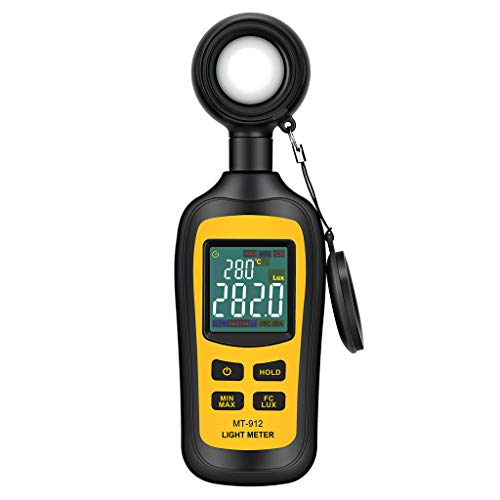
The URCERI handheld pulls double duty by adding an ambient temperature reading to the standard lux display. For growers tracking both light and heat, that’s a meaningful two-in-one. It sits between the DANOPLUS rotating-sensor model and the Triplett LT80 in terms of seriousness.
A 4-digit color LCD keeps numbers readable in mixed lighting, and the meter climbs to 200,000 lux with reported ±3% accuracy. Home users checking whether a reading nook gets enough daylight will find this more than enough headroom.
Strong Points
- Temperature readout removes the need for a separate thermometer in grow spaces
- Color LCD stays legible in dim corners and bright rooms alike
- Auto power-off helps preserve battery during occasional checks
- MIN/MAX tracking captures peak and trough readings automatically
Things To Consider
- Sensor sits on the body, so measuring overhead fixtures feels awkward
- Temperature feature adds bulk without helping pure photography work
Best Suited To
Home office workers and indoor gardeners who want light and temperature in one device.
Look Elsewhere When
The TopTes TS-710 Light Meter offers a rotating sensor if overhead readings are a regular part of your routine.
The DANOPLUS stands out for one practical reason: the sensor separates from the body and rotates a full 360°. That single design choice eliminates the contortion act of aiming built-in sensors at ceiling fixtures or tucked-away desk lamps. It also makes the unit less likely to be repositioned awkwardly mid-measurement.
Four auto-ranging scales cover 200 to 200,000 lux, and foot-candles switch in for users working in imperial units. The 400 to 700nm spectral range keeps readings relevant for both LED and traditional lighting sources. For plant setups and headlight aiming, the rotating head is genuinely useful.
Features That Help
- Detachable rotating sensor reaches awkward angles without moving the whole meter
- Auto-ranging removes the manual dial-stepping common in older designs
- Spectral range covers full visible light, including most LED grow fixtures
Points To Note
- Two-piece design means an extra piece to keep track of during fieldwork
- Cable connection between sensor and body introduces a potential snag point
Right Fit For
Photographers and indoor gardeners who routinely measure overhead or recessed fixtures.
Swap It Out When
The Fluke 941 Light Meter is a sturdier alternative for those prioritizing long-term tool durability over sensor flexibility.
Fluke carries a reputation for tool-grade build quality, and the 941 brings that pedigree to a budget-friendly meter. Unlike the SMART SENSOR AS803 pocket model, this unit feels more like a piece of professional equipment, with a protective sensor cap included for transport. The one-button lux/foot-candle toggle keeps operation simple, and the included cap tells you the brand expects this to live in a toolbox.
It tops out at 20,000 lux, which covers indoor environments but may fall short for outdoor daylight or high-output industrial sites. For HVAC technicians, electricians, and building inspectors, that’s usually the right ceiling. Photographers working with mixed natural light may want higher range.
Where It Helps
- Brand reputation supports long-term ownership expectations
- One-button unit switching simplifies training on shared job sites
- Data hold and MIN/MAX features streamline diagnostic workflows
Less Ideal Details
- 20,000 lux ceiling rules out direct sunlight measurements
- Higher entry cost than hobby-oriented options in this list
Whose Shelf It Belongs On
Tradespeople and inspectors who want a brand they trust in a tool bag.
Reach For A Different Pick When
The BTMETER BT-881D handles up to 400,000 lux if outdoor measurement is part of your work.
The UNI-T UT383 is a small, white-plastic meter that slips into a coat pocket and doesn’t intimidate first-time users. Where the Fluke 941 leans professional, this one feels approachable, almost like a TV remote in shape. For hobbyists dipping into indoor gardening or home lighting checks, that’s a real advantage.
Range stretches to 199,900 lux with a 0.5-second sampling time, and the large 4-digit LCD with backlight stays readable in most conditions. It covers the common indoor measurement envelope without overcomplicating things. It’s a sensible starting tool rather than a long-term investment piece.
Everyday Wins
- Compact shape encourages frequent carry and use
- Backlit display handles dim basements and nighttime readings
- Simple button layout shortens the learning curve significantly
Small Caveats
- Plastic housing feels less rugged than the Fluke option
- No rotating sensor limits reach in awkward fixture positions
Who Should Grab It
First-time users and casual hobbyists who want a low-commitment entry point.
Consider Something Else When
The DANOPLUS Lux Meter with 360° Rotating Sensor fits users who quickly outgrow fixed-sensor designs.
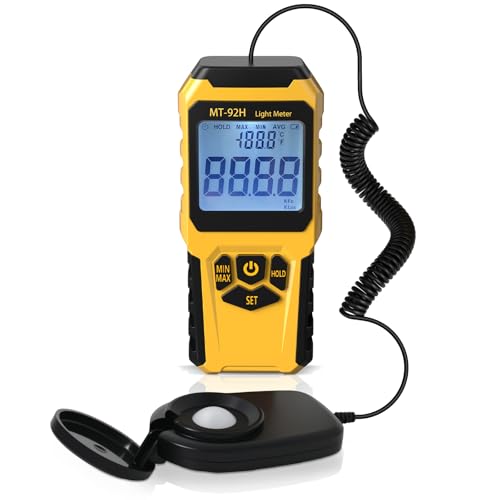
The MT-92H takes the split-sensor concept further than the DANOPLUS by pairing it with a temperature readout and switchable backlight. The detachable probe lets you tape or position the sensor in one spot while monitoring readings from a more comfortable location. For HVAC balancing or grow-room mapping, that flexibility pays off.
It climbs to 200,000 lux with 0.1-lux resolution at the low end, which matters when checking seedling-level light levels. Reported ±3% accuracy and 0.5-second refresh keep the display responsive to subtle changes. Workshop users mapping light across larger spaces will appreciate the hands-free angle.
Useful Touches
- Split probe enables monitoring without holding the main body in awkward spots
- Fine 0.1-lux resolution captures low-light seedling conditions
- Temperature function adds context for greenhouse and grow-tent work
- Switchable backlight adapts to both bright and dark work areas
Trade-Offs To Consider
- Two-piece setup takes longer to deploy than single-body meters
- Extra features raise complexity beyond what casual users need
Who It Suits Best
HVAC technicians and grow-room operators who need extended monitoring.
A Better Fit Elsewhere
The UNI-T UT383 Digital Illuminance Meter is simpler for users who only need quick spot checks.
The Dr.meter leans into plant-focused use, with 2x-per-second sampling that catches fluctuations in real time. Compared to the slower-refreshing meters in this list, that responsiveness helps when adjusting grow lights or checking how shadows shift across a canopy. The toggle between foot-candles and lux keeps it useful regardless of which unit your gardening guide uses.
It stretches to 200,000 lux, plenty for indoor setups and bright greenhouse bays. Owners commonly cite the simple FC/LUX toggle as the feature that makes this model accessible to beginners. It’s not the most rugged meter here, but for the price and the use case, it does the job.
What Earns Its Place
- Fast 2x-per-second sampling captures subtle light shifts
- Toggle between FC and LUX matches common gardening reference charts
- Wide range covers indoor tents through bright greenhouse environments
Worth Bearing In Mind
- Sensor is fixed, so overhead fixtures require holding the meter aloft
- Plastic construction shows wear faster than rubberized professional units
Who Will Love This
Indoor gardeners managing seedling through vegetative light levels.
Another Choice May Suit
The MT-92H Split Sensor Light Meter handles larger grow rooms where leaving the sensor in place is more practical.
The TS-710 pairs a 180-degree rotating sensor with a 2.25-inch backlit LCD, which makes it easier to read numbers while aiming at a fixture. That’s a small ergonomic win that compounds across repeated checks. Where the SMART SENSOR AS803 prioritizes pocket size, this one leans into readability.
Range runs from 0.1 lux to 200,000 lux, and a 0.5-second sample rate keeps the display responsive. The rotating probe covers most real-world angles, though it doesn’t match the DANOPLUS full-rotation design. For users who often work in dim corners with the meter held above eye level, the backlit display earns its keep.
Useful Highlights
- Backlit 2.25-inch screen stays readable in dark corners and at night
- Rotating sensor reduces the need to twist your wrist mid-measurement
- Wide range handles dim seed-starting through bright grow lights
Potential Compromises
- Larger display footprint makes it less pocket-friendly than compact picks
- 180-degree rotation falls short of the full 360° on the DANOPLUS model
The Right Fit
Users with vision concerns or dim workspaces who value screen clarity.
Not Your Match When
The SMART SENSOR AS803 Lux Light Meter suits photographers who need pocket portability above all else.
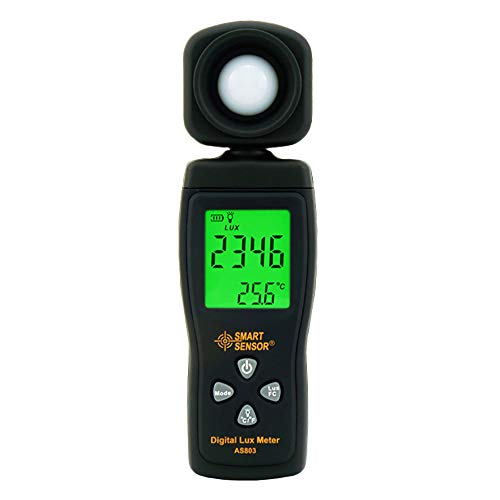
The AS803 is built for camera bags. It slips into a pocket alongside lens cloths and spare batteries, and the slim shape won’t drag down a shoulder strap. For photographers used to carrying minimal gear, that portability matters more than extra features. Compared to the TopTes TS-710, this model strips away the backlit display and rotating sensor in favor of size.
It measures both lux and foot-candles across a broad range, suiting scenic shoots, classroom demos, and field research. The visible-light coverage includes LED and fluorescent sources commonly encountered indoors. Owners commonly find the auto-shutdown helpful for preserving battery across long shoots.
Key Advantages
- Pocketable form encourages everyday carry in a camera bag
- Visible-light sensitivity covers LED, fluorescent, and natural sources
- Simple operation matches the speed of quick location scouting
Where It May Fall Short
- Small display becomes hard to read in bright outdoor light
- Fixed sensor limits measurement angles in cluttered indoor spaces
Built With In Mind
Traveling photographers who scout locations and need on-the-spot lux confirmation.
Skip It When
The Triplett LT80 LED Illuminance/Light Meter fits inspectors who require NIST-traceable documentation over portability.
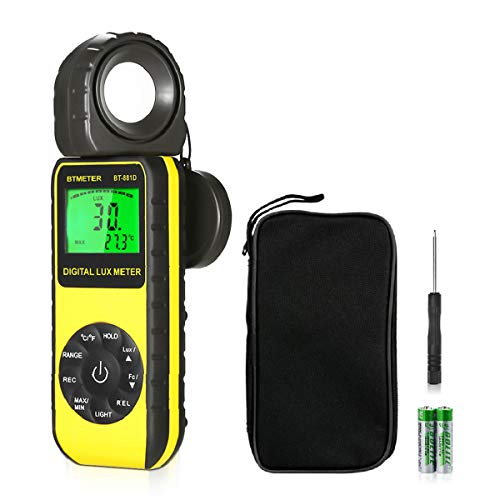
The BT-881D stretches the measurement ceiling further than most picks in this roundup. It reaches up to 400,000 lux, which covers direct daylight, stadium lighting, and high-bay industrial fixtures. For anyone measuring outside or under powerful commercial lighting, that range is the headline feature.
The 270-degree rotated sensor slots between the DANOPLUS full-rotation and fixed-body meters, offering flexibility without two-piece complexity. Reported accuracy sits around ±4% in the mid-range and ±5% at the top end. Photographers and facility inspectors working outdoors will find the wider ceiling practical.
Real-World Strengths
- 400,000 lux ceiling handles direct sunlight and industrial fixtures
- 270-degree sensor rotation covers most real-world aiming angles
- Quick 2-3 times-per-second sampling supports fast field sweeps
Some Limits To Know
- Higher range means slightly looser accuracy at the extreme upper end
- Larger size makes it less convenient for casual indoor carry
Perfect Match For
Outdoor photographers and facility inspectors measuring daylight or industrial output.
Look Elsewhere When
The URCERI Handheld Ambient Light Meter is a tighter fit for indoor-only general use.
Choosing Budget Light Meters That Actually Fit Your Work
Match Range to Your Real Environments
Lux range, the unit that measures how much visible light hits a surface, is the first spec worth checking. Indoor-only users rarely need more than 50,000 lux, while outdoor and industrial work pushes you toward 200,000 or higher. Under-spec’ing here means the meter simply reads “OL” when you point it at a bright source.
Sensor Design Affects How You Actually Use It
Fixed sensors work fine for handheld checks at eye level. Rotating or detachable sensors, like the DANOPLUS 360° or MT-92H split probe, save real frustration when measuring overhead fixtures, recessed cans, or grow lights mounted high. If your work involves any of those, the ergonomic difference is worth a few extra dollars.
Accuracy and Refresh Rate Matter Differently
A ±3% to ±5% accuracy window is plenty for most non-laboratory work. Refresh rate, how often the meter updates its reading, matters more when you’re watching light shift in real time. Gardeners adjusting grow lights and photographers scouting variable conditions benefit from faster sampling; occasional spot checks don’t.
Build Quality and Brand Reputation
Tool-grade brands like Fluke tend to survive drops, dust, and daily transport better than plastic hobby units. For shared workshop use or fieldwork, that durability adds value over time. For a meter that lives on a desk and rarely moves, lighter construction is usually fine.
What Most Shoppers Miss Before Buying
Common Shopping Slip Ups
Buying a meter with a 20,000 lux ceiling and then wondering why it overloads outdoors. Or grabbing a unit with fixed sensor placement and realizing overhead fixtures are a pain to measure. Range and sensor flexibility are the two specs most often underweighted before purchase, and both directly shape how often you’ll actually reach for the tool.
When Paying More Pays Off
Higher-tier meters tend to deliver three concrete advantages: NIST-traceable calibration paperwork, faster refresh rates for dynamic environments, and tougher housings for shared or field use. For occasional home checks, the extra cost rarely justifies itself. For professional workflows where documentation, durability, or rapid sampling matters, the upgrade usually pays for itself.
Frequently Asked Questions
What does lux actually measure?
Lux measures the amount of visible light falling on a surface, weighted to how the human eye perceives brightness. One lux equals one lumen per square meter, so a dim room might register 50 lux while bright daylight can exceed 50,000.
Do I need a rotating sensor for indoor use?
Most home and office readings happen at desk or eye level, where fixed sensors work fine. Rotating or detachable sensors become valuable when measuring ceiling fixtures, recessed lights, or grow lights mounted overhead.
How often should these meters be calibrated?
Budget meters typically don’t include factory recalibration programs, so most users replace rather than recalibrate. For documentation work, look for units that ship with a calibration certificate, like the Triplett LT80.
Can one meter handle both photography and gardening?
Yes, in practice. Both fields rely on lux or foot-candle readings, and the difference is mostly about which reference values you compare against. A wide-range meter with foot-candle switching covers both scenarios comfortably.
Are expensive meters always more accurate?
Not always. Higher-tier meters tend to add calibration documentation, build quality, and faster refresh rates, but raw accuracy differences between budget and mid-range units are often within a few percentage points.
Wrap Up
The right budget light meter comes down to where and how you’ll measure. Photographers and travelers tend to favor compact, pocket-friendly units like the SMART SENSOR AS803. Indoor gardeners usually want fast sampling and grow-friendly ranges, which points toward the Dr.meter or MT-92H. Facility and safety work rewards the calibration paperwork and reach of the Triplett LT80 or Fluke 941. Match the meter to your real workflow, and the readings will follow.