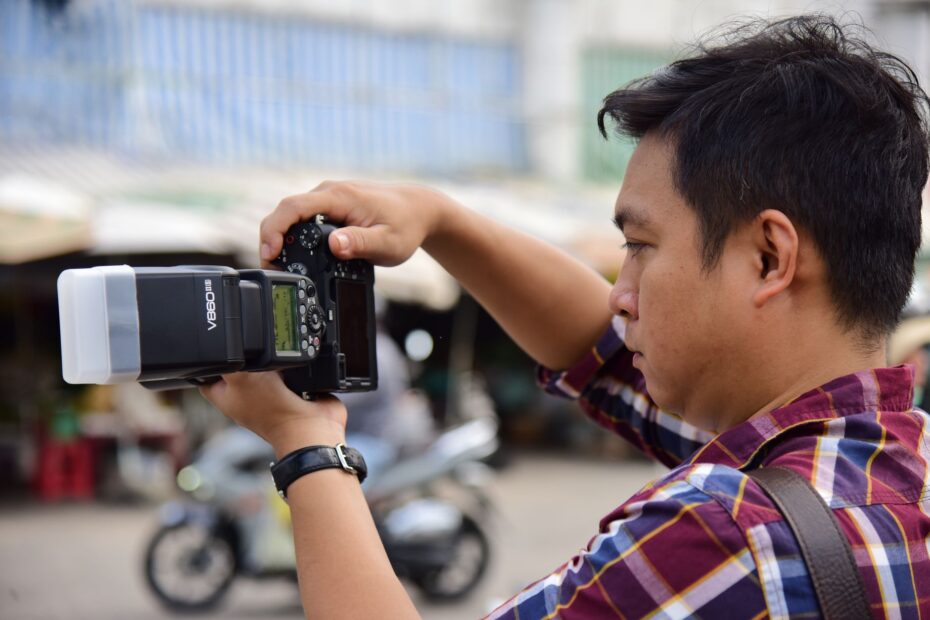
A camera’s pop-up unit trades the power, range, and directional control of a separate speedlight for compact, always-available illumination. In a dim living room, your camera’s pop-up unit can brighten a face, while a speedlight can send light toward a ceiling for softer shadows.
This comparison covers camera flash types, exposure settings, bounce techniques, real shooting situations, and compatibility details for photographers choosing light for a DSLR or mirrorless camera.
Built-In, External, and On-Camera Flash Terms
A small pop-up panel near the viewfinder is your built-in flash. It sits inside the camera body, draws power from the camera battery, and points straight ahead. Your camera raises the unit manually or electronically, then fires a brief burst toward a nearby subject.
An external flash is a separate accessory called a speedlight. Canon uses the Speedlite name for many units, while Nikon uses Speedlight branding. Your external unit slides into the camera’s hot shoe, the metal mount with electronic contacts that passes exposure data between the camera and flash.
Placement and flash type describe different things
“On-camera flash” describes where the light sits, not its size. A speedlight mounted on your hot shoe counts as on-camera flash, yet that same unit becomes off-camera lighting after you move it to a stand and fire it through a cable, optical signal, or radio trigger.
Three camera flash types cover most shooting situations:
- Built-in flash: Your camera-integrated unit gives you direct, close-range fill without extra gear.
- Hot-shoe speedlight: Your separate flash mounts above the lens and adds power, tilt, rotation, and exposure controls.
- Off-camera flash: Your light sits away from the camera, allowing side or rear placement that shapes a face.
- Macro flash: A ring or twin-light setup places compact flash heads close to a macro lens for small subjects.
That placement distinction leads to the main visual difference between built-in and external flash. More power helps at longer distances, yet your ability to aim light away from the lens changes a portrait far more than a brighter frontal burst.
Core Differences in Power, Direction, and Portability
A pop-up unit suits quick use and light packing. A dedicated speedlight becomes more useful once your subject sits farther away, your room has dark walls, or your photo needs softer light than direct frontal illumination can produce.
| Feature | Built-In Flash | External Speedlight |
|---|---|---|
| Light output | Your camera gives you low output for nearby subjects. | Your speedlight gives you higher output for rooms, groups, and longer distances. |
| Flash range | Your useful range stays short for close snapshots. | Your longer reach gives you more exposure choices. |
| Light direction | Your light points forward from near the lens. | Your flash can tilt, swivel, bounce, or sit off camera. |
| Power source | Your flash draws from the camera battery. | Your flash uses AA cells or a dedicated battery pack. |
| Recycle time | Your camera can pause after a full-power burst. | Your speedlight recycles faster with fresh batteries. |
| Portability | Your camera bag gains no added bulk. | Your kit needs room for a flash, batteries, and pouch. |
| Setup needs | Your flash is already part of the camera. | Your speedlight needs a separate purchase and camera-matched setup. |
| Strongest uses | Your flash works for daylight fill and close record shots. | Your flash suits portraits, events, interiors, and repeatable exposure. |
Your built-in unit can handle a backlit face at a picnic or a quick hallway photo. An external flash earns room in your kit once you need consistent exposure across a family group, a reception room, or a run of indoor portraits.
For casual daylight fill, the integrated unit remains a sensible fit for you. For indoor people photography and bounce flash photography, a speedlight gives you more control. Off-camera portraits require a separate light because the built-in unit cannot leave the camera body.
Power, Range, and Exposure Controls
Guide numbers show practical reach
Flash power uses a guide number, a distance rating tied to ISO and zoom position. Divide the guide number by your aperture to estimate reach. A guide number of 100 at ISO 100 reaches about 20 feet at f/5, while a guide number of 40 reaches about 8 feet at the same aperture.
External units carry a much higher guide number than camera-integrated flashes. That extra output lets you keep ISO lower, stop down to f/5.6 or f/8 for a group, or lift your subject above a dim background without pushing your camera into noisy settings.
Dedicated controls shape each exposure
TTL metering sends a small pre-flash, reads the scene through the lens, and selects flash output for the frame. You can start with TTL at a birthday party, where children move from window light to lamp light faster than manual settings can follow.
Manual flash mode sets a fixed fraction of output, such as 1/16 or 1/64. Your exposure stays repeatable while flash-to-subject distance stays fixed. That makes manual power useful for a seated portrait station or tabletop product setup.
- Flash exposure compensation: You can lower TTL output by one stop where direct light looks too obvious on your subject.
- Zoom head: You can match the beam angle to your lens field of view, wasting less light at 50mm than at 24mm.
- High-speed sync: You can use shutter speeds above your camera’s normal sync limit for daylight portraits with wider apertures.
- Rear-curtain sync: Your flash fires near the end of an exposure, placing motion trails behind a moving subject.
High-speed sync trades flash power for shutter-speed freedom. Your range drops sharply, so move the light closer rather than expecting room-filling output.
Flash sync speed also sets a practical limit. Most cameras sync near 1/160 to 1/250 s with normal flash output. High-speed sync lets your shutter go beyond that range, though each faster shutter setting reduces the usable reach of the flash.
That trade-off affects exposure, but the flash’s position determines whether its light looks flattering or flat.
Light Direction Changes the Look of Your Photo
A hard shadow behind a person on a painted wall comes from a light source near the lens axis. A built-in flash lights the face evenly, yet its small size and frontal path remove facial depth and leave the wall shadow in plain view.
Red-eye comes from the same geometry. Your lens records light reflected from blood-rich tissue at the back of the eye because the flash sits only inches away. Red-eye reduction can reduce the problem, but moving your light farther from the lens works better.
Bounce flash turns a ceiling into a broad source
A tilting, rotating head lets you aim light into a white ceiling or neutral wall. The reflected area becomes much larger than the flash tube. Your portrait then receives softer light, gentler cheek shadows, and a smoother shift from forehead to jaw.
Your ceiling needs to sit reasonably low and close, around 8 to 10 feet for practical indoor bounce. Dark wood absorbs light, green walls stain skin, and a high cathedral ceiling wastes output before useful light returns to your subject.
For bounce flash, the room itself becomes part of your lighting setup. A white ceiling acts like a broad reflector, while a red wall can cast a visible tint across skin. You get cleaner color by aiming toward neutral white or light gray surfaces.
Off-camera placement adds shape
Move your speedlight 45 degrees to one side and slightly above eye level, and the face gains a shadow side, a highlight side, and more background separation. That direction resembles window light far more than a burst mounted above the lens.
A radio trigger makes this placement practical across a room. Optical triggering can work indoors, though direct sun and blocked line of sight can interrupt it. Your camera stays mobile while the light remains where the scene needs it.
Real Photography Situations for Each Flash
A backlit child at a park is a strong built-in-flash situation. Set a modest amount of fill, keep your subject within a few feet, and let daylight stay the main source. Your goal is detail in the face rather than an obvious flash-lit appearance.
Travel gives you another valid reason to use the camera’s integrated unit. A pop-up flash adds no batteries, stand, or extra weight. You can record a restaurant table, a hotel-room detail, or a missed sunset without turning a short outing into a larger lighting setup.
Indoor groups reveal pop-up flash limits
At a family dinner, direct pop-up light can brighten the nearest two faces while leaving the back row dim. A speedlight bounced from a neutral ceiling spreads illumination more widely, and your group can stay near ISO 800 rather than climbing toward rougher files.
Receptions, school events, interiors, and dim portraits reward the same control. Your flash can point upward, turn toward a side wall, or sit on a stand. Those choices solve dark-room exposure problems without making every image look like a crime-scene snapshot.
Indoor portraits benefit because you can separate flash exposure from ambient exposure. Your shutter speed and ISO control more of the room light, while flash output controls the brightness on the subject. That split gives you more room to keep lamps, windows, and background color visible.
Macro work needs placement more than power
A flower photographed at close range can sit in the shadow of your own lens. A standard speedlight above the camera can still miss your subject, even with plenty of output. Your flash position matters more than guide number at a distance of 6 inches.
Ring flashes and twin-light systems place small heads near the lens. The Canon Macro Ring Lite MR-14EX II is one specialized example. It places illumination around the front of a macro lens, helping you light tiny subjects without creating a large camera shadow.
Signs an External Flash Is Worth Adding
Repeated indoor frustration is a clear sign that a speedlight could help your work. Dark rooms, moving children, uneven skin tones, and hard wall shadows point toward a dedicated unit, especially where close, light-colored bounce surfaces are available.
| Shooting situation | Built-In Flash Fit | External Flash Fit |
|---|---|---|
| Light travel packing | Your camera gives you occasional fill with no extra gear. | Your speedlight fits trips planned around indoor work. |
| Family snapshots | Your flash works outdoors or at close range. | Your light works better in rooms and with groups. |
| Portrait sessions | Your results stay limited and can look flat. | Your flash gives you bounce light or off-camera shape. |
| Events and receptions | Your flash serves as a short-range backup source. | Your speedlight gives you control over changing indoor light. |
| Macro subjects | Your lens can cast a shadow across the subject. | Your setup can use bracket, twin, or ring lighting. |
| Paid assignments | Your built-in flash is limited as a main source. | Your speedlight gives you repeatable frames across a session. |
Your answer to “should I buy an external flash” depends on how regularly you need controlled light, not whether a speedlight seems novel. Indoor people photography, groups, events, and dim rooms can reveal the same limits again and again. Rare emergency use and strict packing limits leave the integrated unit as a sensible option for you.
- Choose built-in: Your flash appears mainly as daylight fill or an occasional backup after sunset.
- Choose external: Your indoor photos need bounce light more than once or twice a month.
- Start on-camera: Your hot-shoe unit can bounce before you add stands and triggers.
- Move off-camera: Your portraits need side light, rim light, or a cleaner background.
Beginners do not need a speedlight for every camera outing. But once your indoor images matter beyond quick records, a unit with tilt, swivel, TTL metering, and manual flash mode gives you room to learn without changing your camera body.
Once those needs justify the investment, fit and safe communication determine whether the flash will work.
Compatibility and Setup Checks Before Adding a Speedlight
A hot shoe alone does not promise full communication. Your camera needs the right electronic contacts and firmware for TTL functions, zoom control, and flash exposure compensation. A basic center pin can fire a manual flash, yet it cannot pass the richer data needed for a dedicated system.
Canon, Nikon, Sony, Fujifilm, and Micro Four Thirds bodies use brand-specific TTL communication. Your Canon Speedlite uses Canon protocol, while a Nikon-compatible model speaks a different electronic language. External flash compatibility depends on the listed camera mount, not the shape of the flash body.
Confirm the system before mounting a flash
- Hot shoe contacts: Confirm that your camera has the dedicated TTL functions you plan to use.
- Trigger system: Match your radio transmitter and receiver to the flash system for off-camera work.
- Firmware version: Update compatible camera and flash firmware before a major event.
- Battery format: Pack charged AA cells or a charged proprietary pack, plus a spare set for your shoot.
- Sync limit: Find your camera’s flash sync speed, usually near 1/160 to 1/250 s.
- Physical clearance: Confirm that your flash clears the viewfinder hump and mounted accessories.
Some advanced cameras omit a built-in flash entirely, so a hot-shoe unit becomes your compact artificial-light option. PC sync remains useful on certain studio lights and older systems. Your camera can need a PC sync port or adapter to fire that equipment safely.
A flash that fires is not the same as a flash with TTL metering. Match your exact camera mount and listed functions before relying on automatic exposure.
Better Results Through Simple Flash Habits
Fast-moving scenes favor TTL because your subject distance changes from frame to frame. Stable scenes favor manual flash power because a fixed 1/32 setting gives you the same burst through a series of photos. Your distance and shooting pace decide which mode fits the scene.
Direct flash needs restraint. Lower your flash exposure compensation until the burst lifts shadows without wiping out room light. Your camera should still record lamps, windows, and background color rather than leaving a bright face against a black void.
Small habits protect key frames
- Take a sample frame: Review skin tone, wall color, and background exposure before a ceremony or speech begins.
- Aim at neutral surfaces: Bounce from white or light gray ceilings to keep green, red, or yellow casts out of your images.
- Watch flash distance: Move closer before raising ISO beyond what your camera records cleanly.
- Use fill gently: Reduce direct output outdoors so sunlight still shapes your subject’s face.
- Mind recycle time: Pause after rapid full-power bursts because an unready flash cannot light your next frame.
- Carry spare cells: Fresh batteries keep recycle time more predictable through a long indoor shoot.
External flash vs on-camera flash is not a simple power contest because a speedlight can sit on camera or away from it. The larger difference is whether you can redirect the light. Your integrated flash remains useful for quick fill, while your speedlight becomes more useful once direction, range, and repeatability matter.
What to Remember
Your camera’s pop-up flash solves a narrow problem: immediate light close to the lens. A separate speedlight solves a broader one by giving you more output, bounce capability, exposure controls, and off-camera placement. Choose the built-in unit for convenience; choose the external unit once the look of your indoor photos matters as much as their brightness.
Start with the scene in front of you. A face three feet away outdoors needs only light fill, while a group across a dim room needs more reach and a wider source. Your choice becomes clearer once you identify whether distance, harsh shadows, or room color is causing the problem.
FAQ
What is the difference between a built-in flash and an external flash?
A built-in flash sits inside your camera and fires forward from near the lens. An external flash is a separate speedlight that mounts on your hot shoe or works away from your camera. Your external unit gives you more power, longer range, and much better control over light direction.
Is an external flash more powerful than a pop-up flash?
Yes. A speedlight has a higher guide number than a pop-up unit, giving you more reach for groups, rooms, and bounced light. Your external flash can also work at f/5.6 or f/8 more comfortably than a small built-in unit in dim indoor settings.
Why does built-in flash create harsh, flat-looking photos?
A built-in flash sits near your lens and sends small, direct light straight at the subject. That path removes facial shadows, creates a hard shadow on the wall behind your subject, and can cause red-eye. Your photo gains more depth after the light moves away from the lens or bounces from a ceiling.
What is bounce flash, and why can most built-in flashes not do it?
Bounce flash means aiming a tilting flash head toward a white ceiling or neutral wall instead of directly at your subject. The reflected surface becomes larger and softens the light. Most built-in units point only forward, so your camera cannot send their light toward a ceiling or wall.
Should beginners buy an external flash for a DSLR or mirrorless camera?
A beginner benefits from an external flash after indoor photos regularly show dark backgrounds, harsh shadows, or uneven group exposure. Your built-in unit remains enough for occasional daylight fill and close snapshots. A speedlight with TTL metering, tilt, swivel, and manual power gives you useful room to learn.
Can an external flash improve indoor portraits and event photography?
Yes. Your speedlight can bounce from a neutral ceiling, reach people farther from the camera, and keep exposure steadier through a changing room. For portraits, a radio trigger can move the flash 45 degrees to the side, producing more facial shape than frontal light.