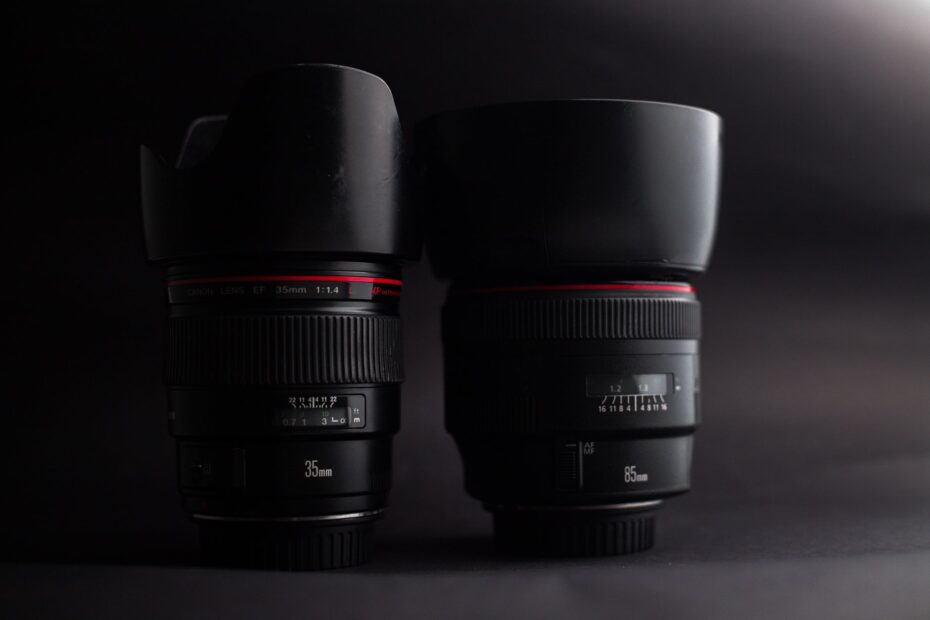
A 24mm captures a wider scene than an 85mm, changing framing, field of view, and working distance. A 24mm lens shows far more of a room than an 85mm lens from the same spot, while your camera position controls how near and far subjects relate in the photograph.
You’ll see how 24mm, 35mm, 50mm, 85mm, and 135mm primes fit travel, family scenes, street work, portraits, indoor spaces, and crop-sensor cameras.
Fixed Lenses Make Your Position Part of the Composition
A zoom lens changes framing with a ring, but a prime lens stays at one focal length. Your 35mm, 50mm, or 85mm lens asks you to move closer, step back, change height, or shift sideways until the frame works.
Focal length is measured in millimeters. That number describes angle of view rather than subject size alone: a 24mm lens records a broad section of a room, while an 85mm lens records a much tighter section from the same camera position.
Fixed Focal Lengths Sharpen Framing Choices
With a fixed lens, a lamp near the edge or a cluttered table cannot disappear through a zoom adjustment. You need to change your position, simplify the frame, or accept the extra context as part of the photograph.
That constraint can make your compositions more deliberate. A 35mm lens forces you to work with the surroundings, while an 85mm lens narrows the scene before you press the shutter.
Many primes also have wide maximum apertures such as f/1.8, f/1.4, or f/1.2. A wider Aperture gives your camera more light and creates a shallower Depth of field, which can soften a background behind your subject.
Lens quality still varies by model. A Nikon, Canon, ZEISS, or Tamron prime can render sharp center detail, yet edge sharpness, flare control, autofocus behavior, and focus shift differ between individual lenses.
Optical quality varies by lens, while framing and spatial relationships follow different principles.
Use focal length to select the view in front of you, then use aperture to control light and depth of field. Those choices affect the image in different ways.
Field of View and Perspective Come From Different Causes
The broad frame from a 24mm lens comes from its wide Field of view. From one camera position, 24mm shows more of the room than 50mm, and 50mm shows more than 85mm.
Perspective distortion comes from camera distance. Move close to a face and the nose sits much nearer to the camera than the ears, so near features appear larger than features farther away.
Step back and those near-to-far size differences settle down. Your lens choice matters because a longer focal length lets you keep similar framing from farther away.
Wide Lenses Reward Careful Placement
A 24mm lens needs to sit close for a tight portrait. That distance can make a hand near the lens look oversized and can stretch faces placed close to the frame edge.
Your 28mm lens offers slightly less width, but it still asks for careful face placement. Keep a portrait subject near the center, hold the camera level, and leave room around the edge for a later crop.
Longer Lenses Require More Working Distance
An 85mm lens requires you to move back for the same head-and-shoulders framing. From that farther position, background objects occupy more of the frame behind your subject, producing the compressed appearance linked with longer lenses.
Compression is not a force inside an 85mm or 135mm lens. Your greater shooting distance changes the size relationship between your subject and the background, while the narrower field of view removes surrounding space.
Do not blame focal length for a close portrait with enlarged facial features. Move the camera back, use a longer lens or a looser composition, and your subject’s proportions become calmer.
Common Focal Lengths Cover Distinct Visual Jobs
The gap between 35mm and 50mm sounds small on paper, yet it feels obvious in a kitchen, along a sidewalk, or near a portrait subject. Prime lens focal lengths from 24mm through 135mm cover wide environments, everyday scenes, and distant details.
| Lens | Your framing and distance | Your visual result | Your main limit |
|---|---|---|---|
| 24mm | Your view is broad, and your camera sits close for people. | Your scene feels expansive and energetic. | Your edge faces can stretch. |
| 28mm | Your frame stays wide with a little more restraint. | Your travel scenes hold place and activity. | Your close portrait needs care. |
| 35mm | Your camera works well at conversational distance. | Your photographs hold subject and surroundings. | Your background stays visible. |
| 50mm | Your framing is selective without requiring much room. | Your view feels clean and flexible. | Your tight indoor frame can feel narrow. |
| 85mm | Your camera moves farther back for portraits. | Your subject separates from the background. | Your room needs more depth. |
| 135mm | Your distance grows for tight details or faces. | Your frame isolates distant subjects strongly. | Your scene loses surrounding information. |
The 24mm and 28mm options suit architecture, landscapes, travel scenes, and indoor family photographs. Their wide coverage lets you include ceiling lines, a dining table, or a mountain ridge without backing through a wall.
At 35mm and 50mm, your view becomes more selective. A 35mm lens keeps a person’s setting in the frame, while a 50mm lens trims the edges and directs attention toward gestures, food, faces, and smaller moments.
The 85mm and 135mm options pull distant parts of a scene closer inside the frame. Your longer working distance gives a subject more personal space at a ceremony or performance, but a small room can stop you from framing a full-body portrait.
Those space constraints are only part of the equation, because sensor size changes how each lens frames a scene.
- Use 24mm carefully for close faces because near-to-far size changes become obvious at short camera distances.
- Use 28mm outdoors for travel scenes that need place, movement, and foreground detail.
- Use 35mm nearby for documentary scenes where your subject belongs with the surroundings.
- Use 50mm selectively for everyday photographs with less edge clutter.
- Use 85mm farther back for portrait distance and stronger background separation.
- Use 135mm patiently for ceremonies, stage work, and details beyond your reach.
Sensor Size Changes the Frame From Every Lens
The framing differences above shift with sensor size. The physical focal length stays the same, but a smaller sensor records a narrower central portion of the image circle.
Your Full-frame sensor serves as the reference for most focal-length discussions. APS-C and Micro Four Thirds cameras crop the image circle, producing a tighter field of view without changing the lens’s optical design.
Crop Factor Converts the Familiar View
On a 1.5x crop-sensor camera, multiply the actual focal length to find its full-frame equivalent field of view. A 50mm lens on a 1.5x APS-C camera frames like a 75mm lens on a full-frame camera.
| Your lens | Your camera format | Your crop factor | Your full-frame equivalent |
|---|---|---|---|
| Your 35mm lens | Your full-frame camera | Your 1x format | Your 35mm view |
| Your 35mm lens | Your APS-C camera | Your 1.5x crop | Your 52.5mm view |
| Your 35mm lens | Your Canon APS-C camera | Your 1.6x crop | Your 56mm view |
| Your 35mm lens | Your Micro Four Thirds camera | Your 2x crop | Your 70mm view |
A 35mm lens can work as a wide everyday optic on full frame, a near-normal lens on APS-C, and a short portrait lens on Micro Four Thirds. Your camera format belongs in every focal-length choice.
Equivalent focal length changes field of view, not perspective. You still change perspective only after moving the camera closer or farther from the subject.
Everyday Subjects Show Where Each Lens Fits
Your normal shooting week reveals more than a specification sheet. A mountain overlook, birthday table, city sidewalk, and ceremony aisle each place different limits on your camera position.
| Your subject | Your useful focal lengths | Your practical reason |
|---|---|---|
| Your landscape or architecture | Your 24mm or 28mm | Your frame holds broad foreground and structure. |
| Your travel and street scenes | Your 28mm or 35mm | Your image keeps activity around the subject. |
| Your food and daily details | Your 35mm or 50mm | Your distance stays comfortable at a table. |
| Your indoor family moments | Your 24mm, 28mm, or 35mm | Your room gives limited room to step back. |
| Your portrait sessions | Your 50mm or 85mm | Your subject separates without extreme distance. |
| Your performances and ceremonies | Your 85mm or 135mm | Your camera reaches past the crowd. |
Wide primes suit environmental portraits because the setting carries part of the story. Your chef can stand in a kitchen, your musician can hold an instrument, and your traveler can appear against a recognizable street.
For street photography and documentary work, a 35mm lens keeps useful background information while keeping your subject large enough to matter. A 50mm lens excludes more surroundings and asks you to stand farther away.
Portrait and event work suit 85mm and 135mm lenses where your subject needs room and privacy. Their narrow view removes visual clutter, while wide apertures can soften the background during low-light photography.
The 35mm, 50mm, and 85mm Portrait Trade-Off
A 35mm, 50mm, and 85mm lens can each photograph a person well, but each changes your working distance and the role of the surroundings. Your available space matters more than a universal ranking.
| Your focal length | Your headshot distance | Your half-body distance | Your portrait character |
|---|---|---|---|
| Your 35mm lens | Your distance is about 2 feet. | Your distance is about 4 feet. | Your setting stays prominent. |
| Your 50mm lens | Your distance is about 3 feet. | Your distance is about 6 feet. | Your frame feels balanced. |
| Your 85mm lens | Your distance is about 5 feet. | Your distance is about 10 feet. | Your background falls away. |
Those full-frame distances are rough working examples rather than rigid measurements. Your framing changes with camera orientation, subject height, and crop, but longer lenses always need more physical room for similar framing.
Thirty-Five Millimeters Holds the Environment
Your 35mm lens works for full-body portraits in a small apartment, restaurant, or city street. Keep close headshots loose because a camera placed too near changes facial proportions quickly.
Fifty Millimeters Narrows the Scene
A 50mm lens gives your everyday portraits a more selective frame than 35mm. Choose 35mm for visible surroundings and tight rooms, then choose 50mm for a calmer frame with less background distraction.
Eighty-Five Millimeters Gives Faces More Space
Your 85mm lens creates comfortable distance for headshots and half-body portraits. It works well outdoors or in a studio with depth, yet a narrow living room can make full-body framing impossible.
The 35mm vs 50mm vs 85mm lens choice becomes clear through one exercise. Photograph the same person at all three focal lengths with similar framing, then study the space, background, and facial proportions after you move.
Choose Your First Prime Around Space and Subjects
Your most photographed subject should lead the decision, not a famous focal length or a stranger’s camera bag. A parent working in a small home faces a different limit from a portrait photographer with access to open outdoor space.
Start with the lens already on your camera. Review 100 photographs and mark the focal lengths recorded in the image files; that record shows your framing habits better than an abstract specification sheet.
Your First-Lens Checklist
- Check your subjects by naming the scene you photograph at least twice each week.
- Measure your room from your usual shooting wall to the subject area.
- Mark your distance by deciding whether close interaction or personal space feels more natural.
- Confirm your sensor by checking for full-frame, APS-C, or Micro Four Thirds format.
- Review your light by noting indoor evenings, dark venues, or daylight-only work.
- Match your view by selecting broad, normal, or short-telephoto framing.
A 24mm or 28mm lens fits broad interiors and expansive scenes. A 35mm lens suits documentary work, a 50mm lens offers a familiar everyday angle, and an 85mm lens fits portrait-focused shooting where you have room to step back.
No single lens fits every subject. For general photography, a 35mm or 50mm equivalent gives your camera a flexible starting point, while your space and habits decide which side of that pair works better.
A Small Prime Kit Covers Separate Needs
Three lenses can cover wide, normal, and short-telephoto views without forcing every scene into the same shape. The familiar 35mm, 50mm, and 85mm set is sometimes called the Holy Trinity of prime lenses.
Your 35mm can record the place, your 50mm can simplify daily scenes, and your 85mm can isolate a person or distant detail. That trio is a useful pattern rather than a rule.
Two-Lens Sets Stay Distinct
A 28mm plus 85mm pairing suits travel and portraits because each lens handles a separate visual task. Your wide lens covers rooms and streets, while your longer lens covers faces, details, and distant subjects.
For documentary work and people, a 35mm plus 85mm pair leaves a larger gap between fields of view. Your feet and camera position fill the middle distance, and each lens gives you a clearly different frame.
Zoom Lenses Still Have a Place
Prime lens vs zoom lens comes down to speed versus flexibility. Your prime rewards deliberate framing and can offer a wider maximum aperture, while a zoom lens helps during fast events where your position cannot change.
Use prime lens focal lengths to shape the way you photograph a scene, not as a collection target. Your strongest kit contains views that solve separate shooting situations without leaving you trapped by a wall, crowd, or narrow room.
Final Thoughts on Fixed Focal Lengths
Your focal length selects the portion of the world inside the frame, while your camera position controls perspective. Start with the scenes you photograph and the space you have, then choose the view that places you at a useful distance.
A 35mm or 50mm equivalent gives many photographers a flexible base. Your own subjects, room size, and preferred camera distance decide the more natural fit.
FAQ
What is the difference between prime lens focal lengths?
A wider 24mm view versus a tighter 85mm view changes your field of view and working distance. A 24mm lens shows more of a scene, a 50mm lens gives a more selective everyday frame, and an 85mm lens produces tighter framing from farther away.
How do 24mm, 35mm, 50mm, and 85mm prime lenses change the look of a photo?
A 24mm lens keeps more surroundings in view, while a 35mm lens balances subject and setting. Your 50mm lens trims more edge detail, and your 85mm lens isolates a subject by using a narrower field of view and greater shooting distance.
Which prime lens focal length is best for beginners?
A 35mm or 50mm equivalent gives you a flexible place to start. Your 35mm lens works well in tighter rooms and travel scenes, while your 50mm lens gives you a narrower everyday frame with less background activity.
Which is better for everyday photography: a 35mm or 50mm prime lens?
In small rooms, travel scenes, and environmental portraits, a 35mm lens usually offers more flexibility than a 50mm. Your 50mm lens works better for food, details, and portraits where you want a more selective frame.
Why is an 85mm prime lens popular for portraits?
From a few feet away, an 85mm lets you frame headshots and half-body portraits comfortably. That distance reduces close-camera facial exaggeration, while the lens’s narrow field of view removes more of the background from your frame.
Does focal length change perspective or only the field of view?
Focal length changes field of view. Your perspective changes after you move the camera, because camera distance changes the size relationship between near and far features in the scene.